A Modern Playbook for software marketing south africa: Local Growth Tactics

By Chris Edington
Marketing software in South Africa isn’t about copy-pasting your international strategy and hoping for the best. It's about getting to grips with a market that has its own unique rhythm, challenges, and opportunities. You're talking to businesses that need digital tools to solve distinctly South African problems—from navigating a tough economy to connecting with an incredibly diverse customer base.
Getting a Foothold in South Africa's Tech Boom

If you still see the South African tech scene as a sleepy outpost, it’s time to look again. Local companies aren't just slowly adopting technology; they are actively hunting for it. This isn't a gradual shift. It's a rapid acceleration, fuelled by a real need for greater efficiency, smarter growth, and a sharper competitive edge.
The demand for software is surging everywhere. You've got large, established enterprises in Johannesburg searching for powerful analytics platforms, and at the same time, agile small businesses in Cape Town are desperate for affordable automation tools. The appetite for smart solutions is huge, creating a massive opening for software companies that get their positioning right.
This Isn’t Just Growth—It's a Complete Mindset Shift
What we're seeing goes way beyond numbers on a chart. It’s a fundamental change in how South African businesses operate. The conversation has moved from, "Do we really need this software?" to "Which software will deliver the best results for us?" That subtle but powerful shift is your way in.
The market has expanded at a blistering pace, set to hit a revenue of USD 4,431.2 million in 2024 and projected to reach an incredible USD 9,683.3 million by 2030. This momentum is driven by a compound annual growth rate (CAGR) of 13.8%. Application software is the clear frontrunner, grabbing a 52.13% revenue share as companies double down on tools for customer engagement and process automation.
Forget selling features. You need to be selling solutions to specific, local problems:
- Economic Pressures: Companies are under the gun. They need software that demonstrably improves their bottom line and delivers a clear, quick return on investment.
- A Diverse Audience: Tools that help businesses truly understand and connect with South Africa's multifaceted consumer landscape are worth their weight in gold.
- Operational Resilience: Solutions for data management, cybersecurity, and remote collaboration have become non-negotiable.
The crucial point is this: South African businesses are savvy buyers. They want partners who understand their world, not just another vendor pushing a generic product. Your marketing has to reflect that deep understanding from the very first ad they see.
Finding Your Niche in a Bustling Market
The sheer size and energy of the market can feel daunting, but that’s where a smart strategy makes all the difference. Real success comes from pinpointing the specific segments where your software delivers the most undeniable value. For instance, to get a piece of this action, you need to know exactly what businesses are looking for, whether it's the best CRM software South Africa or a bespoke logistics platform.
A FinTech startup might find its sweet spot with SMEs looking to simplify payment processing, while an enterprise resource planning (ERP) provider could find huge success targeting the manufacturing sector in Gauteng. The opportunities are everywhere, but they demand focus. Don't try to be everything to everyone. Instead, lock in on the precise business pain point your software solves better than anyone else.
Consider this guide your practical playbook. We're going to move past the high-level stats and dive straight into the actionable steps you can take today. We’ll break down how to build accurate buyer personas, select the right marketing channels, and craft campaigns that actually resonate with South African decision-makers. This is your foundation for a marketing strategy that genuinely connects and converts.
Getting to Know Your South African Software Buyer
To make any headway with software marketing in South Africa, you first have to know who you’re talking to. A generic, one-size-fits-all persona just won’t cut it here.
The tech buyer in South Africa isn't a single entity. They're a diverse group with vastly different needs, budgets, and ways of making decisions. A global message aimed at a vague "CTO" persona is guaranteed to fall flat. You have to get specific.
Just think about the stark contrast between a budget-conscious small business owner in Durban and a data-obsessed enterprise IT manager in Sandton. Their problems, what they value, and their priorities are worlds apart.
The Great Divide: SME vs. Enterprise
The South African market has a very clear split. On one side, you have the large, established enterprises. On the other, a vibrant and rapidly growing community of Small to Medium Enterprises (SMEs). Each one needs a completely different marketing playbook.
This divide is obvious when you look at spending patterns across the whole Information and Communication Technology (ICT) sector. South Africa's ICT market is projected to grow from USD 42.86 billion to USD 62.18 billion by 2031. Large enterprises made up over 62% of that spending in 2025, pouring cash into hybrid-cloud infrastructure and analytics.
Meanwhile, SMEs are growing at a blistering 8.78% CAGR, often helped along by initiatives that subsidise cloud apps and security. You can dig into more of this data in Mordor Intelligence's ICT market report.
This creates two very different opportunities. Big corporates demand integrated, high-end solutions with a clear, impressive return on ad spend (ROAS). SMEs, on the other hand, are hunting for affordable, bundled services, often in the ZAR 8,000 monthly range. Your marketing has to speak directly to one of these realities.
The key takeaway here is that you can't just tweak your pricing. You need to overhaul your entire value proposition—from the features you highlight to the kind of support you offer. The SME owner cares about saving time and money today. The enterprise buyer is focused on long-term scalability and security.
South African Software Buyer Segments Compared
To make this crystal clear, here’s a quick-glance comparison of these two primary software buyer segments in South Africa. Understanding these differences is the first step to crafting a message that actually lands.
| Attribute | Large Enterprise (e.g., JSE-Listed Company) | Small to Medium Enterprise (SME) |
|---|---|---|
| Primary Motivation | Long-term ROI, scalability, security, compliance | Immediate efficiency gains, cost-saving, growth |
| Decision-Making | Committee-based, long sales cycle (months), formal RFP process | Founder/owner-led, short sales cycle (days/weeks), informal |
| Budget Approach | Pre-approved, project-based budgets | Cash flow sensitive, monthly subscription preference |
| Key Concerns | Data security (POPIA), integration with legacy systems, vendor reliability | Affordability, ease of use, local support, contract length |
| Marketing Channels | LinkedIn, industry reports, webinars, targeted account-based marketing | Google Search, Meta (Facebook/Instagram), local forums, peer reviews |
| Effective Messaging | Emphasise ROI, security certifications, scalability, enterprise case studies | Focus on affordability, time saved, ease of setup, local success stories |
As you can see, trying to use the same approach for both is a recipe for failure. You need to pick a lane and tailor everything you do—your messaging, your channels, and your sales process—to that specific audience.
Building Your Buyer Profiles
Let’s get practical and sketch out these two key buyer profiles. A deep understanding here is the foundation of any successful software marketing campaign in South Africa.
The SME Founder (e.g., "Thabo" from Gqeberha)
Thabo runs a growing logistics company with 15 employees. He’s hands-on, incredibly resourceful, and extremely protective of his cash flow. He isn't impressed by fancy jargon; he just wants to see immediate, tangible results.
- His Pains: Inefficiency is his biggest enemy. He's bogged down by manual processes that don't scale and lives with the constant fear of being outpaced by larger competitors.
- His Buying Journey: He trusts people. He relies heavily on recommendations from other business owners, local business forums on Facebook, and Google searches for things like "affordable X software in South Africa."
- His Objections: His questions will be direct: "Is it too expensive?" "Will it be a nightmare to set up?" "Do I have to sign a long contract?"
- Messaging That Works: Hit him with affordability, ease of use, and local customer support. Case studies from other South African SMEs are pure gold here.
To really connect with Thabo, you need to think about the problems he’s actively trying to solve. He's likely searching for practical tools like payment tracking software solutions to get a better handle on his finances and keep his business running smoothly.
The Enterprise IT Manager (e.g., "Anika" from Cape Town)
Anika manages the entire technology stack for a JSE-listed retail company. She's analytical, risk-averse, and ultimately accountable to a board of directors. Her decisions are driven by hard data, strict security protocols, and integration capabilities.
- Her Pains: She’s battling data silos, constant cybersecurity threats, compliance headaches (like POPIA), and the massive challenge of making sure any new software plays nicely with their existing ERP and CRM systems.
- Her Buying Journey: This is a much longer, more formal dance. It involves multiple stakeholders, detailed RFPs, countless demos, and rigorous security reviews. She lives on LinkedIn and consumes industry whitepapers and webinars.
- Her Objections: She'll grill you on the details: "Does it meet our security standards?" "How does it integrate with our legacy systems?" "What does the implementation and training process look like?"
- Messaging That Works: Your pitch needs to be all about security, scalability, compliance, and ROI. Be ready with detailed technical documentation, local enterprise case studies, and clear integration roadmaps. For more advanced tactics on reaching buyers like Anika, check out our guide on powerful https://www.marketwithboost.com/insights/saas-marketing-strategies.
By moving beyond generic labels and building these detailed, localised profiles, your software marketing in South Africa will finally start speaking directly to the people who actually sign the cheques.
Choosing Your Marketing Channels for Maximum Impact
So, you’ve nailed down who you're selling to. The next big question is where do you actually find them? One of the fastest ways to burn through your marketing budget with nothing to show for it is to spread it thinly across every channel you can think of. Smart software marketing in South Africa is about making deliberate, focused choices. It's about showing up where your ideal customers already are.
Your channel mix is going to depend entirely on your target audience. An SME owner in Durban spends their time in completely different digital spaces than a CTO at an enterprise in Sandton. Getting this right means you’re not just shouting into the void; you’re starting a conversation in the right room.
This infographic breaks down the fundamental differences between large enterprise buyers and their SME counterparts in South Africa.
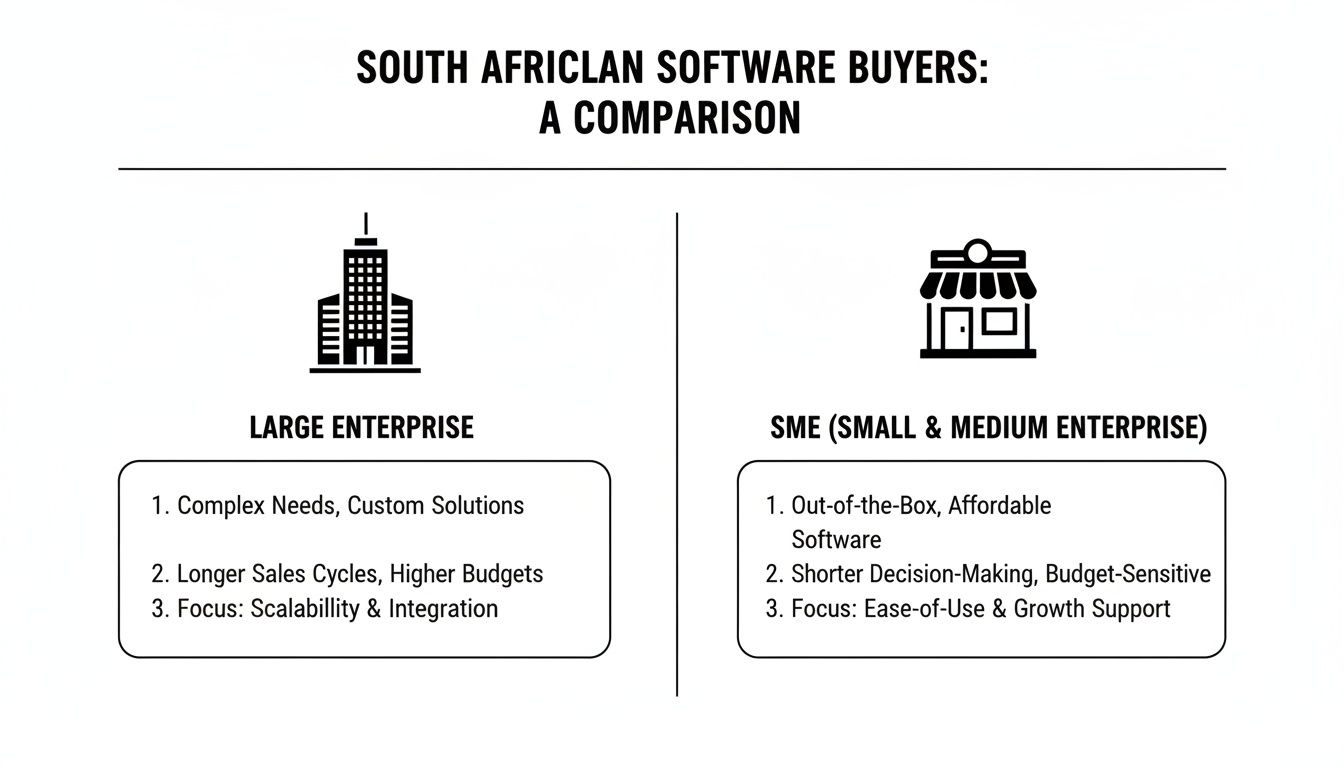
The data clearly shows a critical divide: enterprises are playing the long game, prioritising things like scalability and robust security. SMEs, on the other hand, are focused on immediate needs – affordability and software that's easy to get up and running.
The B2B Power Players: Google and LinkedIn
For most software companies, especially if you’re aiming at mid-market and enterprise clients, Google and LinkedIn are non-negotiable. Let’s be honest, they’re the workhorses of B2B marketing here for a reason—they deliver highly qualified leads when you know how to use them.
Google Search is where you find high-intent prospects. When a decision-maker is actively typing a problem into that search bar, you absolutely have to be there. Think about keywords like “best accounting software for small business ZA” or “enterprise data security platforms South Africa.” These aren’t people just browsing; they have a problem and are actively looking for a solution.
LinkedIn is your tool for surgical precision. No other platform lets you get so granular with targeting specific job titles, company sizes, and industries. Need to get your message in front of IT managers at JSE-listed retail companies? LinkedIn is where you do it. It’s also a fantastic place for building real authority through good content and connecting directly with the people who sign the cheques.
Beyond the Usual Suspects: Meta and TikTok
Don't be too quick to dismiss platforms like Meta (Facebook and Instagram) or even TikTok. This is especially true if your software is geared towards the SME market. A huge number of South African small business owners are incredibly active on these channels, and not just for sharing family photos. They’re networking, learning, and discovering new tools.
- Meta Platforms: Facebook Groups are gold. You’ll find countless communities for South African entrepreneurs and freelancers. The key is to engage authentically—answer questions, offer advice—not just spam your link. That’s how you build trust.
- TikTok: It might seem unconventional for B2B, but TikTok’s algorithm is ridiculously good at finding niche audiences. A short, sharp video showing how your software solves a massive headache for a specific professional (like a salon owner struggling with bookings) can get massive organic reach.
Your goal isn't to be everywhere at once. It's to be surgically precise. Pick one or two primary channels that are a perfect match for your buyer persona, master them, and then think about expanding. Trying to do everything guarantees you'll do nothing well.
Don't Overlook Local Channels
This is a massive, often-missed opportunity for international companies entering the South African market. If you rely only on the global platforms, you ignore the vibrant local communities where genuine business relationships and trust are built.
Here are a few local gems to consider:
- MyBroadband: This is the largest and most active tech community in South Africa. The business forums are filled with decision-makers discussing everything from fibre providers to enterprise software. Becoming a helpful, authoritative voice there can drive some incredibly high-quality inbound leads.
- Bizcommunity: A major online hub for business news and articles across nearly every sector in the country. Contributing thought leadership pieces or running targeted display ads can put your brand right in front of a highly relevant audience.
- Niche Industry Newsletters: Just about every industry in South Africa, from agriculture to finance, has its own set of trusted email newsletters. Sponsoring one of these can be far more powerful than a generic Google Ad because you’re tapping into a curated, engaged audience that already trusts the source.
Ultimately, choosing the right channels is a strategic exercise. It starts with a deep understanding of your buyer. From there, you map their digital habits to the platforms where they are most active and receptive. By combining the scale of global giants with the trust of local communities, you build a strategy that doesn’t just reach your audience, but actually resonates with them.
Building Paid Ad Campaigns That Actually Convert
Anyone can throw money at Google or Meta. Getting a positive return on that ad spend in the South African market? That’s a whole different game. A generic, spray-and-pray approach is a surefire way to burn through your budget with almost nothing to show for it.
Success here is all about being tactical. It means building campaigns that don't just get seen, but actually connect with your specific South African buyer—whether they’re in a Sandton high-rise or a small office in Gqeberha.
This isn't just about running ads; it's about building a predictable engine for revenue. Let's get into the nitty-gritty of structuring campaigns that turn clicks into actual customers.
Geo-Targeting: Go Beyond the Obvious
When you're setting up campaigns, the temptation is to just target "South Africa" and call it a day. That’s a mistake. A much smarter move is to start with the major economic hubs where your ideal customers are most concentrated.
For most B2B software, this means putting your initial budget into:
- Gauteng: Specifically Johannesburg and Pretoria, the country's economic powerhouse.
- Western Cape: Primarily Cape Town, a major tech and creative hub.
- KwaZulu-Natal: Focusing on the Durban area and its surrounding commercial zones.
Once you’ve found what works in these core areas, you can then strategically expand your reach. This tiered approach lets you prove your model and nail down a positive return before scaling up, preventing wasted spend in less concentrated regions.
Writing Ad Copy That Speaks South African
The language you use is everything. It’s about more than just switching to South African English spelling—it's about tapping into local sensibilities and avoiding the cringe-worthy mistakes that instantly mark you as an outsider.
A classic example is pricing. Don't show prices in USD. Always display them in Rand (ZAR). It’s a simple change that removes a major point of friction and shows you've actually made an effort to localise for the market.
Be mindful of the tone, too. South African business culture can be a bit more direct and less formal than in other regions. Your copy should feel relatable and get straight to the point. Focus on the tangible outcome: how does your software save time, reduce "admin," or help a business grow in a tough economy?
The goal is to sound like a local partner, not a distant multinational. Mentioning a well-known South African client in your ad copy can be incredibly powerful social proof. A simple line like, "Trusted by leading SA businesses like [Local Brand]" builds instant credibility.
Structuring Your Campaigns for Success
How you organise your campaigns on platforms like Google Ads and Meta Ads is just as important as the words you write. A messy structure leads to messy data, which makes it impossible to figure out what's actually working.
A common mistake is lumping all your keywords or audiences into one giant ad group. You need to get granular.
- On Google: Create separate campaigns for different software features or solutions. Inside each campaign, build tightly-themed ad groups with just a handful of closely related keywords. This ensures your ad is hyper-relevant to what the person is searching for.
- On Meta & LinkedIn: Segment your audiences ruthlessly. Run separate campaigns for different job titles, industries, or company sizes. An ad targeting an SME founder should look and feel completely different from one aimed at an enterprise IT manager.
This level of organisation gives you far more control over your budget and provides clean data on which messages and audiences are driving real conversions. For a deeper dive into specific strategies, check out our guide on South Africa online advertising.
Tapping into Specific Market Growth
Knowing where the market is heading helps you aim your campaigns with much greater precision.
Take SEO software, for example. In South Africa, that niche generated USD 0.5 billion in 2024 and is projected to hit USD 0.9 billion by 2030. While large enterprises were the biggest spenders in 2024, it’s SMEs that are set to be the fastest-growing segment. This signals a massive opportunity to target smaller, agile businesses that need to get visible online to compete. You can explore more insights on the South African SEO software market on Grand View Research.
This data is a clear sign. If your software helps with online visibility, creating paid campaigns specifically for South African SMEs could be a huge win. Your messaging could centre on affordability and ease of use—exactly what this growing segment is looking for.
By combining smart geo-targeting, locally-tuned copy, and a granular campaign structure, you stop just buying traffic and start making strategic investments. You build a system that allows you to test, learn, and consistently improve your cost per lead, turning your ad spend into a reliable source of revenue.
Optimising Your Funnel for Local User Behaviour

Getting someone to click your ad is just the opening move. The real work in software marketing starts after that click. You’ve managed to get traffic to your landing page—now what? A click without a conversion is just a wasted line item on your marketing budget.
This is where you need to get forensic about the user’s journey. Every single step, from the moment they land on your page to that final click on "Sign Up," is a potential friction point. Your job is to find the leaks in your funnel and plug them, making the path to conversion as smooth as possible.
Pinpointing Local Friction Points
For South African users, the hurdles aren't always what you'd expect. A slick, globally-focused landing page can actually backfire if it fails to address specific local concerns. Getting this right means putting yourself in your customer’s shoes and thinking through their questions and hesitations.
Here are some common drop-off points I've seen time and again:
- Payment Gateways: If a user gets to the checkout and only sees Stripe or PayPal, you might lose them. South Africans trust and expect to see local players like PayFast, Yoco, and Ozow. Integrating these isn't just a nice-to-have; it's a critical trust signal.
- Data Cost Sensitivity: High data costs are a reality for many South Africans. If your landing page is loaded with heavy, auto-playing videos or unnecessarily large images, you risk frustrating people. They might just bounce before they even see your offer. Keep your pages lean and fast.
- Lack of Local Social Proof: Testimonials from companies in New York are great, but a single glowing review from a recognised South African brand is worth ten of them. Showcase logos and case studies from local businesses to build instant credibility.
Your main goal is to remove any doubt that your software is a good fit for the South African market. Every element, from payment options to testimonials, should scream, "We get your business and your context."
Building a High-Trust Landing Page
Think of your landing page as your digital salesperson. It needs to build rapport, answer key questions, and guide the prospect toward a decision—all within a few seconds. Beyond just listing features, your copy has to build trust and overcome that natural scepticism.
Start by making your value proposition crystal clear and putting it front and centre. A South African business owner needs to know immediately what your software does and how it solves a specific local problem. Vague corporate jargon simply won't cut it.
Next, take a hard look at your forms. Are you asking for a phone number on a free trial sign-up? That can feel intrusive and might be unnecessary. Only ask for the absolute essentials to reduce the effort required. Shorter forms almost always convert better.
Running A/B Tests That Actually Matter
Don't just guess what works—test it. A/B testing is your secret weapon for systematically improving conversion rates. But please, avoid wasting time on tiny, insignificant changes like button colours. Focus your energy on high-impact elements that can produce meaningful results.
Here are a few powerful A/B tests to run for a South African audience:
- Headline Variations: Test a benefit-driven headline ("Save 10 Hours a Week on Admin") against a feature-focused one ("The All-in-One Invoicing Platform").
- Offer Phrasing: Compare "Start Your Free Trial" with something more localised and less committal, like "Try It Free (No Credit Card)."
- Social Proof Placement: Test the impact of placing logos of well-known South African clients "above the fold" versus lower down the page.
Each test gives you hard data on what resonates with your local audience. This iterative process—testing, learning, and refining—is the very core of effective conversion rate optimisation. For a deeper dive into how these on-page tweaks fit into a broader strategy, you can get more valuable tips on search engine optimisation in South Africa in our related guide. By methodically fixing the leaks in your funnel, you ensure the traffic you worked so hard to get actually turns into paying customers.
Got Questions About Marketing Software in South Africa? We've Got Answers.
Jumping into a new market always brings up a few questions. South Africa is no different. We hear the same ones time and again, so let's get straight to it with some practical, no-fluff answers to help you get your strategy right from the start.
How Much Should I Actually Budget for Marketing Here?
This is always the big question, isn't it? Instead of pulling a number out of thin air, let's tie it directly to your goals. For most companies breaking into South Africa, a good starting point is to set aside 10% to 20% of your target revenue for your marketing efforts.
If you're an early-stage SaaS business chasing aggressive growth, you'll likely need to push that figure higher. I always advise clients to think of their budget in three parts:
- The Foundation: This covers your non-negotiables—the essential tools and a baseline ad spend to start getting real-world data back from the market.
- The Lab: Dedicate a specific slice of your budget purely for experimentation. This is your playground for testing new channels, fresh ad creative, or different landing page offers.
- The Accelerator: Keep some funds in reserve. When you find a campaign that’s hitting all the right notes, you need to be able to pour fuel on the fire immediately, not wait for the next budget cycle.
And remember, your budget isn't something you set and forget. It's a living document. Review it every quarter against your performance data and adjust accordingly.
Do We Really Need a Local Business Entity to Get Started?
Strictly speaking, no, you don't need one to start running ads. But it makes a massive difference to your credibility. South African businesses, particularly the larger enterprises you want to land, are often much more comfortable dealing with a company that has a local footprint. Even something as simple as a local bank account for ZAR payments can be a game-changer.
Setting up a local entity signals that you're serious about the market. It shows you're invested. From a purely practical standpoint, it also makes invoicing, payments, and dealing with local regulations much, much smoother. It’s one of the quickest ways to build trust and remove a major hurdle for buyers.
A smart first step is often to partner with a local reseller or agency. This gives you an instant presence on the ground and invaluable local expertise without the immediate headache and cost of setting up your own company.
How Seriously Do I Need to Take POPIA Compliance?
Extremely. The Protection of Personal Information Act (POPIA) is South Africa's data privacy law, and it is not just a suggestion. Failing to comply can result in massive fines, but the reputational damage from losing customer trust can be even more costly.
Your marketing has to be POPIA-compliant from day one. This touches everything—from the opt-in checkbox on your landing page forms to how you segment data in your CRM. Your privacy policy needs to be crystal clear, easy to find, and specifically mention POPIA. For B2B software, being able to show you have robust data security and take POPIA seriously is a massive selling point, especially with enterprise clients. Don't treat it as a box to tick later; build it into your core strategy now.
Can't I Just Use My Global Marketing Materials?
You could, but you’d be leaving a lot of money on the table. Think of your global assets as a great starting point, not the finished product. They need a proper localisation pass that goes way beyond just changing "color" to "colour" and putting a "R" in front of your prices.
Here’s what to focus on:
- Imagery: Ditch the generic global stock photos. Use images that actually reflect the rich diversity of South Africa. Seeing local faces and familiar settings in your ads makes an instant connection.
- Case Studies: A glowing testimonial from a business in Johannesburg is ten times more powerful than one from New York. Make it a top priority to find and feature your local customers.
- Language and Tone: How you say things matters. Adjust your copy to be a bit more direct and relatable. Cut out the corporate jargon that might not land well or could be misunderstood.
The goal is to adapt, not just translate. You want your brand to feel like it belongs in the local business community, not like a foreign company shouting from a distance.
Ready to stop guessing and start growing your software business in South Africa? The team at Market With Boost builds data-driven paid media and conversion optimisation strategies that turn ad spend into predictable revenue. Book a no-obligation discovery call with us today.

Written by
Chief Executive Officer
Chris heads the Boost Marketing team and is also CEO and CTO of Shopstar, with over ten years of digital marketing experience. Before these roles, Chris co-founded MADE Agency, a leading South African digital marketing agency, collaborating with renowned clients like BMW, Red Bull, and Pepsi. He has a deep understanding of eCommerce and a talent for identifying emerging trends.

Scale your performance with data-driven insights
Ready to apply these insights to your business? Hannah can walk you through how we'd approach your specific situation.
Hannah Merzbacher
Operations Manager
Continue reading
View all insights
Online Marketing Africa: A Data-Driven Growth Playbook
Master online marketing Africa with channel tactics, mobile-first CRO, payment and logistics fixes, and sector playbooks built for real revenue growth...
Digital Marketing for Business Growth: 2026 Playbook
Build a data-driven digital marketing for business growth strategy with our 2026 playbook. Set goals, pick channels, optimize funnels, and scale reven...
Email Marketing for Agencies: A Modern Playbook
The ultimate playbook for email marketing for agencies. Learn to build, sell, and scale high-ROI email services that clients love and competitors envy...