Your Practical Guide to Sustainable SaaS Growth

By Elizora Yarnell
Let's cut through the jargon. Think of Software as a Service (SaaS) like having a Netflix subscription for your business tools. You pay a simple, recurring fee and get constant access to the latest software, without ever having to worry about installation, updates, or maintenance. It's a total game-changer, shifting the focus from a one-off sale to building a real, lasting relationship with your customers.
What Exactly Is SaaS and Why Should You Care?
At its heart, SaaS is just a way of delivering apps over the internet, like a service. Instead of installing clunky software on your computer, you just access it through your web browser. This simple shift frees you from the headache of managing complicated software and hardware.
Remember the old days? You’d buy a box with a CD-ROM, install it on one machine, and cross your fingers. When a new version came out a year later, you had to go out and buy it all over again. SaaS flips that whole model on its head.
With SaaS, you're not really buying a product; you're renting a solution. This simple change means the provider is always responsible for updates, security, and performance, so you always have the best version without lifting a finger.
This approach gives businesses incredible flexibility. You can easily scale your software usage up or down as your needs change, paying only for what you actually use. It massively lowers the barrier to entry, giving small businesses access to powerful tools that were once only affordable for huge corporations.
The Core Benefits of the SaaS Model
The appeal of SaaS is about more than just convenience—it’s a smarter way of doing business. The model is built to solve the biggest headaches of traditional software ownership.
Here’s a quick look at why it’s taken over:
- Lower Upfront Costs: Forget about massive, one-time licence fees. SaaS runs on a predictable monthly or annual subscription, which makes budgeting a breeze and keeps your cash flow healthy.
- Accessibility and Scalability: Because the software lives in the cloud, your team can get to it from anywhere with an internet connection. Need to add new users as you grow? It's usually just a few clicks away.
- Automatic Updates: The SaaS provider handles all the maintenance and updates behind the scenes. You never have to worry about installing the latest security patch or feature release—it’s all done for you.
To give you a better idea of how different these two approaches are, let's break it down side-by-side.
SaaS vs Traditional Software: A Quick Comparison
| Feature | SaaS (Software as a Service) | Traditional Software (On-Premise) |
|---|---|---|
| Hosting | Hosted by the vendor in the cloud. | Hosted on the customer's own servers. |
| Pricing Model | Recurring subscription fee (monthly/annually). | One-time perpetual licence fee. |
| Upfront Cost | Low. | High. |
| Updates | Automatic and included in the subscription. | Manual; often requires purchasing new versions. |
| Accessibility | From any device with an internet connection. | Limited to specific devices or internal networks. |
| Maintenance | Handled entirely by the vendor. | The responsibility of the customer's IT team. |
As you can see, the SaaS model takes a lot of the burden and risk off your plate, putting the responsibility for performance and upkeep squarely on the provider.
This model is booming, both around the world and right here at home. In South Africa (ZA), for example, the SaaS market is surging as local eCommerce brands and software companies fully embrace the cloud. South African businesses now manage an average of 106 SaaS apps per company in 2024, and the spend per employee has soared to $4,830. This just shows how deeply companies rely on these tools for everything from CRM and ERP to conversion rate optimisation.
You can dive deeper into the data on the global SaaS market growth on fortunebusinessinsights.com.
Finding the Right SaaS Pricing Strategy
Figuring out how to charge for your SaaS product is more than just sticking a price tag on it. It’s one of the most powerful levers you can pull for growth. Get it right, and your pricing won't just bring in money—it'll attract the right kind of customers, give them a clear path to grow with you, and basically shout your product's value from the rooftops.
The first step is often to move away from a simple, one-size-fits-all price. While it’s super easy to understand, a single price usually means you're leaving money on the table. It just doesn't make sense for a tiny startup and a huge enterprise to pay the same amount for the same features—you're either overcharging the little guy or massively undercharging the big one.
This is where smarter models come in. When you line your pricing up with the actual value your customers get, you create a perfect win-win situation. Their success literally becomes your success.
Exploring Common SaaS Pricing Models
Most successful SaaS companies don’t just throw a dart at a board to pick a price. They choose a model that lines up perfectly with their product, their ideal customer, and their growth plans. Let's break down the most popular ways to do it.
Tiered Pricing: This is the bread and butter of the SaaS world. You create a few different packages (think Basic, Pro, Enterprise) at different price points. Each tier unlocks more features, higher usage limits, or better support. It's brilliant because it lets customers pick a plan that fits their current needs and budget. A classic example is HubSpot, with its different tiers that let companies scale up as they grow. To see how others make this work, check out these tiered pricing strategy examples.
Usage-Based Pricing: With this model, customers literally pay for what they use. Think of cloud services like Amazon Web Services, where your bill is tied directly to the data you store or the computing power you use. Customers often see this as incredibly fair because the cost is directly linked to the value they're getting. The only catch? It can make your revenue a bit harder to predict month to month.
Per-User Pricing: Simple, predictable, and easy to get. This model charges a set fee for every person on a team using the software. Slack is the poster child for this; the more team members you add, the more you pay. This is a great fit for collaboration tools where the value actually multiplies with each new user. The potential downside is that it can stop a company from rolling it out to everyone if the costs start to add up.
The Power of Freemium
Another powerhouse strategy you'll see everywhere is freemium. Make no mistake, this isn't just about giving your product away for free. It's a calculated customer acquisition machine. By offering a forever-free—but limited—version of your product, you can attract a huge number of users for next to nothing.
The real goal here is to get people hooked. Once they’ve experienced your product's core value and started to rely on it, the decision to upgrade for more features or higher limits becomes a no-brainer. Companies like Calendly and Dropbox have used this playbook to build enormous user bases that act as a self-sustaining funnel for their paid plans.
The secret to a great freemium model is having an irresistible upgrade path. The free version needs to be valuable enough to keep people around, but the paid version has to offer a big enough leap in value to make them pull out their credit card.
Choosing the right strategy comes down to deeply understanding your customer and what they value. It almost always involves some testing and tweaking. A great place to start is by asking a simple question: does our value scale with the number of users, the features they need, or how much they use? Your answer will point you straight to the model that best ties your revenue to your customers' success.
The SaaS Metrics That Truly Matter for Growth
Trying to grow a SaaS business without tracking the right numbers is like flying a plane blind. You might feel like you're climbing, but you have no idea if you're headed for a mountain or the open sky. Forget vanity metrics—social media likes and website visits won't pay the bills. To build a business that lasts, you need to be obsessed with the numbers that tell the real story of your company's health.
These core metrics aren't just fancy jargon for investor meetings. They are the vital signs of your business. They tell you what's working, what's broken, and where your biggest growth opportunities are hiding. If you're serious about scaling, getting a handle on these is non-negotiable.
Monthly Recurring Revenue: The Heartbeat of Your Business
Let's start with the big one: Monthly Recurring Revenue (MRR). Think of MRR as the predictable, steady heartbeat of your business. It's the total amount of subscription revenue you can confidently expect to bring in every single month. Its bigger sibling, of course, is Annual Recurring Revenue (ARR).
MRR gives you a clear, consistent snapshot of your financial momentum. When it’s climbing, your business is healthy. If it flatlines or dips, that’s your alarm bell—something needs fixing, fast.
To really understand what’s driving that growth, you need to break MRR down:
- New MRR: This is all the revenue from brand-new customers this month.
- Expansion MRR: This is where the magic happens. It’s the extra revenue from existing customers who upgraded or added new services.
- Churned MRR: The flip side—this is the revenue you lost from customers who cancelled.
Looking at MRR this way shows you not just if you're growing, but how. A high Expansion MRR, for example, is a fantastic sign. It means your customers are so happy with your product that they’re willing to pay more for it over time.
The Balancing Act: Customer Acquisition Cost and Lifetime Value
Next up is the fundamental equation that decides whether your SaaS business actually works: the relationship between Customer Acquisition Cost (CAC) and Lifetime Value (LTV).
CAC is simple enough—it’s the total sales and marketing cost you spend to get one new customer to sign on the dotted line.
LTV, on the other hand, is the total revenue you can reasonably expect to earn from a single customer over their entire time with you. It’s the long-term worth of that relationship.
Here's the golden rule of SaaS: your LTV must be significantly higher than your CAC. A healthy ratio to aim for is 3:1 or better. For every rand you spend to win a customer, you should expect to make at least three rands back over their lifetime.
If your CAC is higher than your LTV, you’re literally paying people to use your product. It’s not just a problem; it's a one-way ticket to going out of business. Nailing this ratio is everything. For instance, a sharp focus on CRO can significantly lower your acquisition costs. We’ve actually put together some proven ideas in our guide on eCommerce conversion rate optimisation tips that you can apply.
Churn: The Silent Killer of Growth
Finally, we have to talk about churn. The Churn Rate is the percentage of your customers who cancel their subscriptions in a given period. It might feel like a small number each month, but don't be fooled. Churn is a silent killer that can completely wreck all your hard work.
Think of your business as a bucket you're trying to fill with new customers. Churn is a hole in the bottom of that bucket. It doesn't matter how fast you pour water in; if the hole is too big, you'll never fill it. A seemingly small churn rate of 3% per month compounds to losing over 30% of your customer base in a single year. Ouch.
Fighting churn is just as crucial as winning new customers. After all, keeping a customer you already have is almost always cheaper and easier than finding a new one. Even a tiny improvement in retention can have a huge impact on your bottom line.
The different pricing strategies you use have a direct effect on all these core financial metrics.
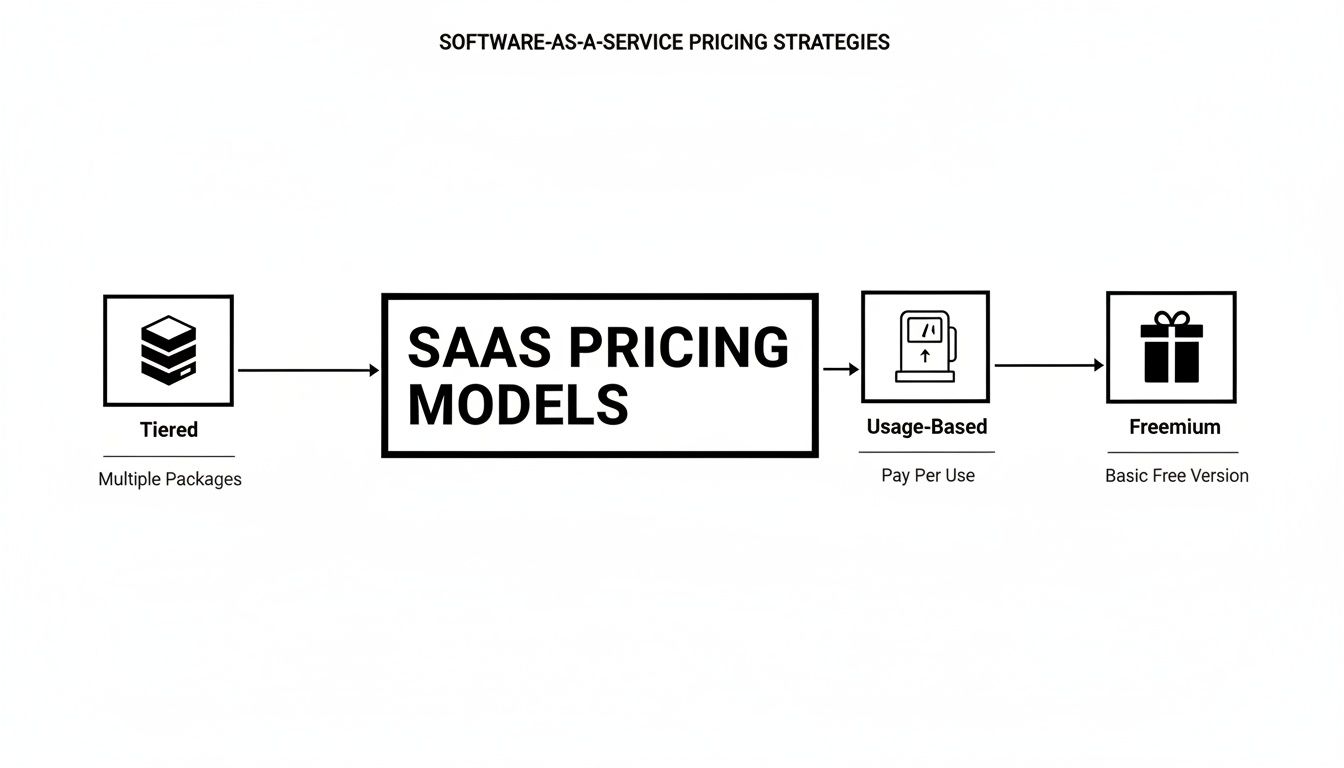
As you can see, every model—from tiered plans to usage-based billing—is a different way of packaging your value, and each one will influence your LTV and churn rate in its own way.
Choosing Your Go-To-Market Strategy
Let's be honest: having a brilliant SaaS product is just the starting line. Without a smart way to get it into the hands of your customers, even the most amazing software is dead in the water.
This is where your go-to-market (GTM) strategy comes in. It's your game plan for reaching, engaging, and winning over your target market. Think of it as the engine of your business – it’s what actually drives growth.
Choosing the right GTM model isn't about following the latest trend. It’s about taking an honest look at your product, your ideal customer, and your company's unique strengths.
The Traditional Sales-Led Growth Approach
For a long time, there was really only one way to sell software: Sales-Led Growth (SLG). This is the classic model where a team of sales reps actively finds and nurtures leads to close deals. It’s a hands-on, human-driven process.
SLG is still the gold standard for companies with complex, high-value products, especially those selling to big enterprises. When your deal sizes are in the tens or hundreds of thousands of rands and you need buy-in from multiple departments, you absolutely need a salesperson to handle that complexity.
They build relationships, run tailored demos, and negotiate contracts in a way that an automated system just can't. Companies like Salesforce built their entire empire on this approach. It works because the high lifetime value (LTV) of each customer easily justifies the cost of a dedicated sales team.
The Modern Product-Led Growth Engine
Over the last decade, a completely different philosophy has taken over: Product-Led Growth (PLG). Here, the product itself is the main driver for acquiring, converting, and keeping customers. If you’ve ever used Calendly, Slack, or Dropbox, you’ve experienced PLG firsthand. You probably started using it without ever talking to a person.
The strategy hinges on offering a freemium plan or a generous free trial. This gets users in the door and lets them experience the product’s value for themselves. The magic of PLG is in a seamless onboarding experience and an obvious path to upgrading.
The core idea of PLG is simple: let the product do the selling. By showing value upfront, you build a massive user base that essentially becomes a self-serve sales funnel. Happy users invite their colleagues, and small teams organically grow into company-wide accounts.
This model is perfect for products that are easy to pick up and deliver value almost immediately. It keeps customer acquisition costs (CAC) incredibly low, paving the way for explosive, viral growth. The catch? Your product has to be exceptional, and the user experience must be absolutely frictionless.
Finding Your Place with Marketing-Led Growth
What if you're somewhere in the middle? That's where Marketing-Led Growth (MLG) shines. In this hybrid model, your marketing team takes the lead, generating a steady stream of qualified leads that are then handed off to sales to close the deal.
This involves a smart mix of content marketing, SEO, paid ads, and targeted email campaigns designed to attract and educate potential buyers. For example, a high-value blog post or a clever LinkedIn ad can bring in prospects who are actively looking for a solution like yours. If you need to sharpen your online visibility, the team at Market With Boost offers expert guidance from our search engine optimisation consultants.
The goal of MLG is to warm up the audience. By the time a lead talks to a salesperson, they're already informed, interested, and much closer to making a decision. HubSpot is the undisputed master of this, using its powerful content machine to pull in millions of potential customers for its sales team.
Actionable Growth Plays for Your SaaS Business
Alright, you've got a handle on the models and the metrics. Now it's time to get your hands dirty and turn that knowledge into real results. This is your playbook for proven, practical strategies that get a SaaS business growing, and fast. We're moving from theory to action.
The goal isn’t just to find any customer. It’s to build a reliable system that consistently brings in the right customers, converts them smoothly, and keeps them happy for the long haul. Let’s break down the core plays that make this happen.
Building a Paid Acquisition Funnel That Works
Waiting for organic growth can feel like watching paint dry. A well-oiled paid acquisition funnel, on the other hand, is like turning on a tap for a predictable stream of qualified leads. The secret sauce is being surgical with your targeting and relentless with your testing.
For B2B SaaS, LinkedIn is often the best place to start. Its powerful professional targeting lets you put your message directly in front of people with specific job titles, at companies of a certain size, and in the right industries. Start with a small, tightly focused campaign. The key is to match your ad creative and messaging directly to their biggest pain points.
Meta platforms like Facebook and Instagram are brilliant for SaaS products with a wider appeal or those that target specific interests. A great tactic here is to create lookalike audiences based on your best existing customers to find more people just like them. And always be testing different formats—video testimonials often crush static images because they build instant trust and show your product in action.
Optimising Your Website for Conversions
Driving traffic to your site is only half the battle. If your sign-up or demo request process is a confusing mess, you're just pouring money down the drain. This is where Conversion Rate Optimisation (CRO) becomes one of the most valuable things you can do.
Start by mapping out your entire sign-up flow. Where are people dropping off? Tools like heatmaps can literally show you where users are getting stuck or confused. Sometimes, the fix is surprisingly simple.
Here are a few high-impact CRO tactics you can try right away:
- Simplify Your Forms: Do you really need to know their company's annual revenue on the first sign-up form? Ditch every single field that isn't absolutely essential. Each field you remove can give your conversion rate a little boost.
- Add Social Proof: Plastering customer logos, glowing testimonials, and case studies right next to your call-to-action buttons is a shortcut to building trust and calming nerves.
- Clarify Your Call-to-Action (CTA): A generic "Submit" button is boring. Try something more specific and value-driven like "Get Your Free Demo" or "Start My Trial." Make it crystal clear what happens next.
Fixing these small leaks can have a massive impact on your customer acquisition costs. If you need some expert help, many lead generation companies specialise in fine-tuning these critical conversion points.
Turning Happy Users into Loyal Advocates
Bringing new customers in the door is expensive; losing them is even more so. A rock-solid retention strategy is the true foundation of a healthy SaaS business. After all, it’s much cheaper and easier to keep a current customer happy than it is to constantly find new ones. To grow sustainably, applying effective customer retention best practices is just as vital as your acquisition plan.
Your goal should be to move beyond a simple transaction. Proactive communication and delivering continuous value are what transform a casual user into a loyal brand advocate who will stick around for years.
This all starts with a brilliant onboarding process. Don't just throw new users into your software and hope they figure it out. Guide them with a series of targeted emails or in-app messages that lead them straight to their "aha!" moment—that point where they truly get the value your product offers.
You should also use customer feedback as your north star. Regularly survey your users to understand what they love and what drives them crazy. Acting on this feedback doesn't just make your product better; it shows your customers you're actually listening, which is a powerful way to build loyalty. Sometimes, a simple proactive check-in is all it takes to stop a customer from churning.
Common SaaS Growth Mistakes to Avoid
The path to building a great SaaS company is a marathon, not a sprint. It’s also a path full of common traps that can easily derail even the most promising products. The good news? Learning from the mistakes of others is a lot less painful than making them yourself.
Let's look at some of the most common—and costly—blunders we see founders make, so you can steer clear of them.
Trying to Scale Before You’re Ready
One of the most tempting mistakes is hitting the accelerator too soon. Pouring money into marketing before you’ve truly nailed product-market fit is like trying to fill a bucket riddled with holes. If your product doesn’t solve a real problem or make your first users genuinely happy, no amount of ad spend is going to fix that.
This mistake almost always leads straight to the next one: ignoring your most important critics.
Neglecting Customer Feedback and Churn
Your first handful of users are a goldmine. They'll give you the brutally honest feedback you need to hear about what’s working and what’s a complete mess. Ignoring their complaints or feature requests is a fast track to building a product nobody actually wants to use.
This is where churn comes in. Treating it as just another number on a spreadsheet is a fatal error. High churn isn't just a "leaky bucket"; it's a massive red flag telling you that your product isn't delivering on its promise.
Chasing flashy vanity metrics like sign-ups or website traffic while ignoring retention is a classic rookie move. A business with 10,000 sign-ups but a 20% monthly churn rate isn't growing; it's just treading water.
Obsessing over why customers leave is one of the most productive things you can do. It gives you a crystal-clear roadmap for what to fix. Often, the reasons are tied directly to these other common missteps:
- Confusing Pricing Tiers: Your pricing has to make sense instantly. If customers can't figure out what they’re paying for or see a clear path to upgrade, they'll just get frustrated and leave.
- A Broken Onboarding Experience: Those first few moments a new user spends with your product are everything. If they can’t quickly get to that "aha!" moment where they see the value, they won’t stick around long enough to become a paying customer.
- Building in a Silo: Don’t build features based on what you think the market wants. Talk to your customers. Building based on assumptions, rather than actual requests, leads to a bloated, unloved product.
Avoiding these growth mistakes really boils down to one core principle: stay relentlessly focused on your customer and the value you provide. Build what they need, listen when they talk, and work to earn their loyalty every single day.
Your SaaS Questions, Answered
Diving into the SaaS world can feel like learning a new language. There's a lot of jargon and nuance, so it's natural to have questions. Let's tackle some of the most common ones we hear from people just getting started.
Is SaaS just for big companies?
Not at all. In fact, you could argue the opposite is true. The beauty of the SaaS model is that it completely changed the game for smaller businesses.
Before SaaS, getting powerful software meant huge upfront costs for licences and the server hardware to run it. SaaS threw that model out the window, replacing it with a predictable subscription. This gives startups and SMBs access to the exact same high-calibre tools as massive corporations, levelling the playing field in a huge way.
What’s the difference between SaaS and Cloud Computing?
This is a really common mix-up, but it's simple once you have the right analogy. Think of cloud computing as the entire electrical grid – the power stations, the pylons, the cables. It's the massive, underlying infrastructure.
SaaS, in this analogy, is the appliance you plug into the wall. It’s a specific product that runs on that infrastructure.
So, all SaaS solutions rely on cloud computing to work, but cloud computing itself is a much broader concept that includes more than just software delivery.
What are the toughest hurdles for a new SaaS business?
Once you've actually built a solid product, the real fight begins on two fronts: getting customers and keeping them. The market is incredibly noisy, and just getting your ideal customer's attention is a huge task.
But getting them in the door is only half the battle. Then you have to convince them to stay, month after month. A seemingly small monthly churn rate of 3% might not sound like much, but over a year, that means you've lost more than a third of your hard-won customers. That’s why focusing relentlessly on product value and customer success isn't just a nice-to-have; it's essential for survival.
Ready to stop guessing and start growing your SaaS business with a data-driven marketing strategy? The team at Market With Boost specialises in building high-performance paid media and conversion funnels that deliver measurable results. Book your free discovery call today and find out how we can help you scale.

Written by
Chief Operating Officer
Elizora brings over 13 years of experience leading marketing teams across various sectors, with expertise in operations and strategy. She's handled complex projects, streamlined processes, and built strong teams. She keeps projects on track and makes sure teams work well together.

Scale your performance with data-driven insights
Ready to apply these insights to your business? Hannah can walk you through how we'd approach your specific situation.
Hannah Merzbacher
Operations Manager
Continue reading
View all insights
A Practical Guide to Marketing for SaaS Growth
Unlock scalable growth with our guide to marketing for SaaS. Master acquisition, conversion, and retention to build a thriving software business....
10 High-Impact SaaS Marketing Strategies to Scale Your Growth in 2026
Discover 10 actionable SaaS marketing strategies to supercharge growth. Dive into PLG, ABM, CRO, and more to attract and retain high-value customers....
B2B SaaS Marketing Strategies: 10 Plays for 2026
Discover 10 actionable B2B SaaS marketing strategies for 2026. This guide covers ABM, PLG, content, and paid channels to help you drive sustainable gr...