Discover search engine optimization consultants to drive measurable growth

By Chris Edington
Hiring an SEO consultant is a big step, not a magic wand you wave at your traffic problems. Think of it as a strategic partnership. It really only pays off when your business is already on solid ground—meaning you know your customers inside and out and have a product or service they genuinely want.
Is Your Business Truly Ready for an SEO Consultant?

Before you even start Googling for experts, it’s time for a little honest self-assessment. I’ve seen so many companies rush to hire SEO help, hoping it will fix fundamental business problems. But here’s the hard truth: driving more traffic to a leaky bucket just makes a bigger, more expensive mess.
SEO is an amplifier. It takes what’s already working and turns up the volume. It doesn't magically create demand out of thin air. If your product isn’t quite hitting the mark, your pricing is off, or your customer service is shaky, SEO will only expose those flaws to a much larger audience, much faster. A top-tier consultant can bring thousands of potential buyers to your digital doorstep, but they can’t make them buy something they don’t want or need.
The Foundational Pillars of SEO Readiness
Think of your business like a house. You wouldn’t hire an interior designer before the foundation is poured and the walls are up, right? SEO is no different. You need a few core elements locked in before a consultant can deliver any real, lasting value.
A great place to start is with the people who are already paying you.
- Do you have a crystal-clear Ideal Customer Profile (ICP)? You need to know exactly who you're selling to—their problems, their goals, and where they hang out online.
- Have you achieved product-market fit? In simple terms, are people already buying what you’re selling without a huge amount of convincing? Do you have positive reviews and testimonials to back it up?
- What does your current sales process look like? Can you map out the journey a visitor takes from landing on your site to becoming a paying customer?
If you find yourself hesitating on these questions, your money is better spent on market research and refining your core offer first, not on SEO. Any good consultant will ask these questions on day one, and having solid answers ready means they can hit the ground running.
An SEO consultant's job is to connect your proven solution with the people actively searching for it. If the solution itself is unproven or poorly defined, you’re setting them—and your investment—up for failure.
Setting Realistic Expectations for Timelines and Results
Being "ready" also means having your expectations firmly planted in reality. SEO isn't an overnight fix. It’s a long-term strategy that builds on itself over time. While you might see a few quick wins from technical tune-ups, substantial results like a steady stream of organic leads typically take four to six months to really show up.
Of course, this timeline depends on how competitive your industry is, your website’s history, and its current technical health. To get a feel for the process, it helps to understand what an SEO service entails. This insight helps you appreciate the sheer scope of the work and why patience is key. It's also worth remembering that this isn't a one-and-done deal; ongoing https://www.marketwithboost.com/insights/web-page-maintenance is crucial for holding onto your hard-won gains.
Ultimately, readiness boils down to this: a stable, valuable business and the patience to invest in a long-haul growth channel. Once you have those pieces in place, the right consultant can become your most powerful ally.
Defining What You Need and Crafting a Clear Brief
Not all SEO is created equal. I've seen firsthand how a strategy that works wonders for a local property business trying to attract buyers in Cape Town falls completely flat for a global SaaS company chasing enterprise leads. This is why you must get specific before you even start looking for potential search engine optimisation consultants.
Jumping into the hiring process without a clear plan is like getting into a taxi and just saying, "Drive." You’ll definitely go somewhere, but I guarantee it won't be where you actually want to end up. You need a map, and for this process, that map is your project brief.
Think of this brief as more than a simple to-do list. It’s a strategic document. It communicates your vision, defines what success looks like for your business, and helps you find the right kind of expert—one who cares about your bottom line, not just vanity rankings.
Auditing Your Current Performance
Before you can map out the future, you need an honest look at where you stand today. Don't worry, you don't need to be an SEO guru for this part. It all starts with asking a few fundamental questions about your business and its online presence.
Grab a notepad and jot down some honest answers:
- Where do your best customers currently come from? Is it word-of-mouth, paid ads, or social media? Knowing this helps you see where organic search can either boost what's working or fill a critical gap.
- What is your website's main job? For an eCommerce store, the answer is direct sales. For a SaaS company, it's likely generating demo requests. A property business lives on qualified buyer or seller enquiries. Be precise.
- Who are your top three online competitors? Look at who pops up when you search for your most important products or services. What do they seem to be doing right? The goal isn't to copy them, but to understand the lay of the land.
This quick audit gives you a solid baseline. It turns vague feelings like "we need more traffic" into a concrete starting point for a strategic conversation.
Setting Goals That Actually Matter
With your audit done, you can now define what you actually want to achieve. Please, avoid vanity metrics like "more traffic" or "#1 rankings." A great consultant will be far more impressed by a clear business objective than a request for meaningless stats.
Your goal isn't to rank for keywords; it's to generate revenue, acquire customers, and build a sustainable business. SEO is simply the vehicle, not the destination.
Think about which of these outcomes is most important for you right now:
- Lead Generation: Increasing the number of high-quality enquiries from potential customers. This is absolutely crucial for property businesses and B2B SaaS companies.
- Direct Sales: Driving more transactions through your eCommerce store. This is the lifeblood of any online retailer.
- Brand Visibility: Dominating search results for your niche and positioning your company as the go-to authority. This is a longer-term play that builds incredible brand equity over time.
Choosing one primary goal brings immediate focus to the strategy. For example, if you're a B2B company, it helps to understand the playbook an expert might use. Getting familiar with B2B SEO best practices will help you articulate your needs much more clearly when you finally talk to a consultant.
Checklist for a Compelling Project Brief
Okay, it's time to pull everything together into a brief that will attract top-tier talent. A well-crafted document immediately signals that you're a serious client who has done their homework, making your project far more appealing from the get-go.
Your brief should be clear, concise, and professional. Make sure it includes:
- Company Overview: A quick summary of what your business does, who you serve, and what makes you unique.
- Project Goals: State your primary objective clearly (e.g., "Increase qualified demo requests by 30% in the next 12 months").
- Target Audience: Describe your ideal customer. What are their pain points? What are they searching for online?
- Current Situation: Share the key takeaways from your audit, including your top competitors and current challenges.
- Budget: Be upfront with a realistic budget range. This respects the consultant's time and ensures you only get proposals you can actually afford.
- Timeline: Note your ideal start date and any critical deadlines.
This brief ensures every consultant is on the same page, which makes comparing their proposals so much easier. This foundation isn't just about hiring; it's about building a partnership that's aligned from day one. That kind of alignment is also a cornerstone of effective website design and development, proving just how interconnected all these digital elements truly are.
How to Evaluate Consultants and Spot a True Expert
Once the proposals start landing in your inbox, it's easy to get lost in a sea of technical jargon and bold claims. So, how do you cut through the noise and tell a genuine strategist from a slick salesperson?
It really comes down to looking past the flashy pitch deck and digging into the three core pillars of modern SEO. You're not just hiring a technician; you're looking for a business partner who thinks critically about your growth.
To get your own head in the right space, this decision tree is a great way to visualise how your core business goals should shape the SEO tactics you prioritise.
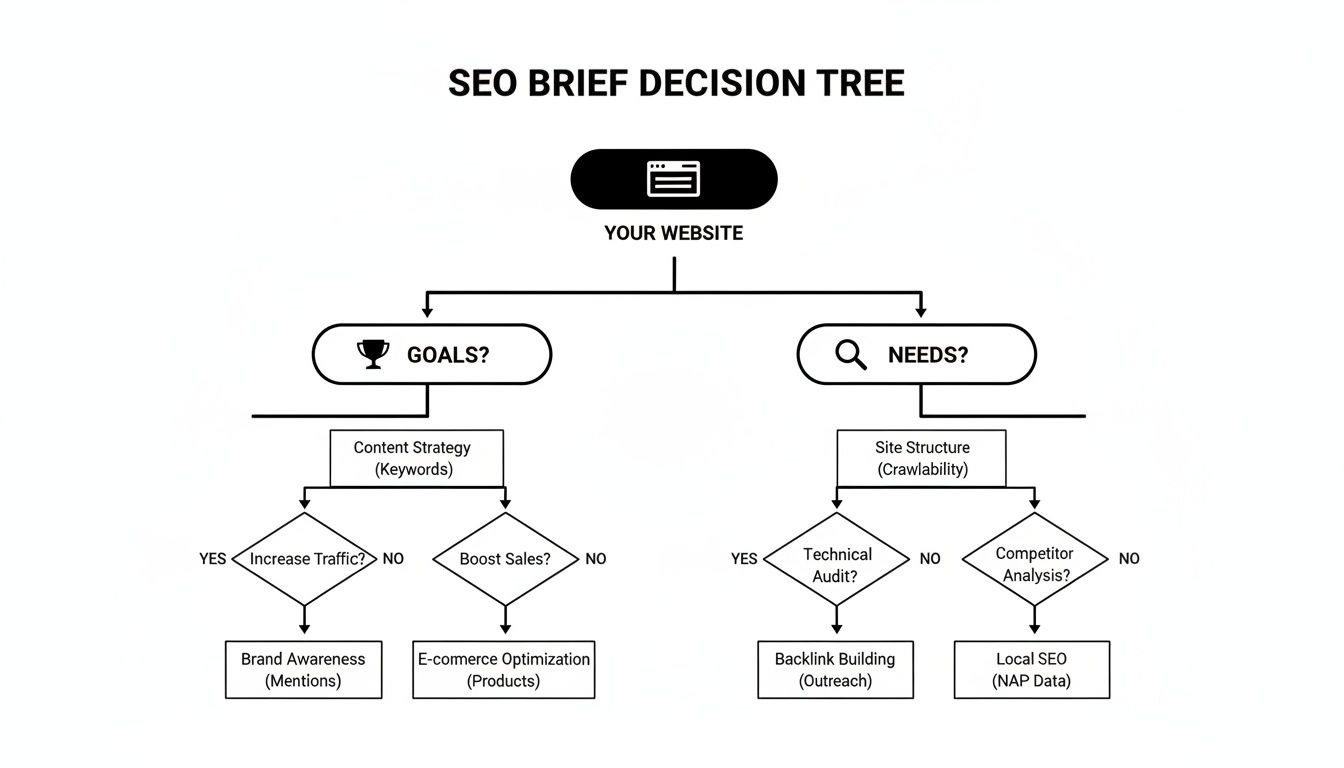
The point is, your main objective—whether it's generating leads, driving direct sales, or building brand authority—must be the driving force behind any proposed SEO strategy.
To help you systematically vet potential partners, I’ve put together a checklist based on years of seeing both the good and the bad in this industry. It’s designed to help you probe deeper than the surface-level answers.
Core Competency Evaluation Checklist
| Competency Area | What to Look For | Red Flags to Avoid |
|---|---|---|
| Technical SEO | Connects technical fixes to business outcomes (e.g., page speed to conversion rates). Discusses concepts like Core Web Vitals and mobile-first indexing in a business context. | Simply lists technical tasks (e.g., "we'll fix 404s"). Can't explain the 'why' behind their technical recommendations. |
| Content Strategy | Thinks like a publisher. Talks about mapping content to the customer journey, building topical authority, and identifying unique content gaps. | Suggests generic "blogging" without a clear strategy. Focuses only on keywords and volume, ignoring user intent. |
| Link Building | Describes strategies rooted in digital PR and creating link-worthy assets. Can provide examples of earned, high-quality links. | Mentions "link packages" or is vague about their methods. Talks about volume over quality or uses outdated terms like "link juice." |
| Local SEO (if applicable) | Immediately asks about your service areas. Discusses Google Business Profile optimisation, local citations, and creating geo-targeted content. | Offers a one-size-fits-all SEO plan without considering your physical locations or local customer base. |
This table should act as your guide during interviews. A consultant who can confidently and clearly address the "What to Look For" points is already showing their value.
Gauging Technical SEO Proficiency
Think of technical SEO as the foundation of your house. If the foundation is cracked, it doesn't matter how beautiful the paint job is. A true expert knows that technical issues aren't just website problems; they're business problems.
Don't just ask, "Can you do a technical audit?" That's a yes/no question. Instead, frame it around a real-world problem:
"Our product pages seem to load slowly on mobile. Can you walk me through how you'd diagnose the root cause and what impact fixing it might have on our conversion rates and rankings?"
A fantastic answer will move beyond the obvious culprits like image sizes. A real pro will start talking about Core Web Vitals, the business case for mobile-first indexing, and how page speed is a critical user experience signal that directly impacts your bottom line. They'll sound less like a developer and more like a strategist who happens to be an expert on the tech.
Assessing Content and Link-Building Strategy
This is where many consultants reveal they're just following a playbook. Anyone can tell you to "write more blog posts." A seasoned expert, on the other hand, thinks like a publisher, mapping content to every single stage of your customer's journey.
They'll understand that a top-of-funnel article for a SaaS company has a completely different job to do than a bottom-of-funnel comparison page for an eCommerce brand. For a closer look at what this means for online retailers, our guide on SEO best practices for your online store is a great resource.
Their approach to link building should be equally modern. The days of buying links are not just over; they're actively dangerous for your business.
Try asking these questions to see how they think:
- On Content: "Beyond basic keyword research, how would you find content gaps our competitors are missing but our ideal customers are searching for?"
- On Links: "Tell me about a successful link you acquired for a client. What was the strategy, and why did it work?"
You're listening for answers that include concepts like building topical authority, using digital PR tactics, and creating assets so valuable that they earn links on their own merit—not just sending out hundreds of emails begging for a placement.
Understanding Their Grasp of the Local Landscape
For businesses in property or local eCommerce, generic SEO just won't cut it. You need an expert who gets the nuances of your geographical market, which is particularly vital in a dynamic economy like South Africa's.
Local SEO is exploding here. Over 90% of South Africa's 43.48 million internet users are searching for city-specific products and services. This makes skilled search engine optimisation consultants a massive competitive advantage.
A consultant who understands this will immediately talk about optimising your Google Business Profile, building local citations, and crafting content that speaks directly to a regional audience, not a vague global one.
Red Flags That Signal a Mismatch
Finally, knowing what to avoid is just as critical as knowing what to look for. Certain promises might sound tempting, but they're often signs of outdated or even harmful practices.
Be extremely cautious of anyone who:
- Guarantees #1 Rankings: This is the oldest trick in the book and impossible to promise. Google's algorithm is a black box that no one controls.
- Is Vague About Their Methods: If they start talking about a "secret sauce" or proprietary techniques, they are likely hiding black-hat tactics that could get your site penalised.
- Focuses Solely on Vanity Metrics: An obsession with traffic or keyword rankings without tying them directly to leads, sales, or revenue is a sign they don't get business.
- Lacks Recent, Relevant Case Studies: They must be able to show you real, tangible results they've achieved for businesses like yours.
Choosing the right consultant is about finding a partner who speaks your language—the language of business growth, not just SEO jargon. By digging into these core competencies, you can confidently find an expert who will deliver real value, backed by data, not just promises.
Making Sense of SEO Pricing and Performance Metrics

Let's cut straight to the chase and talk about the two things that matter most: how much SEO costs and what results you can actually expect. SEO pricing often feels like a black box, but it nearly always boils down to one of three models. Getting your head around them is the first real step to finding an arrangement that works for your budget and your business.
Remember, you aren't just buying a checklist of tasks. You're investing in a strategic outcome. A good consultant will help you shift your thinking from, "How much will this cost me?" to "What's the return on this investment?"
Unpacking Common SEO Pricing Models
Once the proposals start rolling in, you’ll notice that search engine optimisation consultants structure their fees in a few distinct ways. Each has its place, and the right one for you comes down to what you’re trying to achieve.
Monthly Retainer: This is the industry standard for a reason. You pay a set fee each month for ongoing SEO strategy, management, and execution. It’s perfect for long-term, sustainable growth, as it lets the consultant build momentum and pivot as the market changes.
Project-Based Fee: Got a specific, one-time job? This is your model. Think of a comprehensive technical audit before a site relaunch, a website migration, or a focused content campaign to target a new market. You get a clearly defined deliverable for a fixed price, but it stops there.
Hourly Rate: This is less common for a full SEO partnership but can be incredibly useful for quick consultations or troubleshooting a very specific issue. It’s flexible, but it can be a nightmare to budget for and doesn't exactly foster a deep, strategic relationship.
A monthly retainer usually delivers the best long-term value. It encourages a genuine partnership where the consultant gets to know the ins and outs of your business. This deep understanding is what allows them to make proactive, strategic calls that drive real, lasting growth.
For most eCommerce, SaaS, or property businesses, a retainer just makes sense. SEO isn't a "set it and forget it" activity; it's a marathon, not a sprint.
Moving Beyond Vanity Metrics to True KPIs
This is where a great consultant earns their fee. Honestly, anyone can pull a report showing an upward-trending traffic graph. A real partner ties every single action back to the numbers that actually hit your bank account.
Vanity metrics—things like keyword rankings, impressions, and even raw website traffic—can be dangerously misleading. They look great in a monthly report but tell you absolutely nothing about whether the business is actually healthier. We need to focus on Key Performance Indicators (KPIs) that measure real business outcomes.
What You Should Actually Be Measuring
The right KPIs for you will hinge on your business model, but they must always connect back to revenue. A solid consultant will hammer this out with you on day one.
For an eCommerce Business:
- Organic Revenue: The total value of sales that came directly from organic search.
- Conversion Rate: The percentage of visitors from search who actually buy something.
- Average Order Value (AOV): How much the average customer from organic search spends per transaction.
For a SaaS or Property Business:
- Cost Per Acquisition (CPA): How much you're spending in SEO to land one new lead or paying customer.
- Lead-to-Close Rate: Of all the leads that SEO brings in, what percentage turn into paying customers?
- Customer Lifetime Value (CLV): The total revenue a customer, who you acquired through organic search, will generate over their entire relationship with you.
Tracking these numbers is non-negotiable. It’s why the investment in digital marketing tools is exploding. In South Africa alone, the SEO software market is projected to hit USD 0.5 billion in 2024 and is on track to reach USD 0.9 billion by 2030, according to insights from Grand View Research. This growth tells us one thing: businesses are demanding data-driven proof of performance.
At the end of the day, a successful SEO partnership isn’t measured by rankings. It’s defined by a clear, undeniable return on your investment. By picking the right pricing model and obsessing over the right KPIs, you make sure your SEO budget is actively building a more profitable, resilient business.
Future-Proofing Your Strategy with Generative AI
The ground is shifting beneath our feet. For years, the game was simple: get to the top of Google’s search results. Now, it’s not just about appearing in a list of blue links; it’s about becoming the answer inside AI-driven tools like ChatGPT and Google's AI Overviews.
This isn’t some abstract, far-off future—it’s already here. Your customers are asking conversational questions and getting direct, synthesised answers. This forces us to ask a completely new question: "How often does our brand show up when a customer asks an AI about our industry?"
This new reality demands a new approach, often called Generative Engine Optimisation (GEO). Any search engine optimisation consultant worth their salt is already planning for this, seeing it not as a replacement for traditional SEO, but as a critical evolution of it.
What Is Generative Engine Optimisation?
Think of GEO as optimising your content to be found, understood, and cited by large language models (LLMs). Instead of just targeting keywords, you're building a digital presence so authoritative that AI models trust your information enough to feature it in their generated answers.
When an AI like Google’s AI Overviews or Perplexity references your content, it’s a powerful new form of brand validation. It positions you as a primary source of knowledge in your field.
Getting "cited" by an AI is the new #1 ranking. It means the model has determined that your content is one of the most reliable and relevant sources on the web for a specific topic, placing your brand directly in the answer.
This doesn't mean you should toss out everything that works in traditional SEO. In fact, many of the fundamentals are more important than ever. High-quality content, a solid technical foundation, and genuine expertise are precisely what these AI systems are designed to find and reward.
The demand for this kind of expertise is already exploding. For instance, South African businesses are seeing a massive 300% surge in demand for GEO services as visibility shifts to AI-powered platforms. You can read more about these developing trends and what they mean for businesses.
How to Tell If a Consultant Is Ready for an AI-First World
So, how do you know if a potential consultant is genuinely ahead of the curve or just repeating the latest buzzwords? It all comes down to asking the right questions—ones that test their real understanding of this new frontier.
Their answers will quickly reveal whether they are reactive or proactive, a crucial distinction when you’re choosing a partner to guide your business's long-term growth.
Here’s what to dig into during your evaluation:
- Their View on E-E-A-T: Ask them how they apply Google’s principles of Experience, Expertise, Authoritativeness, and Trustworthiness. In an AI world, these signals are everything. LLMs are trained to identify and prioritise content that shows deep, real-world expertise.
- Structured Data Strategy: Get specific about their approach to schema markup and other structured data. This machine-readable information is like a cheat sheet for AI, helping it quickly understand the context and substance of your content, which massively increases the odds of it being featured.
- Content That Answers Questions: A forward-thinking consultant will talk less about "keyword density" and more about creating content that directly answers the nuanced, conversational questions people are actually asking AI chatbots. This means a heavy focus on FAQ-style content and optimising for long-tail queries.
- Originality and Insights: Ask how they plan to create content that stands out from the noise. With AI generating so much generic content, the premium is now squarely on original research, unique data, and proprietary insights that can't be found anywhere else.
A consultant who can speak fluently on these topics is one who gets it. They understand that SEO is no longer just a technical game. It's about building a brand so helpful and authoritative that both humans and AI recognise it as the definitive source. That’s the only way to build a competitive advantage that will last.
Common Questions About Hiring an SEO Consultant
Trying to find the right search engine optimisation consultant can feel like you're learning a whole new language. It’s completely normal to have questions swirling around, and I hear the same ones from business owners all the time. Let's clear up some of the most common concerns.
How Long Does It Really Take to See SEO Results?
This is the big one, isn't it? The question on everyone's mind. The honest, no-fluff answer is that SEO is a marathon, not a sprint. While a few quick technical fixes might give you a small, immediate bump, the meaningful results that impact your bottom line take time to build.
Generally, you should expect to see a real, tangible impact on your organic leads and sales within four to six months. Of course, that's not a hard and fast rule. Things like how crowded your industry is, the current state of your website, and your domain's authority all play a huge part. A good consultant will be straight with you about this, setting realistic expectations and clear milestones, not selling you on impossible overnight success.
A reputable SEO consultant sells a strategic process, not a guaranteed outcome. Be wary of anyone promising a specific ranking by a specific date—they’re selling you a fantasy. True SEO is about building sustainable momentum, not flipping a switch.
What's the Difference Between a Consultant and an Agency?
This is a key distinction that trips a lot of people up. The right choice for you really boils down to your internal resources and what you actually need help with.
Think of a consultant as your high-level strategist, your coach. They’re the perfect fit if you already have an in-house team or freelancers who can do the day-to-day work—writing content, making website updates, and so on. You just need an expert to create the strategy and guide their efforts. They provide the "what" and the "why," while your team handles the "how."
An agency, on the other hand, is your all-in-one execution team. They typically handle the whole shebang, from strategy and content creation to technical fixes and link building. This is your go-to option if you need both the strategic plan and the hands-on horsepower to make it all happen.
What Are the Biggest Red Flags to Watch Out For?
Knowing what to avoid is just as important as knowing what to look for. Spotting these warning signs early can save you a world of time, money, and frustration.
Here are a few of the most glaring red flags:
- Guarantees of "#1 Rankings": This is the oldest, tiredest trick in the book. It’s an immediate sign you’re dealing with someone you shouldn't trust. No one can guarantee a specific ranking because no one controls Google's algorithm.
- A "Secret Sauce" or Zero Transparency: If they're vague about their methods or claim to have some proprietary technique they can't possibly share, run for the hills. A true partner is an open book and will happily walk you through their process.
- An Obsession with Vanity Metrics: Be cautious if all they talk about is traffic, impressions, or keyword rankings without connecting them back to what actually matters: leads, revenue, and your cost per acquisition.
- No Recent or Relevant Case Studies: They have to be able to show you tangible results they've achieved for businesses similar to yours. If they can't offer concrete proof of their success, it's a massive red flag.
Can't I Just Do SEO Myself Instead of Hiring Someone?
Absolutely! You can definitely learn the basics of SEO, and I genuinely encourage every business owner to do so. Just understanding the fundamentals will make you a much smarter client and help you get far more value from any expert you eventually hire.
That said, professional SEO is a complex, full-time discipline. It requires constant learning to keep up with algorithm changes, a deep understanding of technical details, and access to expensive analytical tools. A consultant brings years of experience from seeing what works—and what doesn't—across dozens of different businesses. For serious, sustainable growth, that specialised expertise almost always delivers a much better return than going it alone.
At Market With Boost, we blend strategic SEO with data-driven paid media and conversion rate optimisation to build a complete growth engine for your business. If you’re ready to move beyond guesswork and start seeing measurable results, book a discovery call with our team to uncover the real growth opportunities waiting in your data.

Written by
Chief Executive Officer
Chris heads the Boost Marketing team and is also CEO and CTO of Shopstar, with over ten years of digital marketing experience. Before these roles, Chris co-founded MADE Agency, a leading South African digital marketing agency, collaborating with renowned clients like BMW, Red Bull, and Pepsi. He has a deep understanding of eCommerce and a talent for identifying emerging trends.

Scale your performance with data-driven insights
Ready to apply these insights to your business? Hannah can walk you through how we'd approach your specific situation.
Hannah Merzbacher
Operations Manager
Continue reading
View all insights
Search Engine Optimization Packages: 2026 ZA Guide
Confused by search engine optimization packages? Our 2026 ZA guide breaks down costs, types, and what to look for in eCommerce, SaaS, & property SEO....

Search Engine Optimization Copywriting: A 2026 Guide
Learn search engine optimization copywriting that converts. This guide covers research, writing, CRO alignment, and examples for eCommerce, SaaS, and ...
Finding the Right Search Engine Optimization Agency in South Africa for 2026
Learn how to choose the right search engine optimization agency South Africa for your business. This guide covers strategies, costs, and questions to ...