A Simple Guide to Website Design and Development

By Chris Edington
It's easy to fall into the trap of seeing your website as little more than a digital brochure. That's a huge mistake. A well-executed website is your hardest-working employee—one that works 24/7, never calls in sick, and is relentlessly focused on bringing in leads and sales.
Your Website Is Your Hardest Working Employee
Let's completely reframe how we think about this. Your website isn’t just another task to tick off your list. It's the absolute centre of your entire digital world. It’s your lead generation engine, your round-the-clock salesperson, and the definitive online space where your brand’s story comes to life.
This guide goes deeper than the usual surface-level tips. We’re here to show you how a strategic approach can turn a basic online presence into a powerful driver of real business growth. When you get it right, your site stops being a cost and starts becoming an asset that actively boosts your bottom line.
A Central Pillar for Growth
For some industries, a high-performing website isn't just a "nice-to-have"—it's absolutely mission-critical. It's the central pillar for businesses in:
- eCommerce: Your website is your business. It's the storefront, the checkout counter, and the customer service desk all rolled into one.
- SaaS: This is your primary tool for signing up new users, showing off your product, and turning free trials into loyal, paying customers.
- Property: Think of it as your digital showroom for listings and virtual tours, working tirelessly to capture qualified leads from buyers or renters.
In each of these fields, the website does the heavy lifting for the entire customer journey. It can't just look good; it has to pull visitors in and expertly guide them towards a conversion, whether that’s buying a product, signing up for a demo, or booking a viewing.
Your website is often the first and most meaningful interaction a potential customer has with your brand. A poor experience can end that relationship before it even begins, while a great one builds the foundation for lasting loyalty.
This guide is designed to be a practical roadmap, taking you from core concepts to real-world strategies you can put into action. We'll equip you with the insights to assess your current site and plan for a much more profitable future.
To really supercharge your efforts and make your website an unstoppable asset, you can explore advanced tools like those covered in this guide on using a chat bot for website growth. By the time you're done here, you'll no longer see your website as a cost centre, but as your most valuable employee.
Decoding the Language of Web Creation
Stepping into the world of website design and development can feel a bit like you’ve walked into a room where everyone’s speaking a different language. You’ll hear terms like UI, UX, ‘front-end,’ and ‘back-end’ thrown around, and it's easy to get lost in the jargon.
Let's break it all down with a simple analogy: think of your website as a brand-new commercial building you're constructing from the ground up. This little story makes it much clearer who does what and why every single role matters.
The Architects and Interior Decorators
Before any construction begins, you need the visionaries—the people who figure out the building’s purpose, its flow, and how it should feel to be inside. In the digital world, these are your User Interface (UI) and User Experience (UX) designers.
UX Designers are the Architects: They draw up the blueprints. Their entire focus is on who will be using the building (your customers) and what those people need to get done. They map out the floor plan, making sure the layout is logical and that people can easily find their way from the front door to where they need to go without getting frustrated.
UI Designers are the Interior Decorators: They handle the aesthetics and all the tangible elements. Once the blueprint is locked in, they’re the ones picking the paint colours, the style of the furniture, the light fittings, and every visual detail that makes a space feel a certain way and makes it a pleasure to be in.
You see, a building can have a flawless layout but feel cold and uninviting. In the same way, a website can be simple to navigate but look so dated that nobody trusts it. A great website needs both the rock-solid logic of UX and the polished visuals of UI working in perfect harmony.
A website's success isn't just about what it looks like; it's about how it works and how it makes a visitor feel. The real goal is to create a digital space that feels intuitive, keeps people engaged, and smoothly guides them toward taking action.
The Construction Crew and Engineers
With the blueprints and design plans signed off, it’s time to actually build the thing. This is where the developers come in—they’re the skilled construction crew who turn the vision into a real, working website.
This crew is usually split into two specialist teams: front-end and back-end developers.
Front-End Developers (The Builders): These are the folks who build everything your visitors can see and touch. They put up the walls, install the windows, hang the doors, and paint everything. Using languages like HTML, CSS, and JavaScript, they bring the UI designer’s mockups to life, creating the clickable buttons, smooth animations, and responsive layouts you see in your browser.
Back-End Developers (The Engineers): All of their work is hidden behind the walls, but it’s what makes the entire building function. Think of them as the team handling the plumbing, the electrical wiring, the security systems, and the structural foundations. In website terms, they manage the server, the database, and the application logic that powers the whole show. They make sure data is saved correctly and the website runs securely and quickly.
Getting this right is more important than ever, especially in a growing market. Take South Africa’s eCommerce boom, for instance, where online sales shot up by 29% to R71 billion in 2023. This kind of explosive growth has fuelled a massive demand for conversion-focused website design and development. Businesses need a slick front-end checkout process that’s backed by a seriously robust and secure back-end system. You can dig deeper into the digital economy's impact on South African businesses to see just how big this shift is.
At the end of the day, a beautiful building with dodgy wiring is a disaster. A gorgeous website that crashes or leaks data is just as useless. Real success comes when the architects, decorators, builders, and engineers all work together seamlessly to create an experience that’s not just beautiful, but also functional, fast, and secure.
The Blueprint From Your Idea to a Live Website
You wouldn't build a house without a detailed blueprint, and the same thinking absolutely applies to your website. A clear, well-thought-out plan is often the biggest difference between a successful project and one that spirals into costly revisions and missed deadlines.
A proper website design and development process isn’t a mad dash to the finish line; it’s a methodical journey. Let's walk through the exact steps so you can have productive, informed conversations with your team or agency.
Stage 1: Discovery and Strategy
This is the foundation, and honestly, it’s the most important part of the entire project. Before anyone even thinks about colours or code, we need to answer the big questions. This phase is all about deep listening and getting everyone on the same page.
The main goal here is to define what success actually looks like. Are we trying to boost online sales by 30%? Generate more qualified leads for a SaaS demo? Or maybe streamline the booking process for property viewings? Setting clear, measurable goals gives direction to every single decision that follows. We also dig deep to understand your target audience—what are their pain points, what motivates them, and what do they really expect from your website?
Key Outcome: A detailed project brief and strategy document. Think of this as the North Star for the project, outlining goals, target audience profiles, key features, and a crystal-clear scope of work.
Stage 2: Design and User Experience (UX)
With a solid strategy locked in, the creative work can finally begin. This stage is where we translate all those goals and insights into a tangible visual and interactive plan. It's about so much more than just making things look pretty; it's about crafting an intuitive, seamless journey for your users.
The process usually kicks off with wireframes—simple, black-and-white layouts that focus purely on structure, hierarchy, and user flow. They're like the architectural plans for each page. Once that structure is approved, the designers move on to high-fidelity mockups and prototypes. These are full-colour, detailed representations of the final website, bringing your brand’s visual identity—colours, fonts, and imagery—to life.
The design phase is where your business strategy gets its face. It’s the bridge between what you want to achieve and what your customer will actually see and experience. Getting this right is fundamental to building a site that converts.
Stage 3: Development and Coding
Right, it’s time for the developers to step in and turn those beautiful, static designs into a fully functional, live website. This is often the longest phase, where the visual mockups are meticulously translated into clean, efficient code.
This stage is typically split into two parallel streams, which we touched on earlier:
- Front-End Development: Building everything the user sees and interacts with in their browser.
- Back-End Development: Constructing the server, databases, and integrations that power the site from behind the scenes.
Communication is crucial here. Your development team will likely set up a staging link—a private version of the site—where you can see the progress in real-time and test features as they’re built. This iterative approach helps catch any issues early and ensures the final build is a perfect match for the approved designs.
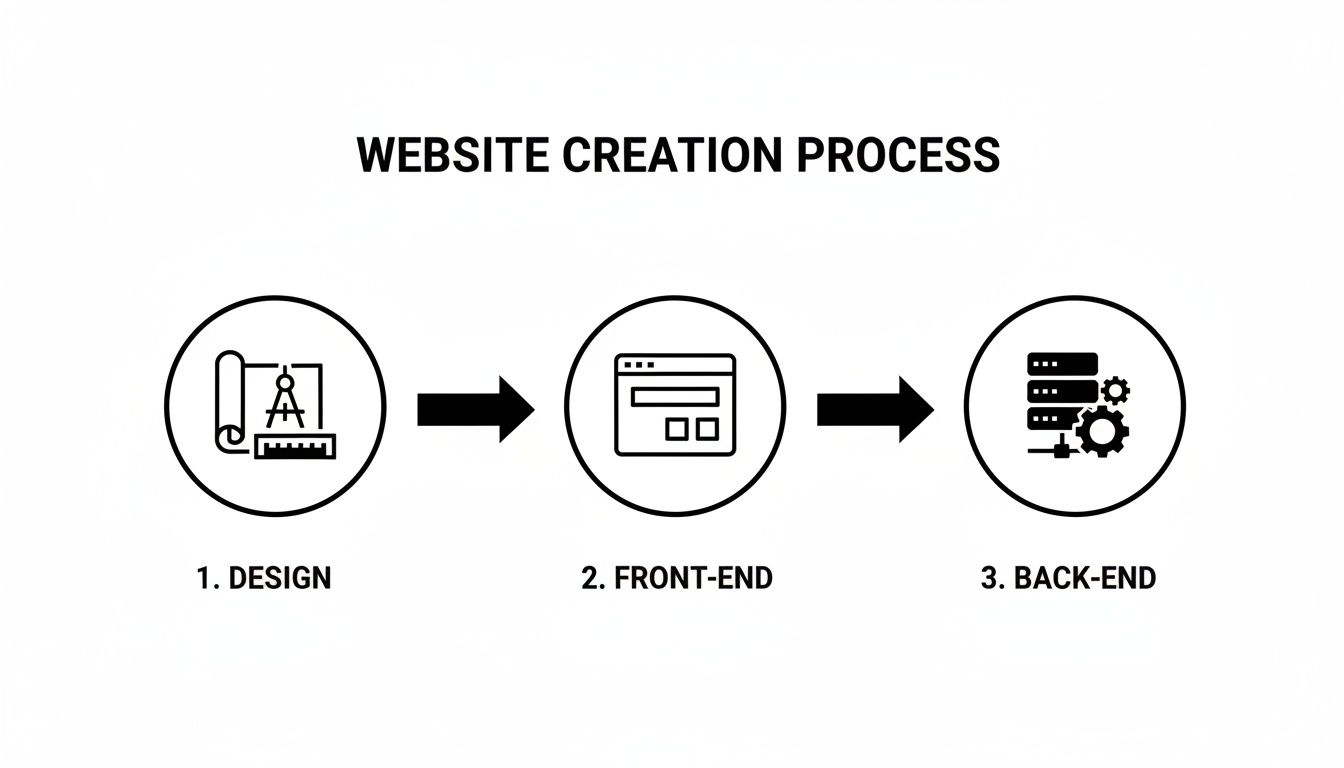
This graphic breaks it down nicely: the design blueprint flows into the front-end build (what you see), all of which is supported by the powerful back-end engine running in the background.
Stage 4: Testing and Quality Assurance (QA)
Before popping the champagne, the website has to go through some serious testing. This entire phase is dedicated to hunting down and squashing any bugs, errors, or glitches to ensure a flawless experience for your visitors on day one. A buggy launch can do real damage to your brand’s reputation, so this isn't a step to be rushed.
Our QA team will rigorously check for:
- Cross-Browser Compatibility: Does the site look and work perfectly on Chrome, Firefox, Safari, and Edge?
- Responsive Design: Does it adapt beautifully to every screen size, from a huge desktop monitor down to the smallest smartphone?
- Functionality: Do all the links, forms, buttons, and other interactive bits and pieces work exactly as they should?
- Performance: Is the site lightning-fast? Slow load times are a conversion killer.
Stage 5: Launch and Ongoing Maintenance
After all the hard work and thorough testing, it's finally time for the big reveal! Launching involves deploying the website to a live server, pointing your domain to it, and making it accessible to the world. But the job isn't done. For a deeper look at what a successful launch entails, have a look at our guide on e-commerce website designing.
Once your site is live, ongoing maintenance becomes critical. This includes regular backups, software updates, security monitoring, and performance checks to keep everything running smoothly and securely. Think of your website as a living asset; it needs continuous care to keep delivering value for your business.
Choosing the Right Technology for Your Website
Picking the technology that powers your website is a lot like choosing an engine for a new car. You wouldn't put a tiny hatchback engine in a massive delivery truck, right? The same logic applies here. Your tech stack is the foundation for your site's performance, security, and, most importantly, its ability to grow with your business.
This decision can feel a bit overwhelming with all the jargon flying around, but it really just boils down to your specific needs. Are you an eCommerce brand that needs to get to market yesterday, or a SaaS company that demands absolute control over the user experience?
Let's break down two of the most popular approaches so you can make a smart choice.
The explosion of internet use in South Africa has completely redrawn the map for website design and development, making mobile-first strategies non-negotiable. As of January 2024, a staggering 74.7% of the population is online—that's 45.34 million active users. Businesses simply have to build for mobile. This is especially true for property firms showcasing listings and eCommerce brands trying to capture sales on the go. You can discover more insights about South Africa's digital growth to get the full picture.
The All-In-One Powerhouse: Shopify
For most eCommerce businesses, Shopify is the go-to solution, and for good reason. Think of it as a fully integrated package deal. It gives you the storefront (front-end), the inventory management system (back-end), payment processing, and hosting—all under one roof.
This approach, often called a monolithic architecture, is incredibly efficient. It’s designed to get you up and running quickly with a powerful, secure, and reliable online store, without needing a team of developers to manage every little detail.
So, what are the real-world benefits?
- Speed to Market: You can launch a fully functional store in a fraction of the time it would take to build from scratch. We’re talking weeks, not months.
- Ease of Use: The admin panel is famously user-friendly. Managing products, tracking orders, and running sales becomes straightforward, even for non-technical folks.
- Robust App Ecosystem: Need extra functionality? There's a massive marketplace of apps that can be installed with just a few clicks to handle everything from loyalty programmes to advanced analytics.
Shopify is the perfect choice for most direct-to-consumer brands that want to focus on what they do best—marketing and selling products—not on managing complex technical infrastructure.
The best technology isn’t the most complicated one; it’s the one that most effectively removes obstacles between your business and its goals. For many online stores, that technology is Shopify.
The Ultimate Flexibility of Headless Architecture
Now, let's look at a completely different approach that’s gaining huge traction with ambitious SaaS and property companies: headless architecture.
Imagine separating your website into two distinct parts. The 'body' is the back-end system where all your content and data live—this is your Content Management System (CMS). The 'head' is the front-end, or the actual website your visitors see and interact with.
With a headless setup, you sever the connection between the two. This means your back-end CMS can deliver content to any front-end you want. You could have one CMS that powers your main website, a mobile app, and even digital screens in a physical store, all at the same time.
This gives you an incredible amount of freedom. Your developers can use modern, lightning-fast technologies like React or Vue.js to build a front-end that is completely customised to your brand and fine-tuned for pure speed. This level of control is ideal for businesses that need a truly unique user experience or have complex technical requirements.
Tech Stack Comparison: Shopify vs Headless CMS
To help you visualise the trade-offs, here’s a quick comparison of these two powerful approaches. Each has its place, and understanding the differences is key to making the right call for your business.
| Feature | Shopify (Monolithic) | Headless CMS | Best For |
|---|---|---|---|
| Speed to Launch | Very Fast (weeks) | Slower (months) | eCommerce brands needing to start selling quickly. |
| Flexibility | Good (within the Shopify ecosystem) | Total Freedom (any front-end technology) | SaaS and property businesses with unique user experience requirements. |
| Technical Skill | Low (easy for non-developers) | High (requires a skilled development team) | Businesses with in-house or agency development partners. |
| Performance | Excellent (optimised for eCommerce) | Potentially Faster (can be fine-tuned for pure speed) | Companies where milliseconds in load time directly impact conversions. |
Ultimately, the right choice comes down to your business goals, your budget, and your technical resources. Are you building a straightforward online store, or are you crafting a complex digital product? Answering that question is the first real step toward building on a foundation that will support your vision for years to come.
Designing for Conversions, Not Just Compliments
A beautiful website that doesn’t bring in leads or sales is little more than an expensive digital brochure. While getting compliments on your site’s look is nice, compliments don't pay the bills. The real purpose of smart website design and development is to turn casual visitors into paying customers.
This is where Conversion Rate Optimisation (CRO) comes into play. It’s the art and science of shaping an online experience that nudges people to take specific, valuable actions. CRO is all about getting inside your user’s head, understanding their behaviour, and using those insights to fine-tune your website’s design.
Essentially, it’s about making the right path the easiest and most obvious one for your visitors to follow.
Guiding the User’s Eye
The moment someone lands on your site, they start scanning. They’re looking for answers, and they’re looking for them fast. A good design creates a clear visual hierarchy, directing their eyes from the most important message right to the action you want them to take.
This isn’t about manipulation; it's about providing clarity. By strategically using size, colour, contrast, and empty space (often called "white space"), you can pull their focus towards your key value proposition, customer testimonials, and, crucially, your calls to action.
Think of it like this: your homepage is a room and you need your visitor to find the key. A cluttered, messy room turns the search into a frustrating treasure hunt. A well-designed room, however, places that key on a clean, well-lit table, making it impossible to miss.
Creating Calls to Action That Actually Work
A “call-to-action” (or CTA) is exactly what it sounds like—a button or link that tells the user what to do next. But getting people to click requires much more than just a brightly coloured button that says "Submit".
An effective CTA is the logical endpoint of a conversation you’ve been having with the user on that page. The words you use (the “copy”) must reflect the value they're about to receive. For instance, “Get Your Free Quote” is far more compelling and user-focused than a generic “Submit Form.”
The placement and design are just as critical. A strong CTA should:
- Be highly visible: It needs to stand out from everything else on the page.
- Use action-oriented language: Start with strong, clear verbs like “Get,” “Book,” or “Start.”
- Create a sense of urgency (when it makes sense): Phrases like “Shop the Sale Now” can encourage immediate action.
The difference between a website that looks good and one that performs well often boils down to the details. A 1% improvement in your conversion rate might not sound like much, but it can lead to a significant increase in revenue over time—without spending a single extra rand on advertising.
Building Trust Through Design
Before a visitor will part with their money or even just their email address, they need to trust you. Great design builds that trust subliminally. A professional, modern, and error-free site sends a powerful signal that you’re a legitimate and reliable business.
Beyond just looking good, you can actively build trust with specific design elements:
- Social Proof: Make your customer testimonials, reviews, case studies, and logos of well-known clients easy to see. This shows new visitors that others have already trusted you and had a positive experience.
- Transparency: Be completely upfront about pricing, shipping costs, and your contact information. Hiding important details makes users suspicious.
- Security Badges: Displaying trust seals from payment providers or security companies reassures users that their personal and financial information is safe with you.
To make sure your website isn't just visually appealing but is also driving the actions you need, it's vital to track your key metrics. Using a tool like a conversion rate calculator can help you measure the real-world impact of your design changes. You might be surprised how small tweaks can produce big results. To see more about how we put these ideas into practice, check out our insights on Conversion Rate Optimisation services.
Finding Your Web Team: Agency vs. In-House
One of the biggest calls you'll make when planning your new website is deciding who will actually build it. Do you hire your own team of designers and developers, or do you partner with a specialised agency? There’s no easy answer, but understanding the pros and cons of each path is critical to making a smart call for your business.
This decision goes way beyond just the cost. It’s about getting the right expertise on board, how quickly you can get things done, and what kind of support you’ll have in the long run. Let’s break down the two main options so you can figure out which one really fits your situation.
The Case for an In-House Team
Hiring your own team gives you total control and undivided attention. These are your people, living and breathing your brand every single day. They get absorbed into your company culture and build a deep, intuitive understanding of your products, customers, and business goals.
That kind of dedicated focus can be a massive plus. An in-house team is always there to handle urgent updates, run a quick A/B test, or start work on a new feature without the back-and-forth you sometimes get with an outside partner.
But, building that dream team comes with its own set of hurdles:
- High Costs, Now and Later: You're not just covering salaries. You've also got to factor in recruitment fees, benefits, ongoing training, and the pricey software and hardware they need to do their jobs properly.
- A Limited Toolbox: It's incredibly tough—and expensive—to find one or two people who are genuine experts in everything from UX design and front-end code to back-end security and conversion rate optimisation. More often than not, you end up with generalists when your project really needs a specialist.
- Slow to Get Going: Hiring takes time. If you need to ramp up fast for a big launch, you’re stuck moving at the speed of your recruitment process.
The Power of Partnering With an Agency
Working with a web design agency is like hiring an entire, pre-built expert team in one shot. You instantly get access to a whole crew of specialists—strategists, UX designers, UI designers, copywriters, front-end developers, and back-end engineers—all for a single project fee or retainer.
This approach gives you a huge injection of expertise and experience right from day one. A good agency has been there and done that; they’ve solved tricky problems for businesses just like yours and bring all those hard-won lessons to your project. This usually leads to a faster, smoother process and a much stronger final product.
An agency’s real value isn’t just in their technical skills; it’s in their strategic perspective. They bring an outside view that can challenge your assumptions, spot new opportunities, and make sure your website is built not just for today, but for where your business is going next.
A Checklist to Help You Decide
Still sitting on the fence? Run through these questions to get some clarity.
- What's my real budget? Be honest with yourself. Can you truly afford the R1.5m - R2.5m+ per year it takes to build a small, capable in-house web team in South Africa? Or does a project-based or retainer fee with an agency make more sense financially?
- How fast do I need to move? If you’re up against a tight deadline, an agency can hit the ground running almost immediately. Building an in-house team from scratch could easily take months.
- Do I need ongoing strategic guidance? If you just need someone to build a site and hand over the keys, an in-house team might do the job. But if you're looking for a partner to help with ongoing optimisation, CRO, and digital strategy, an agency is almost always better equipped. At Market With Boost, we act as a full-service growth partner, making sure your website works hand-in-hand with your bigger marketing goals.
- How complex is my project? For a simple brochure website, a small in-house team could be enough. For a complex eCommerce build with custom integrations, you’ll need the wide range of skills that only an agency can bring to the table.
Common Questions About Website Development
Even with a clear roadmap, diving into a website project can feel a bit daunting. It’s a big investment of both time and money, so it’s completely normal to have questions. To clear things up, we’ve put together answers to the queries we hear most often from business owners.
Think of this as your go-to guide for the practical side of building a website that actually performs.
How Long Does It Take to Build a Website?
This is the big one, and the honest answer is: it really depends on what you're building. A straightforward marketing site or a basic Shopify store using a quality theme can often be up and running in 4 to 8 weeks. These projects are usually simpler, with a well-defined scope from the get-go.
On the other hand, if you're looking at a completely custom website with unique features—think a headless build for a SaaS business or a complex eCommerce site with lots of integrations—it’s a different ball game. These bigger, more involved projects typically take 3 to 6 months, and sometimes longer. That timeline covers everything we've talked about: deep-dive strategy, bespoke design, development, thorough testing, and feedback loops.
The single best way to get an accurate timeline is to have a crystal-clear scope of work defined right from the start. A detailed plan prevents scope creep and keeps everyone aligned and on schedule.
How Much Should I Budget for a Professional Website?
Just like the timeline, website costs can swing wildly. A simple site built from a template might run you a few thousand dollars, while a large, custom-built web application could easily climb into the tens or even hundreds of thousands.
What drives the cost up? It usually boils down to a few key things:
- Custom Design: Creating a unique UI/UX from scratch is a much bigger job than customising an existing template.
- Feature Complexity: The more you add—like payment gateways, customer accounts, or integrations with third-party software—the more development time it takes.
- The Technology: A headless setup, for instance, requires more specialised (and often more expensive) development skills than an all-in-one platform like Shopify.
It helps to stop thinking of your website as a cost and start seeing it as an investment in your company’s growth engine. Focus on the value and return it will generate, and make sure you partner with someone who gives you a detailed, transparent proposal with no nasty surprises down the line.
Do I Need Website Maintenance After Launch?
Yes, absolutely. One of the most common—and costly—mistakes we see is thinking a website is "done" the moment it goes live. Launch day is just the beginning, not the end of the project.
Ongoing maintenance is critical for three main reasons: security, performance, and relevance. This means regularly updating software to patch security holes, running backups to protect your data, and keeping an eye on site speed to ensure visitors have a great experience. A neglected website quickly becomes slow, vulnerable to hackers, and looks dated, which ultimately reflects poorly on your brand and can actively hurt your business.
Ready to turn your website from a simple online presence into your hardest-working employee? The team at Market With Boost specialises in building and optimising websites that drive real, measurable results for eCommerce, SaaS, and property businesses. Book a discovery call with us today to explore how we can help you achieve your growth goals.

Written by
Chief Executive Officer
Chris heads the Boost Marketing team and is also CEO and CTO of Shopstar, with over ten years of digital marketing experience. Before these roles, Chris co-founded MADE Agency, a leading South African digital marketing agency, collaborating with renowned clients like BMW, Red Bull, and Pepsi. He has a deep understanding of eCommerce and a talent for identifying emerging trends.

Scale your performance with data-driven insights
Ready to apply these insights to your business? Hannah can walk you through how we'd approach your specific situation.
Hannah Merzbacher
Operations Manager
Continue reading
View all insights
E-commerce Website Development Your 2026 Business Guide
A complete guide to e-commerce website development for business owners. Learn to choose platforms, design for sales, and build a site that drives reve...
Website Development Cost: A 2026 South African Guide
Uncover the true website development cost in South Africa. Our 2026 guide breaks down pricing, hidden fees, and ROI for eCommerce, SaaS, and property ...
Website Development SEO: Build to Rank from Day One
Learn how to integrate website development SEO from day one. Our guide covers architecture, technical SEO, and CRO for sites that rank and convert....