10 High-Impact SaaS Marketing Strategies to Scale Your Growth in 2026

By Chris Edington
Trying to figure out SaaS marketing can feel like drinking from a firehose. Everyone’s got an opinion, a “growth hack,” or a magic bullet that promises the world. But real, lasting growth isn’t built on trendy tactics. It’s built on solid, proven strategies that match how real people discover, buy, and use software today.
Forget the generic advice. This is a no-fluff, actionable guide to 10 powerful SaaS marketing strategies that cover the whole journey—from getting the right eyes on your product to turning happy customers into your biggest fans. We’re digging deeper than surface-level tips to give you a playbook that actually works. Whether you’re a scrappy startup finding your footing or an established company looking to get more bang for your buck, you’ll find the right approach here.
We'll break down what each strategy is, why it works so well for SaaS companies, and how you can start using it today. For each of the ten strategies, we'll provide:
- Practical steps to get you moving right away.
- Key metrics (KPIs) so you know if what you’re doing is actually working.
- Real-world examples to show you these strategies in action.
- Guidance on which tactics are best for your company’s stage and budget.
Think of this not just as a list, but as your resource for building a reliable revenue engine. These are the levers you need to pull for real, scalable growth. Let’s dive in.
1. Product-Led Growth (PLG)
Product-Led Growth (PLG) is a go-to-market strategy where the product itself does most of the heavy lifting to acquire, convert, and keep customers. Instead of relying on a sales team to show people how great your product is, you let them experience it for themselves through a freemium plan, a free trial, or an interactive demo. This way, the product's quality and usefulness do the selling, making it super easy for people to get on board and start growing with you.
This model has been a game-changer for companies like Slack, whose free version lets teams jump in and start collaborating, spreading organically from there. Another great example is Calendly, which shows its value the second you use its simple scheduling tool. The whole idea is to get users to that "aha!" moment as fast as possible, where they solve a real problem within minutes of signing up. By proving its worth right away, the product builds trust and makes upgrading to a paid plan feel like a natural next step, not a sales pitch.
How to Implement PLG
- Find the "Aha!" Moment: Pinpoint the exact moment a user truly gets your product's value. Then, design your onboarding to get every new user to that point as quickly as possible—ideally within 5-10 minutes.
- Analyze How People Use Your Product: Use product analytics tools (like Mixpanel or Amplitude) to see what people are doing. Track key activation metrics, which features they’re using, and where they drop off. This data will show you where the friction is and how you can make things better.
- Build in Viral Loops: Add features that encourage users to share and collaborate. For example, a design tool could let a user share a project with someone who isn't a user yet. To comment, that person has to sign up, growing your user base naturally.
- Create Smart Upgrade Paths: Use in-app messages and timely prompts to nudge users toward premium features when they hit a limit or try to use something that’s part of a paid plan. This is way more effective than just sending a generic email.
2. Account-Based Marketing (ABM)
Account-Based Marketing (ABM) is a focused B2B strategy that flips the old marketing funnel upside down. Instead of casting a wide net and hoping to catch some leads, ABM treats individual, high-value accounts as their own little markets. It’s all about focusing your marketing and sales energy on a handpicked group of target companies, creating super-personalized campaigns to get the attention of key decision-makers and land those big deals.
This super-targeted approach is a must for SaaS companies going after enterprise clients. Think of Salesforce, which runs massive ABM campaigns to win over Fortune 500 companies. Then you have platforms like 6sense and Terminus that not only use ABM themselves but also sell the tech that helps other companies do it. The core idea is simple: deep personalization and teamwork between sales and marketing. Every touchpoint, from an ad to an email, should be perfectly tailored to the target account’s specific problems and goals.
How to Implement ABM
- Get Sales and Marketing on the Same Page: First things first, get both teams in a room to define your Ideal Customer Profile (ICP) and pick a small pilot list of 10-20 dream accounts. Everyone needs to agree on the goals, messaging, and who’s doing what.
- Use Intent Data: Tools that show you which of your target accounts are actively researching solutions like yours are gold. This data helps you prioritize who to reach out to and tailor your message based on what they're looking for right now.
- Create Personalised Campaigns: Ditch the generic content. Create things specifically for each account, like personalized landing pages, case studies that hit home, and ad creative that speaks directly to their pain points.
- Coordinate Across Multiple Channels: Reach out to decision-makers in a coordinated way across different channels. This could mean a mix of targeted display ads, LinkedIn messages, personalized emails, and maybe even some high-quality direct mail to make a memorable impression.
3. Content Marketing & SEO Authority Building
Content Marketing & SEO is one of the most reliable SaaS marketing strategies out there. It’s all about creating genuinely useful, educational stuff that naturally attracts and nurtures potential customers. Instead of interrupting people with ads, you draw them in by answering their questions and solving their problems with blog posts, guides, webinars, and case studies. By optimizing this content for search engines, you build long-term authority, bring in quality organic traffic, and become less reliant on paid ads over time.
Companies like Ahrefs have absolutely nailed this. Their blog on SEO is so thorough that it makes them an undeniable expert in the field. And then there's HubSpot, who practically wrote the book on inbound marketing. The goal is to become the go-to resource in your space. When a potential customer Googles a problem that your software solves, you want your content to be the first thing they find. That’s how you build trust long before they’re even thinking about buying.
How to Implement Content & SEO
- Target High-Intent Keywords: Use keyword research tools to find the search terms your ideal customers are actually typing into Google. Focus on keywords that show they’re aware of a problem or are actively looking for a solution like yours.
- Build Topic Clusters: Organize your content around core themes. Create a big, comprehensive "pillar page" on a broad topic (like "Customer Retention"), and then link out to smaller, more specific "cluster" articles (like "How to Calculate Churn Rate" or "Best Practices for Customer Onboarding").
- Optimize Every Page: Make sure every piece of content follows on-page SEO best practices. That means writing catchy title tags and meta descriptions, using clear headers (H1, H2, H3), and adding relevant internal links to guide both users and search engines through your site.
- Promote and Repurpose: Don't just hit "publish" and hope for the best. Share every new piece of content in your email newsletter, on social media, and in relevant online communities. Squeeze every drop of value out of your hard work by turning a single guide into a webinar, short video clips, or social media graphics.
4. Conversion Rate Optimisation (CRO) & Funnel Analysis
Conversion Rate Optimisation (CRO) is the science of getting a higher percentage of your website visitors to do what you want them to do, whether that's signing up for a trial or buying a subscription. Instead of just guessing what might work, CRO uses A/B testing, heatmaps, and user data to find and fix the friction points in your customer's journey. It’s a core discipline for any SaaS marketing strategy because it turns the traffic you already have into more revenue.
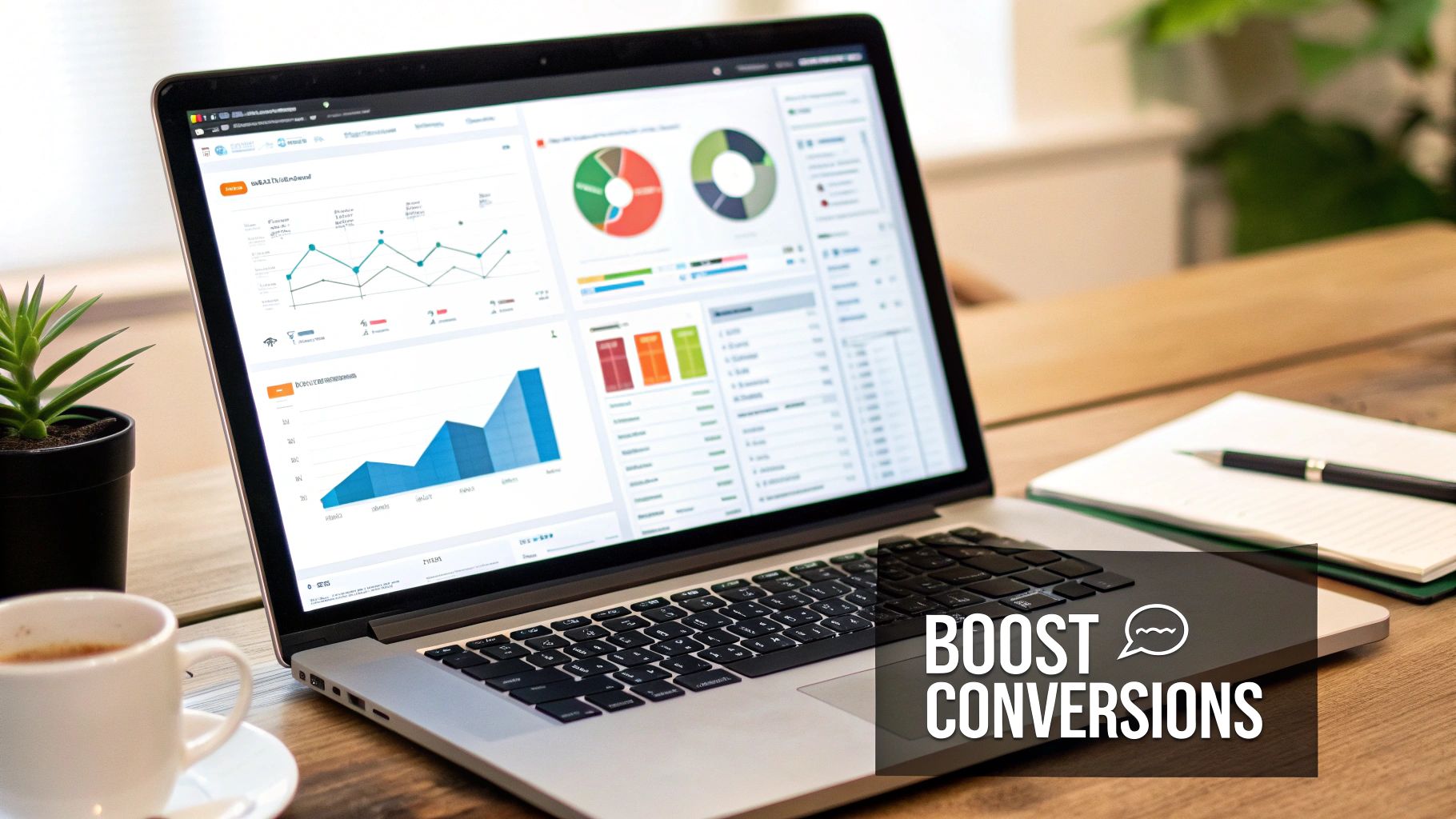
CRO is all about making smart, data-driven improvements, not just changing button colors for the fun of it. For example, ConvertKit increased its free trial sign-ups by 15% just by making their sign-up process more intuitive. Companies like Unbounce and Optimizely give businesses the tools to test everything from headlines to call-to-action buttons, making sure every part of a page is working as hard as it can. This cycle of continuous improvement is how you maximize the return on all your marketing efforts.
How to Implement CRO
- Start Where It Matters Most: Focus your first efforts on pages that get a lot of traffic (like your homepage or pricing page) or on steps in your funnel where the most people are dropping off. This way, your first tests have the best chance of making a real impact.
- Watch How People Behave: Use tools like heatmaps (Hotjar) and session recordings to see where users are actually clicking, scrolling, and getting stuck. This qualitative data gives you the "why" behind the numbers.
- Test One Thing at a Time: To know for sure what made a difference, only change one thing at a time. Test a headline, then a button color, then an image. This methodical approach helps you learn what really moves the needle.
- Make Your Value Prop Crystal Clear: Before you start fiddling with design, make sure your core message is impossible to misunderstand. Your headline and opening sentence should immediately tell visitors what your product does and who it's for. This is often the single biggest thing you can do to improve conversions. Part of this means keeping a close eye on your ads and knowing how to Fix Dead Ads to keep your campaigns running smoothly.
5. Paid Search & Retargeting (Google Ads, Bing, Lifecycle Marketing)
Paid search and retargeting are the one-two punch of SaaS marketing. Paid search on platforms like Google Ads and Bing puts your product right at the top of the search results when people are actively looking for a solution like yours. Then, retargeting follows up by showing targeted ads to people who’ve already visited your site, keeping your brand top-of-mind and gently guiding them back to finish what they started.
This powerful combo is used by pretty much every successful SaaS company. HubSpot bids on terms like "marketing automation" to catch people in the moment, and Asana targets project management keywords to drive trial sign-ups. Meanwhile, Amazon has perfected retargeting by reminding you of that thing you looked at last week. The goal is simple: capture people when they're most interested, then use smart follow-ups to nurture them from a curious visitor into a loyal customer.
How to Implement Paid Search & Retargeting
- Structure Your Campaigns Tightly: Organize your keywords into small, super-specific ad groups (5-20 keywords each). For example, have one group for "project management software" and another for "task collaboration tool." This lets you write ad copy that perfectly matches what the person is searching for.
- Master Negative Keywords: Keep a running list of keywords you don't want to show up for. This stops you from wasting money on irrelevant clicks. If you sell B2B software, you might add terms like "free," "jobs," or "course" to your negative list.
- Segment Your Retargeting Audiences: Put a tracking pixel on your website and create different audiences based on what people did. For example, you can create a segment for people who visited your pricing page but didn't sign up, or another for trial users who've gone quiet.
- Build Lifecycle Nurture Sequences: Create automated campaigns that are tailored to where the user is in their journey. Send onboarding tips to new trial users, show off advanced features to engaged users, and send special offers to win back people who have drifted away.
6. Social Media Advertising (Meta, TikTok, LinkedIn, Pinterest)
Social media advertising is a key part of any modern SaaS marketing plan. It lets you reach potential customers on platforms like Meta, TikTok, and LinkedIn with engaging ads and precise targeting. You can zero in on people based on their demographics, job titles, and online behavior to build awareness, generate quality leads, and drive sign-ups. It's all about cutting through the noise and delivering the right message to the right person, right in their feed.
This approach works wonders for SaaS giants. HubSpot uses LinkedIn to target marketing and sales professionals with content that’s hyper-relevant to their roles. Notion has built a massive community using TikTok and Instagram campaigns that show off creative ways to use their product, inspiring tons of people to try it out. The trick is to match the vibe of the platform with a message that solves a real problem, turning passive scrollers into active users.
How to Implement Social Media Advertising
- Start with Audience Research: Get clear on who your ideal customers are and build different audience segments. On LinkedIn, you can target by job title and company size. On Meta, you can create lookalike audiences based on your best existing customers.
- Create Platform-Specific Ads: Don't just run the same ad everywhere. Design vertical videos for TikTok and Reels, professional graphics for LinkedIn, and eye-catching square images or carousels for Instagram.
- Lead with Your Value Prop: You’ve got about three seconds to grab someone's attention. Make it count by highlighting a clear benefit. The best SaaS ads quickly answer the question, "How does this make my life or work easier?"
- Install Your Tracking Pixels: Make sure you have the Meta Pixel, LinkedIn Insight Tag, and TikTok Pixel set up on your website. This is non-negotiable for tracking conversions, optimizing your campaigns, and building powerful retargeting audiences.
- Test and Refresh Constantly: Run A/B tests on different ad creative, headlines, and audience segments. Swap out your ads every 2-4 weeks to avoid "ad fatigue," where people get tired of seeing the same thing and stop paying attention.
7. Email Marketing & Marketing Automation
Email marketing is still one of the most effective SaaS marketing strategies because it gives you a direct line to your users and delivers a huge return on investment. When you pair it with marketing automation, it becomes a powerful system for nurturing leads, onboarding new customers, and re-engaging people who’ve gone quiet. It allows you to send personalized, timely, and relevant messages at scale by using triggers based on user behavior.
ConvertKit is a master of this, using automated email sequences to guide creators from being free subscribers to becoming paying customers. Intercom is another great example, sending emails based on user behavior to encourage people to try new features or to nudge them back if they haven't logged in for a while. The goal is to create a personalized journey for every user, guiding them toward success with your product so your emails feel helpful, not annoying.
How to Implement Email Marketing & Automation
- Build Your List Organically: Offer valuable freebies like ebooks, webinars, or templates in exchange for an email address. Make sure every form on your site—from your blog subscription to your trial sign-up—adds people to your list (with their permission, of course).
- Segment Your Audience: Don’t just send the same email to everyone. Group your users by things like their lifecycle stage (trial user, new customer, power user), how they use your product, or how engaged they are. This lets you send super-relevant content.
- Create Trigger-Based Workflows: Set up automated campaigns that kick off based on specific user actions. Some must-have workflows include a welcome series for new subscribers, an onboarding sequence for trial users, and a re-engagement campaign for people who have become inactive.
- Personalise and Test Everything: Use merge tags to add the recipient's name or company to your subject lines and emails. Constantly A/B test your subject lines, calls-to-action (CTAs), and send times to see what gets the best open and click-through rates.
8. Community Building & User-Generated Content
Building a community is one of the most powerful things a SaaS company can do to create a loyal, engaged user base. It’s about creating a dedicated space—like a Slack group, Discord server, or forum—where your customers can connect, share tips, and help each other out. These spaces become goldmines for social proof, product feedback, and brand advocacy, all driven by user-generated content (UGC).
This strategy turns customers from passive users into active partners. A huge part of Notion's success comes from its vibrant community, where people create and share countless templates and tutorials, basically doing Notion's marketing for them. Figma's Community is another great example, allowing designers to share plugins and files, creating a powerful ecosystem that keeps users hooked and attracts new ones. When you build a community, you build a competitive advantage that’s incredibly hard for others to copy.
How to Implement Community Building & UGC
- Choose the Right Platform: Meet your users where they already are. If your audience is full of developers, Discord might be the right fit. If you're targeting business professionals, a Slack or Circle community would probably work better.
- Set Clear Guidelines: Right from the start, establish clear rules for how people should interact. A safe, respectful environment is key to getting people to participate openly.
- Kickstart It with Value: Give people a reason to join and stick around. Offer exclusive content, early access to new features, or direct access to your team.
- Amplify User-Generated Content: Actively feature and celebrate what your members create. Whether it’s a clever workflow, a helpful tutorial, or a success story, shining a spotlight on UGC encourages more of it and provides powerful social proof.
- Create Feedback Loops: Show your community that you're listening. Create dedicated channels for feedback and be transparent about how their input is shaping your product. This builds a massive amount of trust and loyalty.
9. Influencer & Partnership Marketing
Influencer and partnership marketing is all about tapping into the trust and reach of other established voices to promote your SaaS product. Instead of shouting into the void, you team up with industry experts, complementary software companies, or content creators whose followers are a perfect match for your ideal customer. It’s like getting a warm introduction from a trusted friend.
Zapier is a master of this, having built a massive ecosystem of over 8,000 integration partners. Each integration makes their product more valuable and brings in new users. Similarly, HubSpot has a huge network of certified agency partners that is a core part of how they get new customers. The goal is to create win-win relationships where both sides get value, whether that's through co-branded content, referral fees, or just making your products work better together for your shared customers. It's one of the best SaaS marketing strategies for building brand authority and driving high-quality leads.
How to Implement Influencer & Partnership Marketing
- Find the Right Partners: Look for non-competing companies or influencers who serve the exact same audience you do. Your ideal partner’s audience should overlap with yours by at least 60% to make sure any joint effort is super relevant.
- Figure Out the "What's in It for Them": A good partnership is a two-way street. Be clear about what your partner gets out of it, whether that's a cut of the revenue, exposure to your audience, or a more valuable product for their own customers.
- Create Valuable Content Together: Pool your resources to create something awesome that you couldn't easily do alone. Joint webinars, in-depth research reports, or comprehensive guides are great ways to share costs and cross-promote to both of your audiences.
- Set Up a Formal Affiliate Program: To scale your influencer and referral relationships, create a formal affiliate program with a clear commission structure. Use tools like PartnerStack or FirstPromoter to handle the tracking, payouts, and communication with your partners.
10. Data Analytics, Attribution, & Performance Measurement
The best SaaS marketing strategies are built on data, not hunches. This means tracking, analyzing, and understanding what your users are doing across their entire journey. It helps you see which channels are actually bringing in valuable customers, how people are engaging with your product, and which touchpoints matter most. By looking past vanity metrics, you can make smart decisions that get you more bang for your marketing buck and fuel real growth.
This data-first mindset is the backbone of pretty much every successful SaaS company. Tools like Google Analytics 4 and Mixpanel let you map out user funnels, while platforms like Amplitude give you deep insights into product usage and customer behavior. The goal is to connect your marketing efforts directly to business outcomes like revenue, customer lifetime value (LTV), and churn. When you know your numbers, you can confidently invest in the channels that actually deliver a solid return.
How to Implement Data-Driven Measurement
- Create a Single Source of Truth: Pull all your data—from your ads, CRM, and product analytics—into one unified dashboard using a tool like Tableau or PowerBI. This breaks down data silos and gives you the full picture of what’s going on.
- Track Key Funnel Conversions: Set up event tracking for every important action a user can take, from signing up for a trial and inviting a teammate to upgrading their plan. This helps you spot where people are dropping off so you can fix it.
- Analyze Customer Cohorts: Group your users by when they signed up or where they came from. This lets you compare their long-term value and behavior, revealing which sources bring in your most loyal and profitable customers.
- Adopt Sophisticated Attribution: Don't just give all the credit to the last thing a customer clicked. To really understand what's working and boost your ROI, implementing AI-Powered Multi Touch Attribution is key to giving proper credit to every touchpoint in the customer's journey.
SaaS Marketing: 10-Strategy Comparison
| Strategy | Implementation Complexity 🔄 | Resource Requirements ⚡ | Expected Outcomes 📊⭐ | Ideal Use Cases 💡 | Key Advantages ⭐ |
|---|---|---|---|---|---|
| Product-Led Growth (PLG) | High 🔄🔄🔄 — product & UX heavy | High — product dev, analytics; ⚡ slower ramp | Strong organic adoption & expansion; 📊 ⭐⭐⭐⭐ | Self-serve SaaS, freemium, SMB growth | Low CAC, scalable, product-driven validation |
| Account-Based Marketing (ABM) | High 🔄🔄🔄 — bespoke campaigns | High — sales+marketing coordination; ⚡ moderate speed to close | Large ACV deals, higher close rates; 📊 ⭐⭐⭐⭐ | Enterprise B2B, high-value target accounts | High ROI per account, tight S&M alignment |
| Content Marketing & SEO Authority | Medium 🔄🔄 — ongoing editorial process | Medium — content creators, SEO tooling; ⚡ slow to mature | Sustainable organic traffic & leads; 📊 ⭐⭐⭐ | Thought leadership, top-of-funnel, long sales cycles | Lower CPL long-term, builds credibility & authority |
| Conversion Rate Optimization (CRO) & Funnel Analysis | Medium 🔄🔄 — iterative experimentation | Medium — analytics, testing tools; ⚡ quick uplifts after tests | Significant conversion uplift potential; 📊 ⭐⭐⭐⭐ | Sites with volume, paid campaigns needing efficiency | High ROI, improves value of existing traffic |
| Paid Search & Retargeting | Medium 🔄🔄 — campaign ops & bidding | High — ad spend + management; ⚡ fast lead generation | Immediate high-intent leads; measurable CPA; 📊 ⭐⭐⭐ | Demand capture, trial sign-ups, short funnels | Scalable, highly measurable, quick to optimize |
| Social Media Advertising | Medium 🔄🔄 — creative & audience testing | Medium — creative production + ad budget; ⚡ fast awareness/testing | Strong awareness & engagement; variable conversion; 📊 ⭐⭐⭐ | Brand building, demand gen, creative-led products | Massive reach, creative flexibility, audience targeting |
| Email Marketing & Marketing Automation | Low-Medium 🔄 — workflow setup & segmentation | Low-Medium — platform + content; ⚡ moderate cadence | High ROI and improved retention; 📊 ⭐⭐⭐⭐ | Nurture, onboarding, churn reduction, cross-sell | Direct engagement, personalized journeys, scalable |
| Community Building & UGC | High 🔄🔄🔄 — moderation & engagement required | Medium — community managers, events; ⚡ slow growth | Strong retention, referrals, social proof long-term; 📊 ⭐⭐⭐ | Niche products, creator tools, retention-focused brands | Organic referrals, product feedback, loyal base |
| Influencer & Partnership Marketing | Medium 🔄🔄 — relationship management | Medium — BD, co-marketing spend; ⚡ variable timing | Access to warm audiences; credibility transfer; 📊 ⭐⭐⭐ | Complementary SaaS, co-marketing, affiliate programs | Third-party validation, extended reach, cost-effective |
| Data Analytics, Attribution & Performance Measurement | High 🔄🔄🔄 — data engineering & modeling | High — infrastructure, analysts, tools; ⚡ faster optimization once built | Clear ROI, informed budget allocation; 📊 ⭐⭐⭐⭐ | Multi-channel programs, scaling, executive reporting | Data-driven decisions, LTV/CAC insights, attribution clarity |
Putting It All Together: From Strategy to Sustainable Growth
So, we've covered a lot of ground, from the customer-first pull of Product-Led Growth and the laser-focus of Account-Based Marketing to the steady power of Content and SEO. Each strategy here—CRO, paid ads, community, you name it—is a powerful tool for growth. But the real magic in scaling a SaaS business isn't about mastering one tactic. It's about getting all of them to work together in a smart, integrated marketing engine.
The best software companies don't just "do marketing"; they build a system where everything feeds into everything else. Your great content doesn't just sit on a blog; it boosts your SEO, gives you ammo for your social media ads, and educates the leads you're nurturing through email. The insights you get from analyzing your funnel don't just make your website better; they help you write better ad copy, improve your product onboarding, and guide your customer success team. When all these pieces connect, you stop just doing activities and start building a real growth machine.
Key Takeaways for Your Go-to-Market Plan
Let's boil it all down to the most important, actionable takeaways. These are the principles that should guide you as you go from reading this article to making real changes in your business.
- Start with Your Customer, Always: Every single strategy lives or dies by how well you know your Ideal Customer Profile (ICP). Before you spend a dime on ads or write a line of code, make sure you know exactly who you're building for and what they actually care about.
- Embrace the Flywheel Model: The old-school linear funnel is dead. Today, growth is a flywheel where getting, activating, and keeping customers all feed into each other. A happy customer you got through a free trial becomes a huge advocate, bringing in referrals and creating content that helps you get even more customers.
- Data Is Your Compass: Gut feelings are great, but lasting growth is built on data. Having solid analytics and clear attribution isn't a "nice-to-have"—it's the only way to know what's working, what's not, and where to put your money for the best return. Don't just collect data; use it to ask better questions and make smarter moves.
Your Actionable Next Steps
Feeling fired up but maybe a little overwhelmed? Totally normal. The key is not to try to do everything at once. Instead, take it one step at a time.
- Audit and Prioritise: Take an honest look at what you're doing now and compare it to the strategies we've talked about. Where are your biggest gaps and your best opportunities? If people aren't sticking around after signing up, focusing on CRO is a much better idea than launching a new paid channel.
- Master One Channel, Then Expand: Pick one or two strategies that make the most sense for your ideal customer and where your business is right now. If you're an early-stage startup with a great product, maybe PLG and content marketing are your best bet. Go all-in on those first before you start adding more complicated things like paid ads or influencer marketing.
- Create a Culture of Experimentation: The best SaaS marketing strategies aren't set in stone; they evolve. Build a team culture where testing is encouraged, failure is seen as a learning opportunity, and decisions are based on the results of controlled experiments. This cycle of hypothesizing, testing, measuring, and optimizing is what powers all high-growth companies.
At the end of the day, building a great marketing engine is a journey of constant improvement. The strategies here are your map, but your unique product, market, and customers will determine the exact path you take. By staying agile, obsessed with your customers, and guided by data, you can move beyond just doing tactics and start building a real, long-term advantage.
Ready to transform these strategies into a measurable, high-performance growth engine? At Market With Boost, we specialize in helping software and SaaS companies build exactly that. We combine data-driven CRO with expert media buying to fix funnel leaks, optimise your ad spend, and scale what works. Let's connect and uncover your biggest growth opportunities today.

Written by
Chief Executive Officer
Chris heads the Boost Marketing team and is also CEO and CTO of Shopstar, with over ten years of digital marketing experience. Before these roles, Chris co-founded MADE Agency, a leading South African digital marketing agency, collaborating with renowned clients like BMW, Red Bull, and Pepsi. He has a deep understanding of eCommerce and a talent for identifying emerging trends.

Scale your performance with data-driven insights
Ready to apply these insights to your business? Hannah can walk you through how we'd approach your specific situation.
Hannah Merzbacher
Operations Manager
Continue reading
View all insights
B2B SaaS Marketing Strategies: 10 Plays for 2026
Discover 10 actionable B2B SaaS marketing strategies for 2026. This guide covers ABM, PLG, content, and paid channels to help you drive sustainable gr...
A Practical Guide to Marketing for SaaS Growth
Unlock scalable growth with our guide to marketing for SaaS. Master acquisition, conversion, and retention to build a thriving software business....
10 SaaS Lead Generation Strategies for 2026
Discover 10 actionable SaaS lead generation strategies for 2026. Drive growth with paid, organic, and product-led tactics proven to get results....