A Practical Guide to Marketing for SaaS Growth

By Chris Edington
Marketing a SaaS product isn't about chasing one-off sales. It’s about playing the long game, building real relationships, and proving your worth over and over again. In this world, success isn't just about the initial purchase—it's about keeping customers happy and engaged for the long haul. Metrics like monthly recurring revenue (MRR) and customer lifetime value (LTV) become your guiding stars, steering your entire strategy toward growth that lasts.
Why SaaS Marketing Is a Completely Different Game
If you're used to selling physical products or one-time services, jumping into SaaS marketing can feel like learning a new sport with a totally different rulebook. It can be a bit of a shock to the system. You’re not just selling a piece of software; you're selling a subscription, a promise of ongoing value, and a partnership.
This one difference changes absolutely everything. Traditional marketing usually builds up to the moment of purchase—that’s the finish line. For a SaaS business, the purchase is just the starting pistol. Your focus has to stretch way beyond that first conversion, deep into user onboarding, daily engagement, and long-term happiness.
The Subscription Model Changes Everything
At its heart, the SaaS model is built on subscriptions, which means your revenue is never a sure thing. A customer can walk away at any time, making retention just as important—if not more so—than acquisition. This reality forces a major shift in how you think about marketing.
Let's break down the key differences between the old and new playbooks.
SaaS Marketing vs Traditional Product Marketing
| Aspect | Traditional Marketing | SaaS Marketing |
|---|---|---|
| Primary Goal | Drive a one-time purchase. | Nurture a long-term subscription. |
| Customer Relationship | Transactional, often ends at the sale. | Ongoing, focused on continuous value. |
| Key Metrics | Sales volume, one-time revenue. | MRR, LTV, churn rate, user engagement. |
| Marketing Focus | Pre-purchase awareness and conversion. | The entire customer journey, from first click to happy advocate. |
As you can see, the SaaS model flips traditional marketing on its head.
- From Transaction to Relationship: You're not just closing a deal; you're starting a partnership. Your marketing needs to build trust from day one and clearly show the value customers will get month after month.
- From Short-Term to Long-Term: A single month's subscription fee is just one small piece of the puzzle. The real prize is maximizing Customer Lifetime Value (LTV), and that only happens by keeping users happy and deeply engaged for months, or even years.
- From Product Features to Customer Outcomes: People don't buy drills; they buy holes in the wall. While your features are important, great SaaS marketing sells solutions and real-world results. How does your software make your customer's life easier or their business more profitable? Answering that question is everything. If you're looking to go deeper, check out this excellent a founder's guide to digital marketing for startups.
This unique model is fueling some incredible growth, especially in emerging markets. The African SaaS market, for example, was valued at $3.5 billion in 2023 and is projected to hit $10 billion by 2030. This just goes to show the massive opportunity out there for companies that can really get this new marketing playbook right.
The core of SaaS marketing is a simple but powerful idea: your success is directly tied to your customer's success. When they grow and thrive using your product, they stick around, creating a steady and predictable revenue stream.
This is exactly why you need a specialized approach. The strategies that work for selling physical goods will almost certainly fall flat here. You can learn more about building a winning plan in our detailed insights on SaaS marketing. Understanding these fundamental differences isn't just theory—it's the first and most important step toward building a marketing engine that doesn't just attract new users but turns them into raving fans.
Building Your Customer Acquisition Engine
Getting customers for your SaaS product isn't about throwing a few campaigns at the wall and hoping something sticks. It’s about building a reliable, predictable engine that consistently brings in the right kind of users. Think of it less like fishing with a single line and more like designing a smart irrigation system that nourishes your whole business for the long haul.
A solid acquisition strategy stands on three core pillars: paid channels, organic growth, and strategic partnerships. When you mix these three together, you create a balanced, multi-channel approach that doesn't just pull in website visitors, but attracts the right visitors—the ones who are most likely to sign up, stick around, and become your biggest fans.
This concept map really brings home how SaaS marketing is a different beast entirely from traditional, one-off sales. It's all about building trust and fostering long-term relationships.
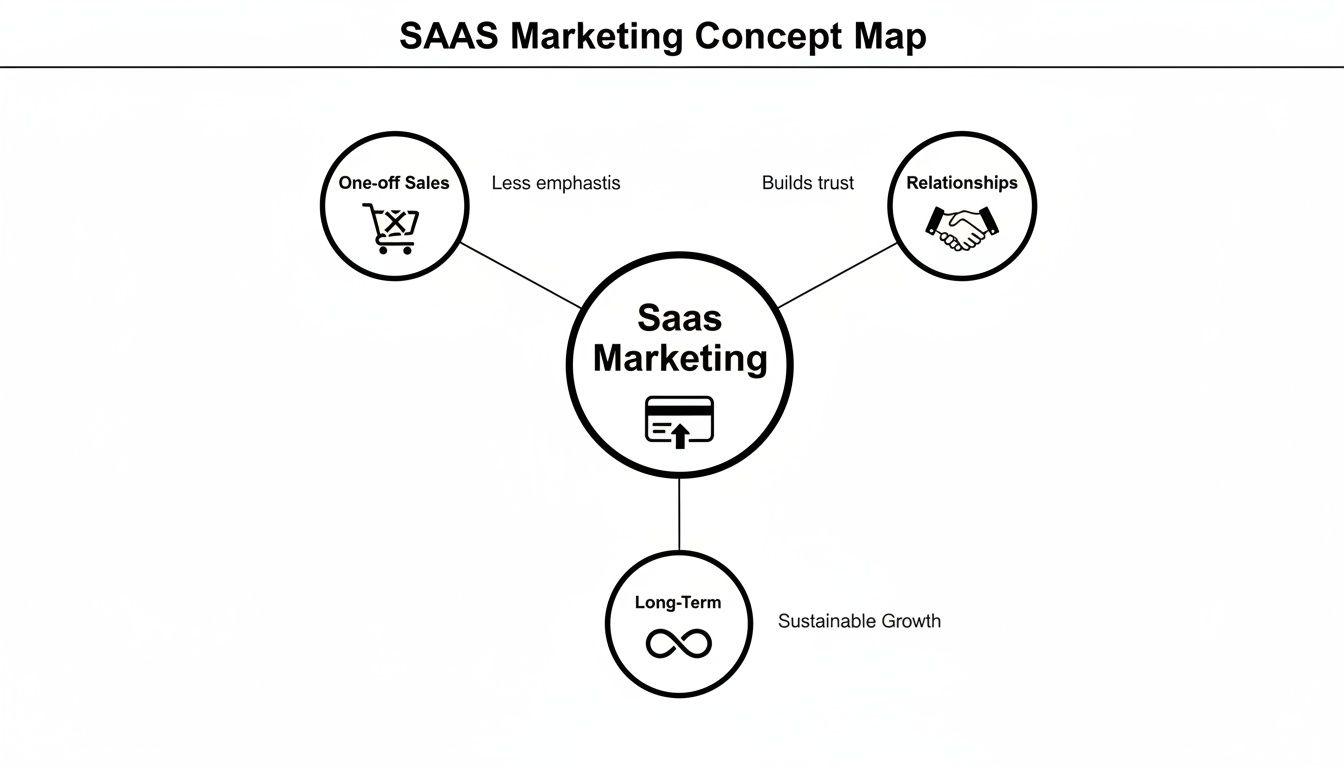
This visual is a great reminder that every acquisition effort needs to feed into a model that puts lifetime value way ahead of a quick, transactional win.
Paid Acquisition Channels
Paid media is almost always the fastest way to get your product in front of a super-targeted audience. But it's so much more than just 'running ads'. It's about crafting data-driven campaigns on the platforms where your ideal customers actually hang out.
The key here is to look past vanity metrics like clicks and impressions. Successful SaaS marketing zeroes in on the numbers that directly affect revenue, like your Cost Per Acquisition (CPA) and the all-important LTV:CAC ratio.
Here are the heavy hitters in the SaaS world:
- Google Ads: This is your go-to for catching high-intent users who are actively searching for a solution. Think search campaigns that are laser-focused on the exact keywords your customers are typing into Google.
- Meta (Facebook & Instagram): Fantastic for building brand awareness and reaching specific audiences based on their demographics, interests, and online behavior, even when they aren't actively looking for you.
- LinkedIn Ads: For B2B SaaS, LinkedIn is simply unbeatable. You can target professionals by their job title, company size, industry, and seniority, making it incredibly precise for getting in front of key decision-makers.
The South African Online Advertising and Marketing SaaS market is currently valued at a whopping USD 1.5 billion. This number is fueled by the huge strategic shift from traditional advertising to digital platforms. For agencies working with SaaS companies, this just goes to show how expertly managed paid media across platforms like Meta, Google, and LinkedIn can deliver powerful, measurable results.
The Power of Organic Growth
While paid channels give you speed, organic growth builds a long-term, sustainable asset for your business. This is where content and Search Engine Optimization (SEO) really shine. It’s a slower burn, no doubt, but the payoff is huge.
Think of it this way: paid ads are like renting a billboard on a busy highway. The moment you stop paying, your billboard comes down. Organic traffic from SEO, on the other hand, is like owning the land that the highway is built on—it keeps delivering value long after your initial investment.
The goal of content marketing isn't just to rank for keywords. It's to become the most trusted and helpful resource for your target audience, building authority and attracting high-intent traffic for years to come.
Your organic strategy should be built around these three activities:
- Solving Problems: Create genuinely helpful, high-quality blog posts, guides, and resources that answer the burning questions your ideal customers have.
- Building Topical Authority: Don't just publish random, one-off articles. Build out clusters of content around your core topics. This tells Google you're a true expert in your niche.
- Technical SEO: Make sure your site is fast, mobile-friendly, and easy for search engines to crawl and index. A technically sound website is the foundation your entire SEO strategy is built on.
To really get ahead, you need the right tools in your corner. Understanding the best SaaS SEO tools can give you a massive advantage in beefing up your organic presence.
Unlocking Growth with Strategic Partnerships
Finally, never underestimate the power of a good partnership. This channel lets you tap into established, relevant audiences without the high cost of paid media. It’s all about finding non-competing businesses that serve the same customer base and creating genuine win-win collaborations.
A few effective partnership models to consider:
- Affiliate Programs: Offer a commission to partners who refer new, paying customers to your product.
- Integration Partnerships: Team up with complementary software products to offer a more complete, integrated solution for your shared customers.
- Co-marketing: Work together on webinars, ebooks, or research reports to cross-promote to each other's audiences and share the leads.
By weaving together paid, organic, and partnership strategies, you move away from a scattergun approach. You start building a robust, predictable customer acquisition engine—the true foundation of sustainable marketing for any SaaS company.
Turning Clicks Into Happy Customers

Getting traffic to your website feels great, but it’s only half the battle. If your landing pages are confusing, your sign-up form is a pain, and your onboarding feels like a maze, you're just pouring expensive traffic into a leaky bucket.
This is where Conversion Rate Optimization (CRO) becomes your secret weapon in SaaS marketing.
CRO is the art and science of turning a curious visitor into an active, engaged user. It’s all about carefully analyzing their journey, from the moment they land on your page to the second they experience that first spark of value inside your product—the famous "aha!" moment.
Crafting High-Converting Landing Pages
Think of your landing page as your digital handshake. It’s the first real conversation a potential customer has with your brand, and it needs to be crystal clear, compelling, and laser-focused on one single goal, whether that’s starting a free trial or booking a demo.
The best SaaS landing pages don't just list features; they speak directly to the visitor's pain points. They show you get their world and immediately answer the biggest question on their mind: "How will this make my life better?"
To build a page that actually converts, you need to nail these core elements:
- A Killer Headline: Your headline has to grab attention and instantly communicate your value. Make it about the outcome, not just the product.
- Compelling Copy: Use simple, direct language that sounds like your customers talk. Focus on the benefits of your solution, not the technical jargon.
- A Clear Call-to-Action (CTA): Your CTA button should be impossible to miss. Use action-packed text like "Start My Free Trial" or "Get Your Demo" instead of boring words like "Submit."
- Social Proof: Nothing builds trust faster. Add testimonials, case studies, or logos of well-known clients to show that people just like them are already winning with your product.
Optimizing the Signup and Onboarding Flow
The moment a user clicks that CTA, the race to deliver value is on. The signup process needs to be as smooth as possible. Every extra field you ask them to fill in is another chance for them to give up and leave. Stick to the absolute must-haves.
The goal of onboarding isn't to show users every single feature. It's to guide them to their first quick win as effortlessly as possible. This 'aha!' moment is what turns a curious trial user into a future paying customer.
A smooth onboarding experience is what separates products that stick from those that don't. It should feel less like a dense instruction manual and more like having a helpful guide by your side. Use things like tooltips, checklists, and short video tutorials to point new users toward the core actions that prove your product's value.
For a much deeper dive into this, you can learn more about how conversion rate optimisation services can help plug the leaks in your funnel.
Finding and Fixing Friction Points
So, how do you find the leaks in your bucket? With data. Tools like heatmaps, session recordings, and user surveys are absolute gold for spotting exactly where users get stuck or confused. They give you a real, over-the-shoulder look at how people are interacting with your site.
For example, a heatmap from a tool like Hotjar can show you precisely where users are clicking on a webpage.
Insights like these are priceless. You might discover that users are constantly clicking a non-clickable element or bailing on a form at one specific field. Suddenly, you have a clear starting point for your next test.
By systematically finding these friction points and continuously testing improvements—whether it’s changing button copy, redesigning a form, or simplifying an onboarding step—you can dramatically boost your activation rate. This is how you make sure the hard work and budget you put into acquisition actually translates into happy, active, and paying customers.
How to Keep Customers and Grow Revenue

In the world of SaaS, getting the initial sale isn't the finish line; it’s the starting block. Real, sustainable growth doesn't come from a constantly spinning door of new users. It's built by keeping the customers you’ve worked so hard to get happy, engaged, and steadily getting more value from your product over time.
This is the less glamorous but far more profitable side of marketing for saas. It’s where you turn a one-time conversion into a lasting relationship and predictable recurring revenue. Forget the leaky bucket analogy; we're building a reservoir.
Practical Retention Tactics That Actually Work
Customer retention is an active process, not a passive hope. It starts by recognizing that users will leave for two main reasons: they aren't getting the value they expected, or they feel like you just don’t care about their success. Your job is to tackle both of these head-on.
Great retention isn't about grand, expensive gestures. It's about consistent, helpful actions that build trust and make your product an essential part of your customer's workflow.
Here are a few strategies that make a real difference:
- Proactive Customer Support: Don't just sit back and wait for customers to run into trouble. Use your own data to spot users who might be struggling—maybe their usage has dipped, or they haven't adopted a key feature. A simple, personalized email checking in can work wonders.
- Building a Community: Give your users a place to connect with each other, like a Slack channel or a dedicated forum. This creates a sense of belonging and turns your most passionate users into volunteer support agents and powerful advocates.
- Consistent Communication: Keep users in the loop with regular updates, tips, and success stories. A well-crafted newsletter that actually teaches them how to get more out of your tool reinforces its value long after they first signed up.
Retention is the new acquisition. The most successful SaaS companies understand that their existing customer base is their single greatest asset for growth. It’s far cheaper to keep a happy customer than to find a new one.
According to industry benchmarks, a typical B2B SaaS company with $3-5 million in ARR spends about 7% of its revenue on customer support and success. This isn't a cost; it's an investment that pays for itself many times over by slashing churn and building a loyal user base.
Monetization That Feels Helpful, Not Pushy
Once you've got a handle on retention, the next step is to grow revenue from your happy customers. This isn't about squeezing every last cent out of them. It's about aligning your monetization strategy with their success. When they grow, you grow.
This is where thoughtful upsell and cross-sell strategies come into play. The key is to make these offers feel like a natural next step in their journey, not an aggressive sales pitch.
Spotting Expansion Opportunities
The best time to offer an upgrade is when a customer is clearly hitting the limits of their current plan. You can spot these moments by digging into user behavior and product data.
Look for these clear signals:
- Approaching Usage Limits: Does your pricing have tiers based on contacts, projects, or data storage? Set up automated alerts to notify users (and your team) when they're getting close. Frame the upgrade as a helpful way to avoid service interruptions.
- Using Advanced Features (or Trying to): If a user on a basic plan keeps clicking on a feature that's only available in a higher tier, that’s a golden opportunity. A simple in-app message can say, "Looks like you're trying to [achieve outcome]. Unlock this feature with our Pro plan."
- Company Growth: Is your customer hiring more people who need access to your tool? This is a natural trigger for moving to a plan with more user seats.
By timing your offers based on real behavior, the upsell feels like you’re helping them solve a new problem. You’re not just selling; you’re guiding them to the next level of value. This approach builds goodwill and turns your pricing into a clear roadmap for your customers' growth.
The SaaS Marketing Metrics That Actually Matter
Feeling lost in a sea of acronyms? It's a common feeling. SaaS marketing is swimming in data, and it’s easy to get fixated on vanity metrics that don't really move the needle. The truth is, a handful of key numbers tell the real story of your company's health and direction.
Think of these metrics as the vital signs for your business. They’re not just numbers on a dashboard; they’re connected signals that tell you where your strategy is working, where you’re bleeding cash, and what your next best move should be. Mastering them is essential for building a scalable SaaS company.
The Foundational Metrics for Growth
Before you dive into complex channel optimization, you have to get the basics right. It all boils down to a simple, crucial relationship: how much does it cost to get a customer, and how much is that customer worth to you over time?
- Customer Acquisition Cost (CAC): This is your total sales and marketing spend—think ad budgets, salaries, tool subscriptions—divided by the number of new customers you landed in that same period. It's the price tag for winning a new user.
- Customer Lifetime Value (LTV): This is the total revenue you can reasonably expect from a single customer throughout their entire journey with you. It’s not just about the first month's payment; it’s about the long-term value they bring.
The real magic happens when you put these two against each other. The LTV to CAC ratio is arguably the single most important indicator of a sustainable business model.
A healthy SaaS business should aim for an LTV to CAC ratio of 3:1 or higher. If you’re spending R1 to acquire a customer, you should be getting at least R3 back over their lifetime. Anything less, and you might be on a treadmill to nowhere.
Monitoring the Health of Your Subscription Model
Getting customers in the door is only half the battle. The subscription model's power lies in retention and recurring revenue. Two key metrics tell you exactly how well you're holding onto your customers and growing that predictable income stream.
- Churn Rate: This is the percentage of customers who cancel their subscriptions in a given period (usually monthly or annually). It's a direct reflection of customer satisfaction and how essential your product is to their workflow.
- Monthly Recurring Revenue (MRR): This is the predictable revenue your business earns every month. Tracking MRR growth isn't just about new sign-ups; it also accounts for customers upgrading (expansion MRR) and those who downgrade or cancel (churned MRR).
When you understand these core metrics—CAC, LTV, Churn, and MRR—you stop guessing and start strategizing. You gain the clarity needed to make sharp, data-backed decisions on where to invest your marketing budget and how to build a business that lasts.
To help you get a firm grip on these concepts, here’s a quick-reference table breaking down the essentials.
Essential SaaS Marketing Metrics Explained
| Metric (Acronym) | What It Measures | Why It Matters |
|---|---|---|
| Customer Acquisition Cost (CAC) | The total cost to acquire one new paying customer. | Tells you if your marketing and sales efforts are efficient. If CAC is too high, you're not profitable. |
| Customer Lifetime Value (LTV) | The total revenue a business can expect from a single customer. | Shows the long-term value of a customer, helping to justify acquisition spend and focus on retention. |
| LTV to CAC Ratio | The relationship between a customer's lifetime value and their acquisition cost. | The ultimate health check for your business model. A ratio below 3:1 signals potential trouble. |
| Monthly Recurring Revenue (MRR) | The predictable, recurring revenue you can expect on a monthly basis. | The lifeblood of a SaaS business. It provides a clear view of financial stability and growth momentum. |
| Churn Rate | The percentage of customers who cancel their subscription in a given period. | A direct measure of customer satisfaction and product stickiness. High churn can silently kill growth. |
Keeping these five metrics on your main dashboard gives you a powerful command center. They cut through the noise, allowing you to focus on the activities that drive real, sustainable growth for your SaaS business.
Simple Go-To-Market Playbooks for SaaS
A great idea is the spark, but a solid plan is the fuel that actually drives growth. A go-to-market (GTM) strategy is exactly that: your roadmap for launching a product or breaking into a new market. It clearly lays out who you’re selling to, how you’re going to reach them, and what it will take to win them over.
Think of it like a playbook for a sports team. You wouldn't send your players onto the field without a clear game plan, and you shouldn’t launch a major initiative without a GTM strategy. It gets your whole company—from marketing and sales to product and support—rowing in the same direction, all focused on a single goal.
Playbook One: Launching a New Product
Bringing something new to the world is exciting, but it’s easy to get overwhelmed. This playbook breaks the process down into clear, manageable steps to make sure your product launch has the biggest impact possible. It’s all about building momentum from a strong foundation.
- Define Your Ideal Customer Profile (ICP): You need to get laser-focused here. Who, exactly, is this product built for? What industry do they work in? What’s their job title? Most importantly, what specific, painful problem are you solving for them?
- Craft Your Core Messaging: Using your ICP’s pain points as your guide, develop a clear and compelling value proposition. You must be able to answer the question: “Why should they choose us over everyone else?” This messaging becomes the foundation for all your marketing materials.
- Choose Your Launch Channels: You can't be everywhere at once, especially at the start. Pick 2-3 primary channels where your ICP spends their time. For a B2B SaaS product, this could be a mix of LinkedIn ads, targeted content marketing, and a PR push to key industry blogs.
- Set Clear Launch Goals: What does a successful launch actually look like? Define specific, measurable goals. This could be getting your first 100 paying customers, hitting R50,000 in MRR, or getting 10 positive reviews on a platform like G2 or Capterra.
Your launch isn't a single event; it's a phased campaign. You should be planning for pre-launch buzz, a big push on launch day, and post-launch follow-up to keep the energy going. This sustained effort is what really cuts through the noise.
Playbook Two: Expanding into a New Market
Moving into a new market, whether it’s a different country or a new industry, requires a fresh approach. You’re not starting from scratch, but you do need to carefully adapt what made you successful to a whole new context. This playbook is all about thoughtful adaptation, not just copying and pasting what worked before.
- Market Research and Localization: Never assume what worked in your home market will fly elsewhere. Dig into the local competitors, pricing expectations, and cultural quirks. This might mean translating your software, but it could also mean tweaking your messaging to align with local business practices.
- Adapt Your Channel Mix: The marketing channels that deliver the best results can change dramatically by region or industry. For example, a different social media platform might dominate, or niche industry forums could prove far more valuable than broad search ads.
- Establish a Beachhead: Don’t try to conquer the whole market at once. Start small and stay focused. Find a specific niche or a handful of pilot customers you can work with closely. Their success stories will become your most powerful sales tool as you expand, giving you that crucial social proof in the new market.
- Measure and Iterate: Keep a close eye on your key metrics. Pay special attention to your Customer Acquisition Cost (CAC) and conversion rates in the new territory. You have to be ready and willing to pivot your strategy based on what this early data is telling you.
SaaS Marketing FAQs
When you're deep in the trenches of growing a SaaS business, you're bound to have questions. Let's tackle some of the most common ones I hear from founders and marketing leaders.
How Much Should We Actually Spend on Marketing?
This is the classic "how long is a piece of string?" question, but we can get pretty close to a solid answer. For most private B2B SaaS companies, a good starting point is around 8% of your annual recurring revenue (ARR).
But that's just a benchmark. If you're an early-stage company that's just raised a seed round, you'll likely push that figure much higher – think 12-15% – because your main goal is aggressive growth and grabbing market share. On the flip side, a bootstrapped and profitable business might spend far less, doubling down on organic growth that costs more time than money.
If I Can Only Track One Metric, What Should It Be?
Hands down, it has to be the LTV:CAC ratio. This one metric is the ultimate health check for your entire business model. It cuts through the noise and answers the most important question: "Are we making more money from our customers than we're spending to get them?"
A healthy SaaS business should aim for a ratio of 3:1 or better. In simple terms, for every rand you spend to bring a customer on board, you should get at least three rands back over their lifetime with you. It perfectly balances the efficiency of your marketing (CAC) with the long-term value and stickiness of your product (LTV).
How Long Does It Really Take for SEO to Start Working?
Let's be real: SEO is a long game, not a quick win. You might start seeing some glimmers of hope and early traction within 3-4 months, but the real, game-changing results—the kind that meaningfully drive traffic and leads—usually take 6 to 12 months to kick in.
Think of SEO like planting a tree. It requires consistent watering and care—creating genuinely useful content, building authority—long before you can enjoy the shade. But once that tree is grown, it provides value for years with very little upkeep.
How fast you get there depends on how competitive your niche is, the authority of your domain to begin with, and how consistently you show up. Patience is the name of the game.
What’s the Single Biggest Mistake Marketers Make?
It's an easy trap to fall into: getting obsessed with top-of-funnel acquisition and forgetting about everything that comes after. I see so many companies burn through their budget generating sign-ups, only to completely neglect the onboarding, activation, and retention parts of the journey.
This creates the dreaded "leaky bucket." New users pour in the top but churn out just as quickly because they never truly understand the value of the product. The best SaaS marketing strategies are holistic. They map out a seamless, valuable experience from the very first ad a person sees to the moment they become a long-term, happy advocate for your brand.
Ready to stop guessing and start growing? At Market With Boost, we build data-driven marketing engines that turn clicks into loyal customers. Book a discovery call today to see how we can help you break through your growth plateau.

Written by
Chief Executive Officer
Chris heads the Boost Marketing team and is also CEO and CTO of Shopstar, with over ten years of digital marketing experience. Before these roles, Chris co-founded MADE Agency, a leading South African digital marketing agency, collaborating with renowned clients like BMW, Red Bull, and Pepsi. He has a deep understanding of eCommerce and a talent for identifying emerging trends.

Scale your performance with data-driven insights
Ready to apply these insights to your business? Hannah can walk you through how we'd approach your specific situation.
Hannah Merzbacher
Operations Manager
Continue reading
View all insights
10 High-Impact SaaS Marketing Strategies to Scale Your Growth in 2026
Discover 10 actionable SaaS marketing strategies to supercharge growth. Dive into PLG, ABM, CRO, and more to attract and retain high-value customers....
B2B SaaS Marketing Strategies: 10 Plays for 2026
Discover 10 actionable B2B SaaS marketing strategies for 2026. This guide covers ABM, PLG, content, and paid channels to help you drive sustainable gr...
Your Practical Guide to Sustainable SaaS Growth
Discover the essential strategies for sustainable SaaS growth. Learn to master key metrics, pricing models, and marketing channels to scale your busin...