Search Engine Optimization South Africa: Your Complete Guide

By Bronwyn Furno

Search engine optimisation in South Africa is all about tweaking your website so it shows up higher in Google's search results when local customers are looking for you. It's a must-have strategy for reaching a massive and growing online audience, building brand trust, and getting a steady flow of leads and sales without constantly paying for ads.
Why Your South African Business Needs SEO Today

Picture your ideal customer sitting in Cape Town, searching on their phone for exactly what you sell. Do they find you, or do they find your biggest competitor? In a country with over 41 million internet users—most of whom use their phones first—being visible on Google isn't just a nice-to-have. It's a basic requirement for doing business.
Search engine optimisation, or SEO, is what connects your business to customers at the very moment they're looking for a solution you offer. It’s not about gaming the system; it’s about making your website the single most helpful and trustworthy answer to their search.
The Modern Customer Journey Starts With A Search
Think of Google as the new high street. When someone needs a product, a service, or just some information, their first instinct is to pull out their phone and search. They aren't just scrolling past your ad on social media; they have a real, immediate need and they're ready to take action.
A solid search engine optimization South Africa strategy makes sure your business is right there in that critical moment. This visibility builds credibility long before a potential customer even thinks about walking into your store or talking to a salesperson. It sets you up as the go-to expert in your industry.
SEO is a long-term asset. Unlike paid ads that disappear the second you stop paying, the visibility you build through organic search keeps delivering value, driving traffic and leads 24/7.
Moving Beyond Costly Advertising
Too many businesses get caught on a treadmill, constantly paying for ads just to get traffic. While ads have their place, relying on them completely is an expensive game that's hard to win in the long run. SEO offers a much more sustainable way to grow.
When you invest in SEO, you're building a real asset for your company. Ranking on the first page of Google for your most important keywords brings a consistent stream of high-quality traffic. These aren't just random visitors; they are people actively looking for what you do.
Here’s why that’s so powerful for different businesses:
- For eCommerce Stores: SEO brings ready-to-buy customers straight to your product pages, boosting sales and revenue.
- For SaaS Companies: It pulls in users searching for software solutions, filling your pipeline with qualified leads.
- For Property Businesses: It connects you with buyers and sellers who are actively looking for agents and listings right in their area.
Ultimately, a smart SEO strategy lowers how much you spend to get a new customer and builds a predictable growth engine, making it an essential tool for any modern South African business.
Navigating The Unique South African Search Landscape
Trying to apply a generic SEO strategy in South Africa is like navigating Durban with a map of London. It might look familiar on the surface, but the local rules, routes, and rhythms are completely different. Your success here depends on understanding these local nuances, not just blindly copying what works in Europe or the US.
The first reality to get your head around is Google's absolute dominance. Sure, other search engines exist, but they're barely a footnote in the local market. For any South African business that's serious about growth, optimising for Google isn’t just an option; it's the only one that truly matters.
Google Is The Only Game In Town
In South Africa, Google isn't just the leader; it holds a staggering 93.51% market share. This complete monopoly leaves competitors like Bing with a tiny 5.62% and Yahoo! with a mere 0.24%. For local eCommerce brands, property firms, or SaaS companies, this means you have to laser-focus your efforts on Google’s ever-changing algorithms. You can dig deeper into these numbers with recent South African agency insights.
This market concentration simplifies where you need to put your energy, but it also raises the stakes. Every single technical and content decision must align with what Google wants to see. There’s no alternative channel to fall back on if your Google rankings suddenly tank.
This means you have to get serious about things like Google’s mobile-first indexing. With the vast majority of South Africans accessing the internet on their phones, Google primarily uses the mobile version of your site for indexing and ranking. If your site isn't perfectly responsive and lightning-fast on a mobile device, you're starting the race with a massive handicap.
Speaking The Language Of Your Customers
Beyond the technical setup, the biggest mistake I see businesses make is assuming English is enough. South Africa is a beautifully diverse country with 11 official languages, and your keyword strategy absolutely has to reflect that. Ignoring languages like Afrikaans means you’re willingly turning your back on a huge chunk of your potential audience.
Put yourself in the customer's shoes. Someone searching for "bakkie te koop" has the exact same intent as someone searching for "bakkie for sale." By targeting both, you instantly double your chances of being found.
A truly effective SEO strategy in South Africa embraces our multilingualism. It’s not just about translating keywords; it's about understanding the cultural context and the local phrasing people actually use when they talk and search.
This multilingual approach extends beyond just English and Afrikaans. Depending on who you're trying to reach, weaving in terms from isiZulu or isiXhosa could unlock new customer pools that your competitors are completely ignoring.
Core SEO Focus Areas For The South African Market
To succeed, you have to adapt your approach to these local realities. The table below breaks down the core pillars of SEO and how they apply specifically to businesses operating right here in South Africa.
| SEO Pillar | Why It Matters In South Africa | Example Action For A ZA Business |
|---|---|---|
| Technical SEO | With Google's mobile-first focus, a technically sound, fast-loading mobile site is non-negotiable for ranking well. | Prioritise optimising your website's performance for 3G network speeds to cater to users outside of major urban centres. |
| Local SEO | South African consumers heavily rely on "near me" searches. Strong local signals are crucial for brick-and-mortar stores and service-area businesses. | Optimise your Google Business Profile with location-specific keywords like "plumber in Sandton" and gather reviews from local customers. |
| Content Strategy | Content must address local needs and incorporate regional languages and slang to build trust and relevance. | An outdoor eCommerce store could create a blog post on "Best Hiking Trails in the Drakensberg" instead of a generic "Best Hiking Trails" article. |
| Keyword Research | Relying solely on global keyword tools will miss crucial local search terms, including those in Afrikaans and other languages. | Use tools to find and target local keyword variations like "load shedding schedule" or "buy airtime online" that are highly relevant to daily life in ZA. |
Ultimately, winning at SEO here means thinking locally first. When you align your strategy with Google's dominance, embrace our country's linguistic diversity, and focus on the unique needs of South African consumers, you build a foundation that generic, international playbooks simply can't compete with.
Dominating Local Search With A Winning Blueprint
If your South African business has a physical address or serves a specific area—whether you're an estate agency in Sandton, a restaurant in Sea Point, or a plumber covering the greater Durban area—local SEO is your secret weapon. It’s all about making sure that when someone nearby searches for what you offer, your business is the first one they find.
This isn’t about some grand, global strategy. It’s about winning your neighbourhood, street by street. It’s about showing up for those crucial "near me" searches that now make up a massive chunk of all mobile queries. The goal is simple: when a customer is ready to pull out their wallet, you need to be the most visible and obvious choice.
The infographic below paints a clear picture of the South African search environment, showing exactly why a local-first approach is non-negotiable.
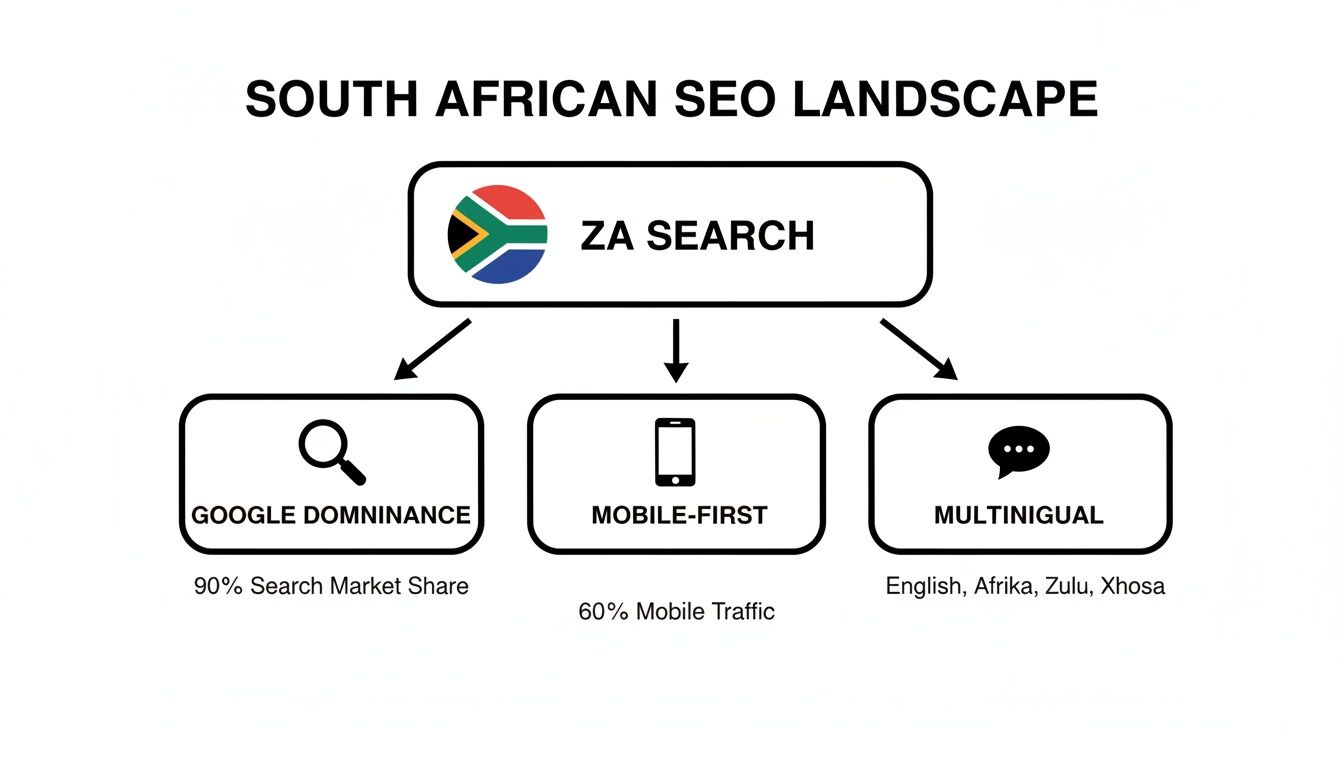
This hierarchy proves that any successful strategy must be built on three pillars: Google's dominance, a mobile-first mindset, and an awareness of our country's multilingual nature.
Your Google Business Profile Is Your Digital Shopfront
Think of your Google Business Profile (GBP) as the heart of your local SEO efforts. It's that handy info box that pops up in Google Search and on Maps, and for many people, it's their very first interaction with your brand online. Just claiming it isn't nearly enough; you have to treat it like your digital shopfront.
An unoptimised profile is the online equivalent of a shop with a dusty window and a faded sign. To draw people in, it needs to be vibrant, packed with useful information, and engaging. This means going way beyond the basics to truly bring your business to life.
Here’s how to turn your GBP into a customer magnet:
- Upload High-Quality Photos: Show off your space, your team, and your products. If you're in property, that means crisp images of your office and agents. For a restaurant, it's all about mouth-watering pictures of your dishes.
- Write A Compelling Description: Clearly explain who you are, what you do, and why you’re the best choice. Naturally weave in local keywords, like "family-friendly dentist in Randburg."
- Use The Q&A Feature: Get ahead of the game by answering common questions your customers might have. It saves them time and positions you as a helpful expert right from the start.
The Power Of Consistency: NAP and Local Citations
In local SEO, consistency is everything. Google needs to be 100% certain about your business's core details before it will trust you enough to feature you in local search results. This trust is built on what we call NAP consistency—making sure your Name, Address, and Phone number are identical everywhere they appear online.
Think of it this way: if you tell three different friends you're meeting at three slightly different places, you're guaranteed to cause confusion. It's the same for search engines. Even a tiny variation like "St." versus "Street" can create doubt and hurt your local rankings.
Your NAP is your digital fingerprint. Every mention of it online, from your website to local directories, must be an exact match to build the authority Google needs to see.
This brings us to local citations. A citation is simply a mention of your business's NAP on another website, even if it doesn't link back to your site. These are pure gold for local SEO.
Getting your business listed in reputable South African directories is a crucial step. It sends strong signals to Google that your business is legitimate and a fixture in its local community. Key directories to focus on include:
- Brabys: A long-standing and trusted South African business directory.
- Ananzi: One of South Africa's oldest and most recognised web portals.
- Cylex: A popular local business directory with a strong presence in ZA.
By meticulously optimising your Google Business Profile and building a solid, consistent network of local citations, you lay a powerful foundation for your local search presence. This blueprint ensures that when customers in your area are looking for a solution, your business doesn’t just show up—it stands out as the clear choice.
Crafting a Content Strategy for a South African Audience
If your technical SEO is the foundation of your house, then your content is everything that makes it a home—the furniture, the decor, the people inside. A technically flawless website without great content is just an empty building. It's the content that truly powers your SEO, turning faceless searchers into actual customers.
But you can't just use any old content for a South African audience. Think of it like a braai master. They wouldn't just grab generic, imported meat from a chain store. They'd go to their trusted local butcher for the best cuts, spices, and boerewors that speak to the local palate. Your content strategy needs that exact same mindset.
It has to be built around local tastes, language, and challenges. This is how you show both Google and your customers that you’re the most relevant, trustworthy answer to their search.
Finding Keywords Your Competitors Miss
Your keyword strategy is the recipe book for every piece of content you create. While the standard tools are a great starting point for broad terms, the real win for search engine optimization South Africa is digging deeper to find those uniquely local phrases your competitors are probably ignoring.
This means you need to look beyond simple English terms and start thinking about how South Africans actually search online. It’s all about getting the nuance of our local languages and culture right.
Here’s where you’ll find those game-changing keywords:
- Embrace Afrikaans: A huge number of South Africans search in Afrikaans. Targeting terms like "eiendom te koop" (property for sale) or "beste selfoonkontrakte" (best mobile phone contracts) can unlock a massive, less-crowded part of the market.
- Listen for Local Slang: Think about the words we use every single day. A company selling bakkie accessories should be targeting "bakkie covers," not just "pickup truck covers." That small shift makes your brand feel instantly familiar and authentic.
- Solve Local Problems: Your most powerful keywords will come from the unique challenges we face in SA. Think about terms like "loadshedding solutions," "Jojo tank installation," or "fibre deals in my area." These are high-intent searches that solve immediate, real-world needs.
By building a keyword list that reflects the true linguistic diversity of South Africa, you're not just optimising for search engines; you're showing your audience that you genuinely understand them and their world.
Creating Content That Genuinely Helps
Once you've got your local keywords, the mission is to create content that is genuinely useful. Let's be honest, people don't use Google to be sold to; they're looking for answers, solutions, and solid advice. The best content strategies focus on helping first and selling second.
This approach is often called building topical authority. It’s about becoming the undisputed go-to resource for a specific subject. By consistently publishing high-quality, in-depth content around a core topic, you’re sending strong signals to Google that you’re an expert. This builds incredible trust and makes it much easier to rank for related keywords down the line. To see how this applies to online stores, you might find these SEO best practices for your eCommerce store helpful.
Your content should always, always be focused on solving a problem or answering a question.
Real-World Examples of Local Content
Right, let's get practical. Theory is one thing, but seeing how this works in the real world is what really matters. Here’s what a local-first content strategy could look like for different South African businesses.
For an eCommerce Store selling outdoor gear:
- Generic Idea: "Best Running Shoes"
- South African Idea: "The Best Trail Running Shoes for the Drakensberg Grand Traverse"
- Why it works: This is incredibly specific and targets a passionate niche. It speaks directly to an iconic local challenge, immediately positioning the store as an expert that gets the unique demands of South African terrain.
For a SaaS Company offering payroll software:
- Generic Idea: "Features of Our Payroll Software"
- South African Idea: "How to Choose SARS-Compliant Payroll Software for Your Small Business"
- Why it works: This hits a major pain point for every South African business owner—staying on the right side of SARS. It goes way beyond a boring feature list to solve a critical business problem, which builds instant credibility and attracts highly qualified leads.
When you tailor your content to the local palate, you create a powerful connection. You stop being just another website and become a trusted local expert who provides real solutions to real South African problems. That’s the core of a content strategy that doesn't just rank—it resonates.
Mastering The Technical SEO Essentials
Let's imagine all your SEO work—the brilliant content, the carefully chosen local keywords—is a beautiful house you've built for your business online. Technical SEO is the foundation holding that entire house up. If that foundation has cracks, is uneven, or is sitting on shaky ground, everything you've built on top is at risk of crumbling.
At its core, technical SEO is about making sure your website's structure is solid. It helps search engines like Google easily find, crawl, and understand your content. It’s the behind-the-scenes work that makes all your other marketing efforts shine, because even the best content can be invisible if the technical setup is poor.
The growing importance of a solid technical base is undeniable here at home. The South African SEO software market hit USD 0.5 billion in revenue and is barreling toward USD 0.9 billion by 2030. This surge shows just how seriously local businesses are taking optimisation, with smaller companies being the fastest-growing segment investing in these tools.
Your Website Must Be Fast And Mobile-Friendly
In South Africa, mobile isn't just a channel; it's the channel. Most of your customers will find you on their phones, often using less-than-perfect data connections. In this context, speed isn't a luxury—it's a necessity. A slow-loading website is like a shop with a permanently jammed door; potential customers will just get frustrated and go next door to your competitor.
Google gets this, which is why it uses mobile-first indexing. This simply means that Google primarily looks at the mobile version of your site to decide how to rank it. If your site is clunky, slow, or hard to use on a phone, your visibility will suffer everywhere, even for people searching on a desktop.
A one-second delay in mobile load times can impact conversion rates by up to 20%. For any South African business, optimising for speed is one of the highest-impact technical fixes you can make.
To get a handle on where your site stands and what needs fixing, a thorough checklist is a great place to start. This Ultimate Site Audit Checklist can provide a comprehensive overview.
Making Sense Of Your Site With Structure and Data
Beyond speed, a logical site structure is crucial. Imagine walking into a massive Makro with no signs, no aisles, and products scattered randomly. You'd leave immediately. Your website is no different. It needs a clear, logical structure so that both users and search engine crawlers can easily find what they're looking for.
This means creating a simple navigation menu and using a clear hierarchy for your pages. This logical flow not only makes for a better user experience but also helps Google understand which pages on your site are the most important. For a deeper dive, check out our guide on the fundamentals of proper web page maintenance.
Another powerful tool in your technical arsenal is structured data, often called schema markup. This is a special bit of code you add to your website to give search engines more context about your content. It’s like adding labels to the boxes in your storeroom, telling Google exactly what’s inside.
Here’s how it helps different businesses in practice:
- eCommerce Stores: Mark up products with price, availability, and review ratings that can show up directly in search results.
- Property Businesses: Use schema for property listings to highlight details like price, address, and the number of bedrooms.
- SaaS Companies: Highlight software features, pricing tiers, and customer reviews to stand out from the crowd.
By mastering these technical essentials—speed, mobile experience, site structure, and structured data—you build a rock-solid foundation. This ensures that all the hard work you put into your content and local strategy has the best possible chance to succeed in the competitive South African market.
Building Your Authority With South African Links
Think of links from other websites as votes of confidence. In the world of SEO, not all votes are created equal. A link from a tiny, unheard-of blog is like a quiet nod from a stranger on the street. But a link from a major South African news outlet like News24? That’s a powerful endorsement from a trusted community leader. Google notices these endorsements and rewards your website with more authority and, ultimately, better rankings.
Building a strong backlink profile is all about earning those high-quality votes, especially from sources right here in South Africa. This isn’t about trying to game the system with spammy tricks. It’s about building real relationships and creating content so genuinely useful that other people want to link to it. This approach is fundamental to any serious search engine optimization South Africa strategy because it proves your relevance and credibility within the local market.
And it's a market you want to be relevant in. South Africa's piece of the entire African SEO industry is a massive 35.96%, powering a market that’s expected to be worth nearly USD 8 billion by 2033. This incredible growth just underscores how vital it is for local businesses to build their digital authority now. If you're interested in the numbers, you can explore the full research on the African SEO industry to see the opportunity for yourself.
Earning Links The Right Way
Let’s be clear: forget about buying links or using dodgy automated schemes. Those days are long gone. The only sustainable way to build links today is by creating "link-worthy" assets and connecting with real people. It’s about giving journalists, bloggers, and industry peers a solid reason to reference your website and your work.
A great link isn't just a hyperlink; it's a signal that your business is a trusted, authoritative voice in its field. Each quality backlink you earn strengthens your digital reputation and tells Google you deserve to be at the top.
So, what kind of content actually earns these endorsements?
- Publish Original Research: Run a survey on a hot topic in your industry within South Africa. For instance, a property company could create a "State of the Rental Market in Gauteng" report. This unique data instantly becomes a valuable source for others to cite.
- Create Local Case Studies: Nothing beats a good local success story. A SaaS company could publish a detailed breakdown of how they helped a Cape Town-based eCommerce store double its revenue. It's tangible, relatable proof that you get results.
- Develop Ultimate Guides: Aim to create the single best resource on a specific local topic. An outdoor gear shop could publish "The Ultimate Guide to Hiking Lion's Head," covering everything from safety tips and route maps to the best times of day to go.
Building Relationships With Local Publications
Once you've created something brilliant, you need to get it in front of the right eyeballs. This means doing your homework to identify and build genuine relationships with local bloggers, journalists at publications like Business Day or Daily Maverick, and other influencers in your space.
It starts small. Follow them, share their articles, and leave thoughtful comments. When you finally have a piece of content that's a perfect fit for their audience, your outreach won't feel like a cold, spammy pitch. It'll come across as a helpful suggestion from someone who's already on their radar.
To get a deeper understanding of how to build a powerful backlink profile, it's worth exploring these 10 Best backlink building strategies.
The Understated Power Of Citations
Finally, let’s not forget about local citations. As we mentioned earlier, a citation is any online mention of your business's name, address, and phone number (NAP). While a direct link is the gold standard, even a simple text mention on a reputable local directory or an industry association’s website sends a small but important signal to Google.
These mentions help confirm that your business is a legitimate, active entity within the local community. Consistently building both high-quality backlinks and accurate local citations is the one-two punch that truly solidifies your authority and pushes you up the search rankings.
Common Questions About SEO In South Africa
Jumping into SEO for the first time can feel a bit like learning a new language. There are a lot of terms and moving parts, so it's only natural to have questions before you invest your hard-earned time and money.
Let's cut through the jargon and tackle some of the most common questions we hear from South African business owners. The goal here is to give you clear, straightforward answers so you know exactly what to expect.
How Long Does It Take To See SEO Results?
This is the big one, and the honest answer is, "it depends." SEO isn't an instant fix; it's a long-term investment in your business's online presence. Think of it like planting a tree. You won't get a towering oak overnight, but with consistent care, it grows into a strong, valuable asset.
Generally, you can start seeing some positive movement—like a bump in traffic or better keyword positions—within 3 to 6 months. These are the early signs that things are heading in the right direction. To get those really solid, lasting rankings for the keywords that matter most, you're usually looking at a timeline of 6 to 12 months.
SEO is a marathon, not a sprint. The results you build over time create a lasting asset for your business, driving traffic and leads long after the initial work is done.
What’s The Difference Between SEO And Paid Ads (PPC)?
It's easy to get these two mixed up, but the difference is actually quite simple. SEO is all about earning your spot in the organic (unpaid) search results. Paid ads, often called Pay-Per-Click or PPC, are where you pay Google to place your ad right at the top of the page.
Here’s a quick way to think about it:
- SEO (Organic): This is your long-term strategy for building trust and authority. Once you rank, the traffic you get is essentially "free," and many people trust these natural results more than they trust ads.
- PPC (Paid): This is all about speed. You can be at the top of Google the moment your campaign goes live. The catch? The traffic disappears the second you stop paying.
The smartest approach often involves a bit of both. PPC is fantastic for getting quick results and testing what works, while SEO builds the solid foundation for sustainable, long-term growth.
Can I Do SEO Myself?
Of course! For business owners willing to roll up their sleeves, there are tons of online resources to help you learn the ropes. With a bit of dedication, you can definitely grasp the basics of keyword research, on-page SEO, and writing good content. It's a fantastic way to understand what makes search engines tick.
The challenge comes as your business scales. SEO gets a lot more complex. Keeping up with Google's constant algorithm updates, running technical website audits, and building quality backlinks can quickly turn into a full-time job. This is the point where many businesses decide to partner with an agency or a consultant to get better results, faster. If you're weighing up your options, our guide on choosing an SEO service near me offers some really practical advice.
At Market With Boost, we specialise in building data-driven SEO strategies that deliver measurable growth for South African businesses. If you're ready to turn your website into a powerful customer acquisition engine, book a discovery call with our team today. Find out more at https://www.marketwithboost.com.


Scale your performance with data-driven insights
Ready to apply these insights to your business? Hannah can walk you through how we'd approach your specific situation.
Hannah Merzbacher
Operations Manager
Continue reading
View all insights
Search Engine Optimization Packages: 2026 ZA Guide
Confused by search engine optimization packages? Our 2026 ZA guide breaks down costs, types, and what to look for in eCommerce, SaaS, & property SEO....

Search Engine Optimization Copywriting: A 2026 Guide
Learn search engine optimization copywriting that converts. This guide covers research, writing, CRO alignment, and examples for eCommerce, SaaS, and ...
Finding the Right Search Engine Optimization Agency in South Africa for 2026
Learn how to choose the right search engine optimization agency South Africa for your business. This guide covers strategies, costs, and questions to ...