Hiring a Web Development Company That Actually Drives Growth

By Dylan Klichowicz
A top web development company does more than just build a website—they build a growth engine for your business. It's about mixing sharp technical skills with smart business strategy to create a digital platform that actually brings in revenue, captures leads, and keeps people coming back.
Laying the Groundwork Before You Hire
Before you even start looking at portfolios or sending out project briefs, the most important work happens right inside your own company. Diving into the hiring process without a clear plan is like trying to build a house without a blueprint. You might end up with something that looks nice, but it won’t work the way you need it to.
Taking the time to figure out what you want to achieve upfront is the single best way to find a true partner, not just someone you hire to do a task. This initial clarity shapes every decision you make later, from the questions you ask to the proposals you take seriously.
Define Your Commercial Goals
First things first, let's forget the tech jargon for a minute. What business problem are you actually trying to solve? A new website is a serious investment, and it has to deliver a return. Vague goals like "we need a better design" are a recipe for disappointment. Instead, you need to focus on specific, measurable business outcomes.
For example, your main goals might be:
- To increase conversion rates by 15% within six months of launch.
- To generate 50% more qualified leads by creating a smoother user journey with clearer calls-to-action.
- To reduce bounce rates on key landing pages by completely rethinking the user experience.
This kind of clarity makes sure that every design choice and technical feature serves a direct business purpose. It’s what turns your website from a simple online brochure into an active part of your bottom line. For a complete look at the entire process, this guide on how to outsource software development is a great resource.
The planning process is pretty straightforward when you break it down.
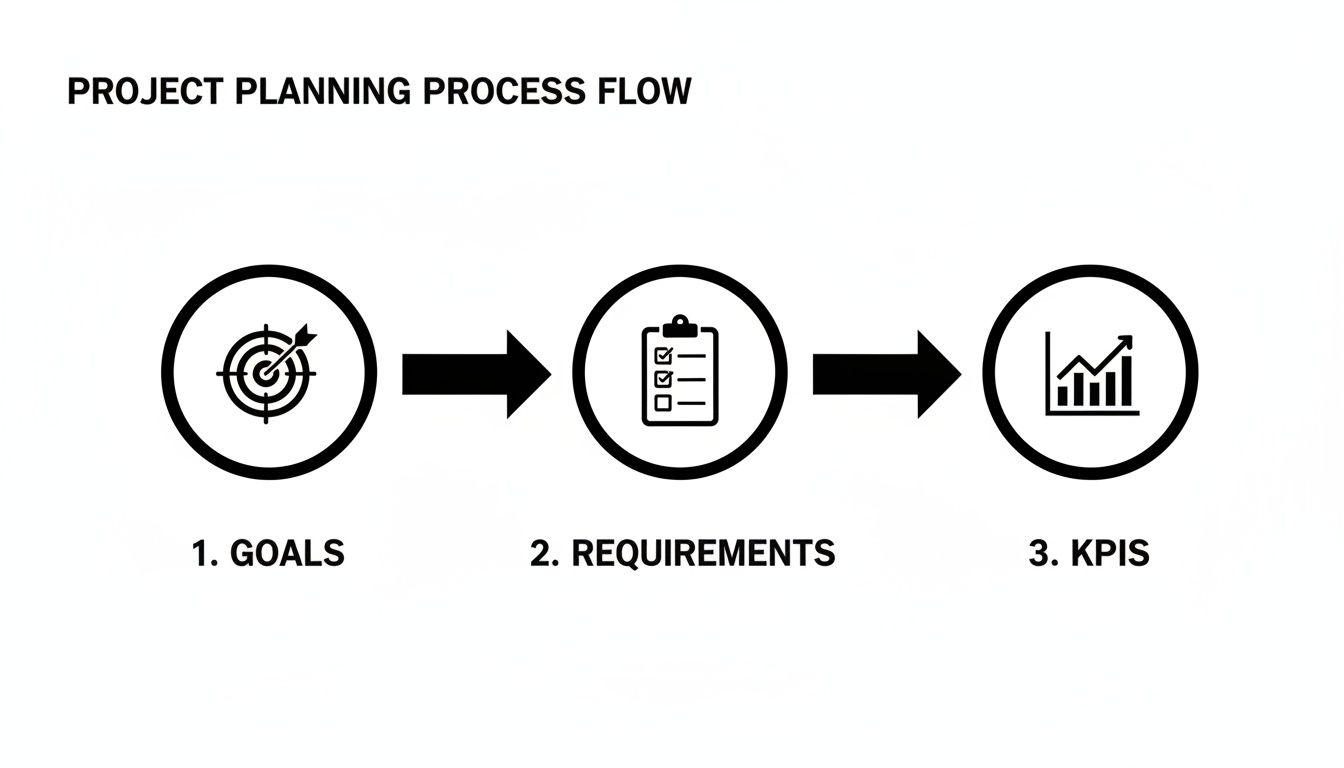
As you can see, setting clear business goals is the foundation. Everything else—your technical requirements and how you'll measure success—flows from there.
Map Out Your Technical and Functional Needs
Once your business goals are locked in, you can start translating them into what the website actually needs to do. This isn’t about picking a coding language; it’s about outlining the core features required to hit those targets.
A detailed project brief is your most powerful tool. It eliminates guesswork, helps you get accurate quotes, and gets everyone on the same page about what success looks like from day one.
The demand for these custom solutions is undeniable. In 2026, South Africa's web development sector is buzzing, with over 213 specialised companies recognised as top performers. This really highlights how important it is for brands to invest in online platforms that can scale and deliver results.
Digging into Technical Skills and Strategic Thinking
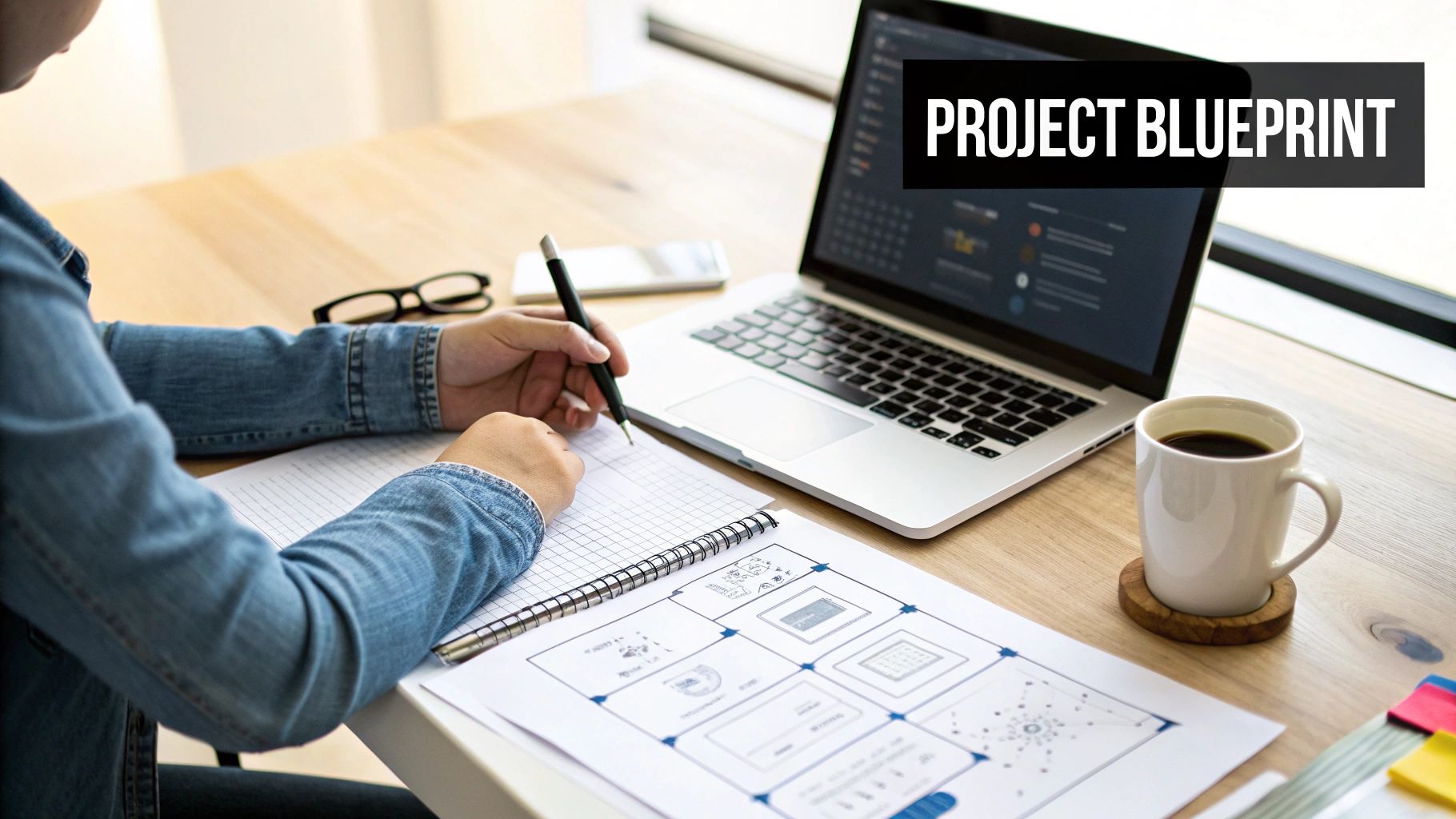
Once you've got a solid project blueprint, it's time to find a partner who can actually bring it to life. This is where you look past the polished sales decks and start examining the real technical and strategic muscle of a potential web development company. You're not just looking for a team to build what you ask for; you need someone who understands why you're asking for it in the first place.
A great agency thinks bigger than just the website. They’re already thinking about how it will plug into your marketing, support your sales team, and, most importantly, hit those business goals you've just defined.
Look for More Than Just Code
Frankly, any half-decent developer can put a website together. What you're looking for is a partner who can build your website—one that’s lightning-fast, secure, ready to grow, and a perfect match for your business. This means you need to hunt for very specific expertise.
If you’re running an eCommerce store, for example, their experience with Shopify, Magento, or a custom headless setup is a deal-breaker. You have to be sure they understand the nuances of payment gateways, inventory syncing, and what it takes to build a checkout process that people actually finish.
For a SaaS business, the conversation might shift to their experience building secure, multi-tenant applications or integrating with your core tools like HubSpot or Salesforce. The key is to line up their proven skills with your specific needs. Don't be shy about asking direct, pointed questions about their tech stack and how they approach development.
A truly strategic partner won't just talk about code. They'll ask sharp questions about your business model, your customers, and where you want to be in three years. That curiosity is a massive green flag.
The Make-or-Break Capabilities
Vetting a company’s skills isn't just a casual chat; it’s more like a technical check-up. You need to be sure they have the strategic smarts to align their work with your brand voice and genuinely connect with your customers.
To help with this, I've put together a checklist of essential capabilities. Think of this as your scorecard for comparing different agencies.
Essential Capabilities Checklist for Your Web Partner
Use this checklist to evaluate and compare the technical and strategic skills of potential web development companies.
| Capability | Why It Matters for Growth | Key Questions to Ask |
|---|---|---|
| Performance Optimisation | Slow sites destroy conversions and tank your search rankings. Speed is a feature. | "What's your process for optimising for Core Web Vitals?" |
| Mobile-First Development | Most of your users are on their phones. The site must be built for their experience, not just adapted to it. | "Can you show me a site you built mobile-first from the ground up?" |
| SEO Foundations | Your site needs to be built for visibility from day one. Clean code and smart architecture are non-negotiable. | "How do you handle technical SEO elements like schema and site structure?" |
| eCommerce Specialisation | If you're selling online, you need a team that lives and breathes conversion funnels, not just a generalist. | "Walk me through an eCommerce project where you solved a complex checkout or inventory problem." |
| Platform-Specific Expertise | Whether it's Shopify, Webflow, or a custom CMS, they need to be masters of your chosen platform. | "What are the limitations of [Platform X] that we should be aware of?" |
| Integration Experience | Your website doesn't live in a vacuum. It needs to talk to your CRM, ERP, and marketing automation tools. | "Tell me about a challenging API integration you've managed. What went wrong and how did you fix it?" |
Having this checklist handy will help you cut through the marketing fluff and focus on what truly matters for your business's growth.
Remember, the South African web development scene is quite competitive. Recent 2026 rankings list over 240 vetted agencies, many of which specialise in building fast, SEO-ready sites that deliver real ROI for both eCommerce and SaaS clients. Digging into a breakdown of top local companies can give you a great benchmark for the kind of proposals and pricing you should expect to see. This groundwork is invaluable, especially when you consider how crucial a solid technical foundation is. That’s why many businesses also bring in expert search engine optimization consultants early on to make sure nothing gets missed.
How to Analyse Portfolios and Case Studies
Okay, so you've confirmed they have the technical skills. Now it's time to see that expertise in action. A portfolio is so much more than a gallery of pretty websites; it's solid proof that an agency can deliver real, measurable results. Your job here is to look past the beautiful designs and analyze their work with a strategist’s eye.
It's easy to get wowed by flashy animations or slick, modern layouts. But you need to dig deeper. The most important question to ask is, "Did this website actually solve a business problem?" This is where case studies become your best friend, offering a look into how an agency thinks, collaborates, and ultimately drives growth.
Look for Results, Not Just Resumes
An agency showing off ten stunning websites for local coffee shops is great, but that experience means very little if you're a B2B software company. You need to find proof that they’ve handled challenges similar to your own. A truly strategic portfolio isn’t just organized by industry; it’s organized by the problems they’ve solved.
Look for specific, concrete results that tie directly back to your business goals.
- For eCommerce brands: Did they boost the average order value for a similar online store? Can they show a real drop in cart abandonment rates?
- For SaaS companies: Is there a case study explaining how a UX redesign cut user churn or increased free trial sign-ups?
- For lead-gen sites: Can they point to a project where they increased qualified lead submissions by a clear percentage?
This is what separates a genuine growth partner from a simple design shop. You’re looking for a team that gets just as excited about your key metrics as you do.
Unpacking the Story Behind the Work
A solid case study isn't just a summary; it's a story. It should walk you through the entire project, from the initial challenge to the final, data-backed result. Vague descriptions won't cut it. You need to see their problem-solving process on full display.
A case study without numbers is just an opinion. Always insist on seeing the data—conversion lift, revenue growth, bounce rate reduction—that proves their work actually worked.
When you find an agency that backs up its claims with hard data, you know you're on the right track. For instance, the impact of top-tier ZA web development firms is clear. One leading agency helped a local eCommerce client achieve a 425% online revenue growth in just six months by focusing on SEO and conversion rate optimization. These are the kinds of verifiable results that build real confidence.
Ultimately, what you're searching for is a consistent track record of success. Reviewing a portfolio of proven case studies gives you the assurance that the company you choose has a repeatable process for delivering growth, not just a few lucky wins. Their past performance is the most reliable predictor of your future success.
Navigating Proposals, Budgets, and Timelines

Alright, you’ve done the hard work and shortlisted a few strong contenders. Their portfolios look great, and their case studies check out. Now it's time to get down to the details. This is where you move from theory to specifics, diving into proposals, budgets, and timelines to see which web development company is the right fit on paper and in practice.
The first discovery calls are more than just a formality. Think of them as your first real taste of what a partnership would feel like. A good agency will come prepared with sharp, insightful questions about your business, trying to get to the heart of your challenges. This is your chance to do the same.
Beyond the Price Tag: Understanding Value
When the proposals start rolling in, it's natural to immediately look at the cost. My advice? Resist that urge. The cheapest quote is rarely the best value, and a surprisingly low bid can be a serious red flag. More often than not, it hints at cut corners, work being passed to junior teams, or a basic misunderstanding of your project’s scope.
A strong proposal should read like a strategic plan. It won’t just list features; it will connect each item back to the business goals you discussed. Look for a detailed breakdown of what’s included, the project phases, and—just as importantly—what is not included.
When you’re comparing quotes, look for clarity on these points:
- Scope Detail: Does the proposal clearly outline every deliverable, from discovery and design to development and testing? Vague proposals are a recipe for scope creep and unexpected costs down the road.
- Team Composition: Who, specifically, will be working on your project? A quality proposal will often introduce the key team members and explain their roles. You want to know you're getting the A-team.
- Post-Launch Support: What happens after the site goes live? Look for clear terms on maintenance, bug fixes, and what ongoing support retainers look like.
This level of detail is a great sign. It shows the agency has truly listened and invested time in understanding your needs, not just plugging your name into a template.
Decoding Timelines and Setting Milestones
A realistic timeline is every bit as important as a fair budget. A professional agency won't just give you a single end date; they’ll provide a project plan with clear milestones. This shows they have a structured process and helps you manage expectations with your own team.
A timeline is a two-way street. Your ability to provide timely feedback and content is just as crucial as the agency's ability to deliver on schedule. Make sure the proposed timeline accounts for your team's availability and review cycles.
At a minimum, you should see these typical project phases laid out in a proposal:
- Discovery & Strategy: Deep-dive sessions to finalize the project blueprint.
- UX/UI Design: Wireframing, prototyping, and creating the visual design.
- Development & Integration: The actual coding and connecting to third-party tools.
- Testing & QA: A thorough quality assurance phase to hunt down bugs before users do.
- Launch & Handover: Deploying the site and training your team to use it effectively.
Seeing a well-organized plan like this should give you confidence that the web development company is organized and professional. It breaks a big, complex project into a series of manageable steps, giving you a clear path from today to a successful launch.
Finalizing the Contract and Kicking Off the Project
You’ve found the one. After all the interviews and portfolio reviews, you've chosen a web development company that gets your vision and has the skills to bring it to life. But before you get started, there’s one final, crucial step: getting the agreement right and kicking the project off on the right foot.
This isn’t just paperwork. A well-structured contract is the foundation of a successful partnership. It protects everyone by setting crystal-clear expectations, defining the project's boundaries, and creating a shared understanding of what a "win" actually looks like. A truly professional agency will guide you through this smoothly, showing their organization and commitment from the get-go.
What to Look for in a Web Development Contract
Don’t just give it a quick scan and sign on the dotted line. Your contract should be a detailed blueprint for the entire project. If it feels vague or overly simple, treat that as a major red flag.
A solid agreement will have a few key areas clearly nailed down:
- A Detailed Scope of Work (SOW): This is the heart of the contract. It should explicitly list every single deliverable. We’re talking specific features, functionalities, and even the number of design revisions included. If it isn't listed here, you can bet it will be considered out of scope later.
- Payment Schedule: This part needs to clearly outline the total project cost and how it’s broken down into milestone payments. A common structure is a 30-50% upfront deposit, with the rest of the payments tied to completing key phases, like design approval or the end of development.
- Intellectual Property Rights: This is non-negotiable. The contract must state that once the final payment is made, you own everything—the code, the design, all of it. The IP rights must be transferred to you.
- Post-Launch Support and Warranty: What happens if a bug pops up a week after you go live? A good contract will include a "warranty period," usually 30-90 days, where the agency fixes any bugs from the original scope at no extra charge. It's also smart to understand what ongoing support looks like. For a deeper dive, you can learn more about professional web page maintenance and see why it’s so vital.
Think of your contract as the project's rulebook. It's the document everyone refers back to when questions about scope, timelines, or deliverables come up. A clear contract prevents misunderstandings and keeps the focus on building something great.
Kicking Off for a Smooth Start
With the contract signed, the project officially begins. The kickoff meeting is your first real chance to set the tone and rhythm for everything that follows. This isn't just a quick "hello"; it's a strategic session designed to get both teams perfectly aligned.
There are a few key things you need to walk away with from that first meeting:
- Communication Channels: How is everyone going to talk? Decide whether you'll use a project management tool like Asana or a Slack channel. Also, set up a single point of contact on each side to keep communication clean.
- Meeting Cadence: Agree on a regular check-in schedule. Whether it's a weekly call or a bi-weekly progress review, consistent communication is the best way to avoid nasty surprises down the road.
- Define the First Steps: What happens next? The agency should walk you through their discovery process and tell you exactly what they need from you to get started—things like brand assets, logins, or access to your existing analytics.
A strong kickoff ensures everyone leaves that meeting feeling energized and, most importantly, on the same page. You're ready to start building.
Got Questions? We've Got Answers

Choosing the right web development partner is a big decision, and it’s normal to have a few questions. We get it. Below, I’ve broken down the most common questions we hear from business owners and marketing managers just like you. Think of it as a quick guide to help you move forward with a bit more confidence.
What's a Realistic Budget for a Professional Website?
This is always the first question, and the honest answer is: it really depends. For a straightforward, well-built informational website, you might be looking at a starting point around R75,000. On the other hand, a complex custom eCommerce platform with deep integrations could easily reach R400,000 or more.
The trick is to shift your thinking from "cost" to "investment." A cheap website that doesn't convert or breaks when you try to grow will cost you far more in the long run. Any reputable web development company will give you a detailed proposal that explains every line item, so you see exactly what you’re paying for and the value it delivers.
What’s the Real Difference Between a Web Developer and a Web Designer?
This one causes a lot of confusion, but the difference is pretty important. I like to use the analogy of building a house.
- A web designer is your architect. They’re focused on the blueprint—the look, the feel, the user journey, and the overall experience (UX/UI). They design the layout and map out how people will move through the space.
- A web developer is your builder. They take that beautiful blueprint and bring it to life with code. They’re the ones making sure the lights switch on, the plumbing works, and the whole structure is solid and secure.
The best agencies have both of these key roles working together seamlessly. That integrated approach is how you get a website that's not just stunning but also technically sound and built for top performance from day one.
How Long Does It Actually Take to Build a Business Website?
The timeline is completely tied to how complex the project is. A standard marketing site can often go from kickoff to launch in about 6 to 10 weeks.
However, if we're talking about a sophisticated eCommerce store with custom features, migrating thousands of products, and linking up multiple systems, you should probably plan for a 4 to 6-month project, sometimes longer.
A good partner will give you a clear project timeline with key milestones right in the proposal. Just remember, it’s a two-way street! Your team's ability to provide feedback and content on time is a huge factor in keeping everything on track.
A website is never truly 'finished'. To keep it secure, fast, and effective, it needs consistent attention and strategic improvement long after launch day.
What Kind of Ongoing Support Will I Need After Launch?
Hitting "publish" on your new site is just the beginning, not the finish line. To protect your investment and keep it running smoothly, you'll need some kind of ongoing maintenance. This usually covers the basics:
- Regular software and plugin updates
- Security monitoring and malware scans
- Performance checks to keep it fast
- Consistent backups to prevent data loss
Most agencies will offer a monthly retainer for this. Beyond just keeping the lights on, you should also think about strategic support. Things like Conversion Rate Optimisation (CRO) are what make sure your site continues to adapt and deliver on your business goals month after month.
Ready to build a website that does more than just sit there looking pretty? The team at Market With Boost builds growth-focused digital platforms for ambitious eCommerce and software brands. Book a discovery call today and let's talk about how we can turn your website into your hardest-working asset.

Written by
Head of Boost Marketing & Performance Specialist
Dylan is a digital marketer who specializes in conversion and lead generation strategies. He works closely with our clients to tailor their campaigns and evolve strategies based on data and real-time information, ensuring optimal performance and results.

Scale your performance with data-driven insights
Ready to apply these insights to your business? Hannah can walk you through how we'd approach your specific situation.
Hannah Merzbacher
Operations Manager
Continue reading
View all insights
Top 7 Web Development Companies South Africa for 2026
Find the best web development companies south africa for 2026. Our guide reviews 7 top agencies for eCommerce, SaaS, & enterprise-level projects....
Web Development Pricing in 2026: A Founder's Guide
Unpack web development pricing in South Africa. Learn about pricing models, cost drivers, and how to choose a developer that delivers real ROI....
Ecommerce Web Development The Ultimate 2026 Guide
A complete guide to ecommerce web development. Learn about platforms, costs, SEO, and how to build a high-converting online store for your brand in 20...