How to Hire the Right Agency for Website Development

By Dylan Klichowicz
Before you even start Googling for a web development agency, the most important work starts at your own desk. Think of it like drawing up a detailed blueprint before you bring in the builders. Nailing this foundation is the single biggest step toward finding a partner who gets your vision and can deliver real results, not just a pretty website.
Defining Your Website Goals and Budget
Jumping on calls with agencies without a clear plan is a recipe for a headache. It’s like going grocery shopping without a list—you’ll wander the aisles, grab things you don’t need, and probably forget the milk. Vague goals like "we need a new website" just don't cut it. To get accurate quotes and find an agency that’s the right fit, you have to turn your big business objectives into specific, tangible website goals.
Translate Business Objectives into Website Goals
First things first: what does this website actually need to do for your business? Are you trying to sell more products? Book more client meetings? Or are you aiming to become the go-to expert in your field? Each of these outcomes needs a completely different strategy and set of tools.
For example, a real estate business focused on getting more viewing appointments has a very different main goal than an online store trying to stop people from abandoning their shopping carts. Your primary objective will shape everything, from the site's features and user experience to the technology it's built on.
Let's look at a few real-world examples:
- Business Objective: Increase qualified leads by 30% this year.
- Website Goal: This means you'll need clear call-to-action buttons on every service page, a simple contact form that’s easy to fill out, and maybe a dedicated "Request a Quote" feature.
- Business Objective: Cut down customer support tickets by 50%.
- Website Goal: You'll need a solid, easily searchable FAQ section, or maybe even a full knowledge base built right into the site.
- Business Objective: Boost brand credibility to attract higher-value clients.
- Website Goal: Here, the focus would be on a stunning portfolio or case study section, complete with professional photos and compelling stories about your projects.
Setting a Realistic Project Budget
I get it—talking about money can feel a bit awkward, but it's a conversation you need to have right from the start. Without a realistic budget range, no agency can give you a meaningful proposal. Website costs are driven entirely by complexity. A simple five-page brochure site is a world away from a custom eCommerce platform that needs to connect with your inventory and shipping software. You can learn more about what goes into the cost in our comprehensive guide to website design and development.
A well-defined scope is your best friend when it comes to controlling costs. When you know exactly what you need, you prevent "scope creep" and ensure every agency is quoting on the same set of requirements. This makes comparing your options fair and square.
How to Critically Evaluate a Web Development Agency
So, you’ve got a shortlist of potential agencies. Now the real work begins. A polished sales pitch and a gorgeous homepage are just the basics; they don’t tell you if an agency can deliver a project that actually moves the needle for your business.
You need to dig deeper to find a genuine partner, not just a team that checks off a to-do list.
This decision path can help you visualize which type of agency might be the best fit based on your main goals and budget.
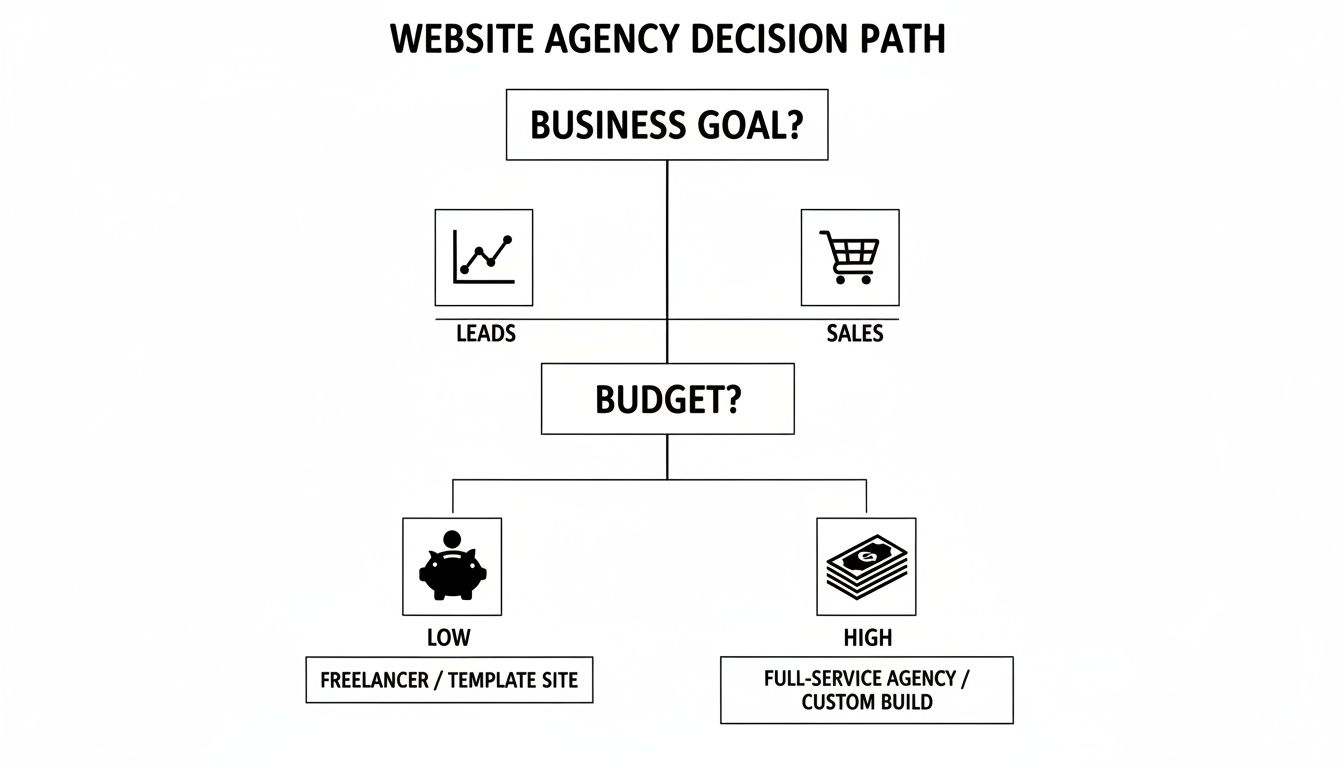
Whether you're chasing leads or direct sales, this helps clarify what kind of partnership you should be looking for.
Look Beyond Pretty Pictures in Their Portfolio
Any agency can show off its best-looking work. Your job is to look for proof of performance, not just pretty designs. When you’re reviewing a portfolio or case studies, don't just glance at the screenshots. Get in there and kick the tires.
Click through to the live websites they've built and ask some tough questions:
- Is the user experience actually good? Try to complete a key action on the site. Is the navigation intuitive, or do you feel lost? The flow should feel natural.
- How fast is it? Pop the URL into Google's PageSpeed Insights. A slow website is a conversion killer, period.
- Does it work on your phone? With over 60% of web traffic now coming from mobile devices, a site that’s clunky or broken on a smartphone is a dealbreaker.
- Where are the results? Look for hard numbers in their case studies. Did they increase conversions by 29%? Did they help a client achieve 580% revenue growth? Vague claims about "improved branding" are a red flag.
Scrutinise Their Technical Expertise
You don't need to be a developer to ask smart questions about an agency's tech. The technologies they choose directly affect your site’s performance, security, and how easily you can grow down the road. Are they using modern, well-supported frameworks, or are they relying on outdated tech that will become a maintenance nightmare?
This is especially true for eCommerce businesses. If you’re selling online, you absolutely need an agency for website development that has proven, deep experience with platforms like Shopify or Magento. They should be able to confidently talk about tricky challenges like payment gateway integrations, custom shipping rules, and third-party inventory systems.
A great agency won't just build what you ask for; they'll challenge your assumptions and suggest solutions that better fit your long-term business goals. They act like a partner who's invested in your growth, not just a vendor completing a task.
The South African market is a great example of this. Top local agencies are building high-performance, conversion-focused sites with starting prices from R10,000, and they're delivering serious returns. We've seen portfolios showing 150%+ conversion uplifts for clients.
Here's a simple checklist you can use to keep your evaluations consistent across different agencies.
Agency Evaluation Checklist
| Evaluation Area | What to Look For | Red Flag |
|---|---|---|
| Portfolio & Case Studies | Live site examples, clear metrics (e.g., conversion rate increase, revenue growth), industry-relevant experience. | Only screenshots, vague results ("increased engagement"), all sites look the same. |
| Technical Stack | Experience with modern, scalable platforms (e.g., Shopify, Webflow), clear explanation of why they use certain tech. | Using outdated or proprietary tech that locks you in, can't explain their choices. |
| eCommerce Experience | Proven examples of complex stores, knowledge of payment gateways, shipping logic, and third-party integrations. | Limited eCommerce portfolio, superficial understanding of online retail challenges. |
| Data & CRO Focus | Discussion of A/B testing, heatmaps, analytics, and data-driven design decisions in their process. | Focus is purely on aesthetics, no mention of performance metrics or optimisation. |
| Team & Communication | Clear project management process, direct access to the team, proactive communication style. | Vague process, sales-only contact, poor response times during the proposal phase. |
This structured approach helps you compare apples to apples and make a decision based on substance, not just a slick sales presentation.
Ultimately, you’re not just buying a website; you’re investing in a growth engine for your business. For a more extensive look at the selection process, check out this complete decision guide on choosing a web design agency. This expertise is also crucial if you plan to run paid ad campaigns, as your site's architecture directly impacts ad performance. You can learn more about finding the right partner in our guide to choosing a https://www.marketwithboost.com/insights/pay-per-click-advertising-company.
Crafting a Brief That Gets You Accurate Quotes
Think of your project brief as the foundation for your new website. A vague, one-page document just won't cut it—it’ll only get you equally vague quotes that are impossible to compare. A detailed, thoughtful brief, on the other hand, gives a great agency for website development everything they need to truly understand your vision, ask the right questions, and deliver a proposal you can count on.
This isn't about writing a novel. It's simply about providing clarity. The more specific you are now, the less an agency has to guess, which always means more accurate timelines and budgets.
A solid brief sets clear expectations from the very first conversation and paves the way for a successful partnership.
The Essential Components of a Project Brief
Don't get bogged down in the format. A straightforward document covering the core parts of your project is all you need to get the ball rolling. Just make sure your brief answers these crucial questions:
- Who are you and what do you do? Start with a quick overview of your business, your mission, and where you fit in the market. What problem do you solve for your customers?
- What is the primary goal of this new website? Circle back to the goals you defined earlier. Are you aiming for more leads, driving online sales, or building brand authority? Be specific.
- Who is your target audience? Paint a picture of your ideal customer. What are their challenges, what motivates them, and how comfortable are they with technology? This helps an agency build an experience for real people, not just a generic user.
- What are the must-have features? Make a list of your non-negotiables. This could be anything from a blog and events calendar to a secure customer portal or specific payment gateway integrations.
- What are some websites you admire (and why)? Give them 2-3 examples of sites you love, even if they're outside your industry. The key here is to explain what you like about them—is it the minimalist design, the seamless checkout, or a particular tool? Don't forget to include sites you don't like and explain why.
Before you even think about getting quotes, you need absolute clarity on what you're building. Learning how to define project scope effectively will ensure your brief is rock-solid from the start.
Your brief isn't just a request for a quote; it's the first test of an agency's ability to listen. A great agency will come back with insightful questions, challenging your assumptions and offering suggestions based on their experience. A weak one will just send back a price.
Smart Questions to Ask Potential Agencies
Once you’ve sent your brief out and the responses start coming in, the real conversation begins. Those initial calls are your chance to see past the flashy portfolio and find out how a potential partner really operates. Ditch the generic questions like "How long have you been in business?" and dig into how they actually work.
Here are a few insightful questions to get you started:
- What does your project management process look like? Find out if they use Agile, Waterfall, or something in between. You'll also want to know who your main point of contact will be and how often you can expect updates.
- How do you handle scope creep or new feature requests mid-project? Things change. A good agency expects this and has a clear process for handling it. Their answer shows how they protect your budget and timeline when things need to shift.
- Based on our brief, what do you see as the biggest potential challenge or risk? This is a fantastic test of their experience. A seasoned partner will have already spotted potential roadblocks and won’t be afraid to be honest about them.
- Can you walk me through a similar project you’ve completed? What were the results? Ask them to connect their work to real business outcomes. You want to hear about increased conversion rates or improved user engagement, not just their design choices.
Remember, this isn't an interrogation. It's a two-way conversation to find a team that communicates openly and feels like a genuine extension of your own.
Navigating Project Costs, Timelines, and Common Pitfalls
Let's get straight to it: money. When you start getting quotes from an agency for website development, you're going to see some wild variations. One proposal might be for R25,000, and the next, for what looks like the same project, is R100,000. It can feel like the Wild West.
So, what’s really going on? The price tag isn't just about a pretty design. It’s a reflection of the strategy, technical complexity, and custom work that goes into building a high-performing website. A lower quote almost always means you're getting a template with a fresh coat of paint. That higher price, on the other hand, usually includes proper user experience (UX) research, custom development, and critical integrations that turn your website into a real business asset.
Understanding Common Pricing Models
Agencies don't just pull numbers out of thin air. They typically use one of a few common pricing models, and knowing the difference will help you find the best fit for your project.
- Fixed-Bid: This is straightforward. You get one flat price for a very specific, clearly defined scope of work. It’s great for projects where you know exactly what you need, giving you total budget certainty. The catch? If you decide to add something later (scope creep), it'll mean a new quote.
- Time & Materials (T&M): Here, you pay for the actual time the agency spends on your project, usually at an hourly or daily rate. This model is built for flexibility, making it perfect for complex projects where the full scope isn't clear from the start. It does require a strong sense of trust and great communication to keep the budget in check.
- Monthly Retainer: This is the standard for long-term partnerships. Think ongoing maintenance, SEO, or continuous improvements after your site goes live. You pay a set fee each month for a specific block of hours or a list of tasks. This ensures your website stays secure, relevant, and performing at its best.
The right pricing model really boils down to your project's clarity and complexity. If you're building a standard marketing site with a clear feature list, a fixed bid is a safe bet. But for a large-scale eCommerce platform with evolving requirements, Time & Materials is often the more practical route.
Realistic Timelines and Red Flags
A simple, well-defined website can realistically be designed and launched in 6-8 weeks. But if you're building something more complex, like a custom eCommerce store, you should be prepared for a timeline closer to 3-6 months. Be very skeptical of any agency that promises a lightning-fast turnaround; good work takes time.
The investment size mirrors this complexity. For example, looking at current Cape Town website design trends, a basic optimisation project might fall between R25,000-R75,000. In contrast, an advanced build with custom AI features could easily push the budget to R250,000+. The key is that these more advanced sites are generating massive returns, with some eCommerce businesses reporting 300% traffic growth and incredible 425% spikes in revenue. You can dig deeper into these local trends and their impact.
Finally, keep your eyes peeled for red flags during the proposal stage. Vague proposals that are light on detail, high-pressure sales tactics to get you to sign right away, or a reluctance to share client references are all major warning signs. A good partner will be transparent, answer your questions patiently, and be proud to let you speak with their past clients.
Managing the Project from Kickoff to Launch
You’ve signed the contract and picked your agency. Now for the fun part: actually building the thing. A successful project doesn’t happen by accident. It’s the result of clear communication, solid processes, and a shared vision from the very first meeting.
That first kickoff meeting is more than just a formality—it’s where you set the tone for the entire project. This is your chance to align on the scope, nail down the timeline, and agree on how you'll communicate. When everyone leaves that meeting on the same page, you avoid a lot of potential headaches down the road.
One of the smartest things you can do is appoint a single point of contact on your team, and have the agency do the same. This simple move cuts out the noise of conflicting feedback and makes decision-making a hundred times easier.
What Does the Project Lifecycle Actually Look Like?
Every project has its own quirks, but a good agency for website development will almost always follow a structured process. Knowing what’s coming helps you anticipate when your feedback will be most valuable.
Here’s a rough sketch of how things usually play out:
- Discovery & Strategy: This is where they go deep, really getting to grips with your business, your customers, and what your competitors are up to.
- Wireframing & UX Design: Think of this as the architectural blueprint. It's all about mapping out the user journey and site structure before a single pixel of design is coloured in.
- UI & Visual Design: Now the personality comes through. This is where your brand's look and feel get applied to the wireframes, creating a high-fidelity preview of the final site.
- Development Sprints: The developers get to work, coding the designs into a functional website. They'll often use "sprints"—short, focused bursts of work—to build and test features as they go.
- User Acceptance Testing (UAT): It's your turn to play! Before the site goes live, you get to click through everything, test every form, and hunt for any last-minute bugs.
Your feedback during this process is gold. Be specific. "I don't like it" isn't helpful. "The call-to-action button gets lost on the mobile view because it’s the same colour as the background" is something the team can actually fix. Actionable input is everything.
The Right Tools and Communication for a Smooth Ride
Great agencies don't hide their work. They'll give you a window into the project using tools like Asana, Trello, or Jira. You should expect access to a project board where you can see progress in real-time. It keeps everyone honest and on the same page.
Regular weekly check-ins are also non-negotiable. These meetings aren't just for status updates; they’re for tackling problems and making sure the project keeps moving forward. Good project management is what separates a frustrating slog from a successful launch.
Here in South Africa, agencies are making a massive impact. In Cape Town, for instance, one eCommerce client saw a 425% jump in online revenue within six months of their new site launch. You can see more examples of how top agencies in South Africa are driving growth.
Of course, getting the site live is just the beginning. To get a head start on what’s next, read our guide on the essentials of web page maintenance.
Got Questions? We've Got Answers
Choosing the right web development partner brings up a lot of questions. It's a big decision. We've been there, and we've guided countless businesses through it. Here are some of the most common things people ask us, with honest, straightforward answers.
How Much Should I Budget for a Professional Business Website in South Africa?
This is always the first question, and the honest answer is: it really depends on what you need. A simple, professionally built informational site – what you might call a 'brochure' website – will typically start in the R20,000 to R50,000 range with a quality agency.
But if you're stepping into the world of eCommerce, things get more complex. A custom online store with payment gateways, shipping integrations, and unique features requires a bigger investment. For something like that, you should be budgeting anywhere from R75,000 to R250,000, and sometimes more for highly sophisticated systems. Always insist on a detailed quote that breaks down every single cost. No surprises.
What’s the Difference Between a Web Designer and a Web Developer?
Great question. It's easy to see why they get mixed up, but their roles are very different.
- A web designer is all about the user's journey. They're the visual and experiential architects, focusing on the look and feel (UI) and the overall usability (UX). They decide how the site flows and how a visitor interacts with it.
- A web developer is the engineer who brings that vision to life. They write the code, build the database, and make sure everything works perfectly behind the scenes.
The best agencies for website development have strong teams in both camps, working together. This ensures the final product isn't just a pretty picture, but a robust, fast, and secure business tool.
Here's an analogy we like to use: the designer is the architect who draws the blueprints for a house, planning the layout and look. The developer is the builder who pours the foundation and puts up the walls to make it a functional home.
How Long Does It Take to Build a Website with an Agency?
The timeline is a direct reflection of the project's complexity. A standard marketing website with five or six pages can often be turned around in about 6 to 8 weeks from our first meeting to the day it goes live.
For bigger projects, like a custom eCommerce store or a web application with a client login area, you're looking at a more involved process. These can take anywhere from 3 to 6 months, and sometimes longer. The final timeline always depends on the scope and how quickly you, the client, can provide feedback and content.
Do I Really Need Ongoing Maintenance After My Website Is Launched?
One hundred percent, yes. Think of your website like a new car, not a painting. It's not something you just hang on the wall and admire; it's a high-performance machine that needs regular tune-ups to keep running smoothly.
Ongoing maintenance is a must for a few critical reasons:
- Security: To protect your site from hackers and the latest digital threats.
- Performance: To keep it loading quickly for your users.
- Updates: To ensure all your software and plugins work well together.
- Backups: So you have a recent, clean copy of your site just in case the worst happens.
Most reputable agencies will offer a monthly maintenance plan. It’s a small price to pay for the peace of mind that your most important digital asset is protected and performing at its best.
Ready to build a website that does more than just sit there looking pretty? The team at Market With Boost focuses on creating high-performance websites that become powerful growth engines for eCommerce, software, and property businesses. Book a discovery call today and let's start talking about what's possible.

Written by
Head of Boost Marketing & Performance Specialist
Dylan is a digital marketer who specializes in conversion and lead generation strategies. He works closely with our clients to tailor their campaigns and evolve strategies based on data and real-time information, ensuring optimal performance and results.

Scale your performance with data-driven insights
Ready to apply these insights to your business? Hannah can walk you through how we'd approach your specific situation.
Hannah Merzbacher
Operations Manager
Continue reading
View all insights
E-commerce Website Development Your 2026 Business Guide
A complete guide to e-commerce website development for business owners. Learn to choose platforms, design for sales, and build a site that drives reve...
Website Development Cost: A 2026 South African Guide
Uncover the true website development cost in South Africa. Our 2026 guide breaks down pricing, hidden fees, and ROI for eCommerce, SaaS, and property ...
E Commerce Website Development South Africa: Your 2026 Guide
Your expert guide to e commerce website development South Africa. Learn to build, launch, and grow a successful online store for the local ZA market....