Finding the Right Pay Per Click Advertising Company

By Dylan Klichowicz
So, what exactly is a pay-per-click advertising company? Think of them as a team of specialists you hire to run your paid ad campaigns on platforms like Google and Meta. Their entire job is to take your ad budget and turn it into real, measurable results – whether that's sales, leads, or phone calls.
They're your expert partners, dedicated to putting your brand in front of the right people at the exact moment they're looking to buy.
What a PPC Advertising Company Really Does for You

Thinking about hiring a PPC company is a big move. It’s easy to feel like you're just handing over a chunk of your budget for some mysterious "magic" that happens behind the scenes. Let's pull back that curtain.
A great agency does a lot more than just "run your ads." They should feel like a strategic extension of your own marketing team, with a laser focus on one thing: growing your bottom line. Their work isn't just picking a few keywords and writing some ad copy; it's a constant cycle of research, testing, and fine-tuning to make every rand you spend work as hard as possible.
Beyond the Basics of Ad Management
Look, almost anyone can set up a basic Google Ads campaign. The real value you're paying for with a professional agency is the strategic depth and their constant drive for improvement. They don't just "set and forget." They live and breathe inside your ad accounts every single day.
This all comes down to a few core activities that have a direct impact on your success:
- Deep Competitor Analysis: They’re constantly digging into what your rivals are up to. Which keywords are they bidding on? What offers are resonating with their audience? This intel is crucial for positioning your ads to win those valuable, ready-to-buy customers.
- Holistic Strategy Development: A top-tier agency doesn't operate in a silo. They work to connect your PPC efforts to your bigger business goals. They aren't just chasing cheap clicks; they're building campaigns designed to attract the right kind of customer—the one who actually converts.
- Rigorous A/B Testing: They are always testing. From different ad headlines and images to various landing page layouts and calls-to-action, they use hard data to discover the winning combinations that persuade more people to act.
The goal isn't just to get traffic; it's to get profitable traffic. A skilled pay per click advertising company focuses on tangible business outcomes, like increasing your Return on Ad Spend (ROAS) and lowering your Cost Per Acquisition (CPA).
Translating Clicks into Customers
At the end of the day, you're hiring a PPC agency to fuel your growth. Their expertise is what translates your ad spend into results you can actually see and measure. They are responsible for turning impressions into clicks, clicks into leads, and leads into paying customers.
For an e-commerce brand, this might mean a direct, trackable increase in online sales. For a B2B company, success is measured by the number of qualified demo requests coming through. The agency’s job is to understand your specific business model and then tweak the campaigns to deliver those exact outcomes.
Sometimes, a truly great agency will look beyond just the ads. They might give you pointers on your content strategy or even how to use engaging stuff like marketing memes to warm up an audience. This holistic view ensures that every part of your funnel—from the first ad impression to the final thank-you page—is working together to scale your business. Understanding what they should be doing is the first, most crucial step in choosing the right partner.
Navigating the Ad Platforms Your Customers Actually Use
It’s easy to lump all "PPC" into one basket, but that’s like saying rugby and soccer are the same because they both use a ball. A killer strategy on Google Search will almost certainly bomb on TikTok. This is exactly why channel-specific expertise is non-negotiable when you’re looking to hire a pay per click advertising company.
Your customers don’t just stick to one corner of the internet. They're jumping between search engines, social feeds, and video apps all day long. A skilled agency understands the unique mindset and what someone is trying to do on each platform. They know someone typing a query into Google has a problem to solve right now, whereas a person scrolling through Instagram is in discovery mode, open to being inspired.
Google Ads: The Intent Powerhouse
When it comes to grabbing customers who are ready to pull out their wallets, Google Ads is still king. People hit up Google with a clear goal, typing in exactly what they’re after, from "emergency plumber near me" to "best running shoes for flat feet." A great agency knows how to tap directly into that powerful intent.
Their skills go way beyond just bidding on keywords. They should be masters of:
- Google Shopping: Absolutely vital for any e-commerce brand. An expert team doesn't just upload a product file and hope for the best. They meticulously optimize product feeds, titles, and images to make your items pop in a very crowded marketplace.
- Performance Max (PMax): This is Google's all-in-one, AI-driven campaign type. A savvy pay per click advertising company knows how to feed PMax the right creative and audience signals, letting the algorithm hunt down customers across YouTube, Display, and Search for you.
- Search Ad Copywriting: It's an art form. They craft sharp, compelling ad copy that speaks directly to the searcher's query, answers their immediate question, and gives them a clear reason to click your ad instead of a competitor’s.
Meta and TikTok: The Visual Storytelling Arenas
Hop over to social platforms like Meta (Facebook and Instagram) and TikTok, and the game completely changes. Success here isn’t about capturing existing demand; it’s about creating it. Your audience isn't actively looking for your product, so your ads have to be good enough to stop their scroll and earn their attention.
This is where your creative strategy becomes the hero. A top-tier agency partner understands that a static image that does well on Facebook will likely be invisible on TikTok, which runs on authentic, user-generated-style video. Their social media ad plan will be built around telling compelling visual stories that feel natural to each platform's unique culture.
This is especially true in markets where social platforms deliver incredible value. For instance, in 2025, South Africa's Facebook Ads market proved to be a goldmine for pay-per-click campaigns. The average cost per click (CPC) was just $0.22 across all industries—less than a fifth of the global average. This massive difference shows why ZA-based companies can deliver phenomenal ROAS for clients by capitalising on these lower entry costs. You can dig deeper into these CPC insights on SuperAds.ai.
The core difference is simple: On Google, you help customers find you. On social media, you help customers discover you. A proficient pay per click advertising company must be fluent in both languages.
Matching Agency Skills to Your Business Needs
So, what does this all mean for you? Start by figuring out where your customers spend their time, then find an agency with proven strengths in that area. If you're a local service business, their deep expertise in Google Local Service Ads is what you should be looking for. If you're a D2C fashion brand, their portfolio better be full of engaging TikTok and Instagram Reels campaigns.
Don't fall for a "one-size-fits-all" pitch. The best agencies have dedicated teams or specialists for each major platform. They can talk intelligently about the nuances between them and recommend a media mix that actually makes sense for your goals—not just the platforms they like to work on. Check out our guide on the complementary strengths of Meta vs Google Ads to see how these platforms can work together.
Ultimately, you’re not just hiring someone to push buttons in an ad account. You’re bringing on a team of strategists who understand how to connect with your ideal customer in the right place, at the right time, and with the right message. That nuanced understanding is what separates an average agency from a true growth partner.
Making Sense of Agency Pricing and Contracts
Agency fees can often feel like a black box. You’re ready to invest, but the proposals landing in your inbox use different models and terms, making it nearly impossible to compare apples to apples. Let’s pull back the curtain on how a professional pay per click advertising company typically structures its pricing so you can walk into negotiations with confidence.
Understanding these models is key. The way an agency charges is directly tied to its incentives, and choosing the right structure is the first step in making sure their goals are perfectly aligned with yours.
Common Pricing Models Explained
You'll almost always come across one of three main pricing structures. Each has its place, and the best fit for you really depends on your budget, your business goals, and how big you plan to go with your campaigns.
Here’s a quick rundown of what to expect:
- Percentage of Ad Spend: This is probably the most common model you'll see. The agency charges a fee that’s a percentage of your monthly ad budget, usually somewhere between 10-20%. It’s simple and scales easily—as your ad spend grows, so does their management fee.
- Flat Monthly Retainer: With this model, you pay a fixed fee every single month, no matter what your ad spend is. This gives you predictable costs, which is a huge plus for any business that needs to keep a tight grip on its monthly budget.
- Performance-Based Fees: This is often a hybrid approach. It might involve a smaller base retainer plus a commission or bonus tied to hitting specific goals, like achieving a certain ROAS or generating a target number of leads.
An agency’s pricing model isn't just a number on an invoice; it's a reflection of the partnership. A transparent pay per click advertising company will be able to clearly explain why their chosen model is the best fit for your specific situation and what you're trying to achieve.
Weighing the Pros and Cons
Let's be clear: no single model is universally "the best." A structure that works wonders for a large e-commerce brand might be a terrible fit for a small, local service business.
Let’s walk through a real-world scenario. Imagine you run a SaaS company with a monthly ad budget of R50,000.
An agency proposes a 15% of ad spend model. That comes out to R7,500 per month. The upside is that if you decide to scale your budget to R100,000, the agency is naturally motivated to manage that larger spend effectively. The potential downside? It can sometimes create an incentive to simply increase your spend rather than focusing purely on efficiency and squeezing every drop of performance out of the existing budget.
Another agency offers a flat retainer of R10,000 per month. This is fantastic for budgeting because your costs are completely predictable. The key here is to make sure the scope of work is clearly defined. You want to ensure the agency stays motivated to optimize and improve, even as your account gets more complex, without the fee changing.
A third option is a performance model—say, R5,000 plus a 10% commission on every qualified demo booked. This is powerful because it directly aligns the agency's success with your most important business metric. The only thing to watch for is that these models can occasionally lead to a focus on short-term wins over sustainable, long-term brand building.
For a deeper dive into the actual ad costs themselves, our article on how much Facebook ads cost is a great resource to get a better feel for platform expenses.
Demystifying Contracts and Fees
Finally, let's talk about the fine print. When you get a contract, pay close attention to the length, notice periods, and any mention of setup fees.
A one-time setup fee is pretty standard in the industry, but the agency should be able to tell you exactly what it covers. This usually includes things like a deep-dive account audit, pixel installation and testing, and building out the initial campaigns.
Be cautious of long-term contracts (anything over six months) that don't have a clear, performance-based exit clause. A 30-day notice period is fair for both sides—it gives the agency some stability but doesn't trap you in an underperforming partnership.
How to Spot a Great Agency and Avoid the Red Flags
Choosing the right PPC partner is probably the single biggest decision you'll make in this whole process. Get it right, and you'll see a real return on your investment. Get it wrong, and it can feel like you’re just setting money on fire.
You need a reliable way to cut through the slick sales pitches and find a genuinely great pay-per-click advertising company. This is your field guide. We’ll cover the green flags that signal a true partner and the bright red ones that should have you running for the hills. This isn't about gut feelings; it's about using a clear set of criteria to make a smart, informed choice.
Green Flags of a High-Performing Agency
Great agencies all tend to share a few common traits. They’re less focused on selling you a service and more interested in getting under the hood of your business to see how it really works. When you’re talking with them, listen for these positive signals.
The first thing you’ll notice is their intense focus on your actual business goals. A top-tier agency’s initial questions won't be about keywords or ad spend. Instead, they’ll dig into your profit margins, customer lifetime value, and your biggest growth challenges. They want to connect their work directly to your bottom line, not just vanity metrics.
Here are the key green flags to look for:
- Transparent Reporting: They offer you direct, real-time access to a reporting dashboard. There are no smoke and mirrors—you can see exactly where your money is going and the results it's generating, anytime you want.
- Verifiable Case Studies: They don't just flash logos at you. A good agency will walk you through detailed case studies with real, verifiable numbers and explain the why behind their strategy—the specific actions that led to a client's success.
- Proactive Communication: They set clear communication expectations from day one. You'll know who your point of contact is, how often you’ll meet, and exactly what to expect in your performance reports.
The best agencies operate like an extension of your own team. They're transparent, results-obsessed, and genuinely invested in helping you win. If it feels like a true partnership from the first call, that's a massive green flag.
Red Flags That Scream Trouble Ahead
Just as important as knowing what to look for is knowing what to avoid. Some agencies have perfected the art of sounding impressive while offering very little substance. Spotting these red flags early can save you a world of time, money, and frustration.
The biggest red flag of all? A guarantee of results. Seriously. No reputable pay-per-click advertising company can promise a specific ROAS or a number-one ranking on Google. There are simply too many variables in play, from market shifts to what your competitors are doing. "Guarantees" are a sales tactic, not a professional commitment.
This decision tree shows how your goals and spend should influence the pricing model you choose, helping you spot if an agency's proposal actually aligns with your needs.
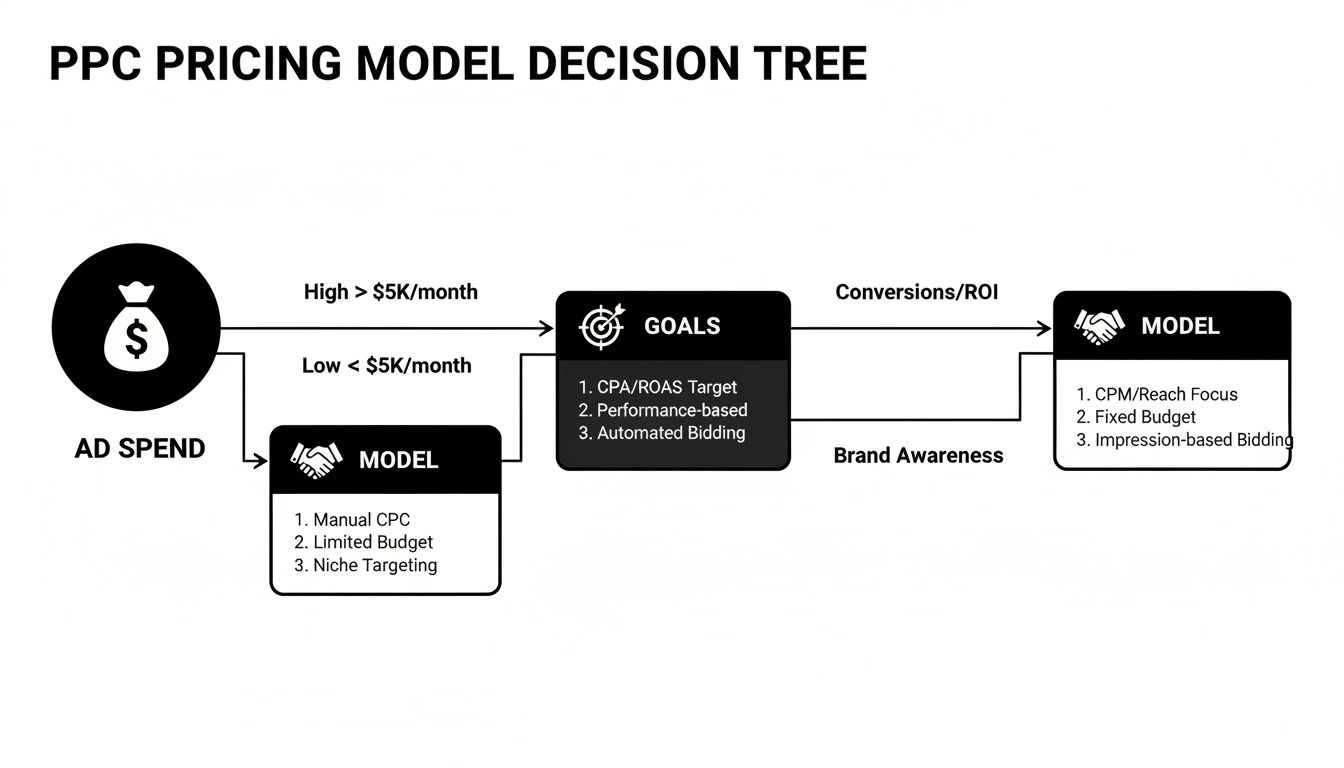
As the flowchart illustrates, businesses with high ad spend and a focus on performance are often a better fit for percentage-of-spend or hybrid models, while those with stable monthly budgets might prefer a flat retainer.
Here are other critical red flags to watch for:
- Vague or "Secret" Strategies: If they can't clearly explain their proposed strategy for your business in simple terms, that's a problem. Be wary of anyone who talks about "secret formulas" or "proprietary methods." Good PPC is a science, not magic.
- They Insist on Owning Your Ad Accounts: This is a non-negotiable, walk-away-now deal-breaker. You, the client, must always own your ad accounts. The agency should only ever be granted administrative access. If you part ways, you keep all your data and campaign history.
- They Don’t Ask Enough Questions: An agency that does all the talking and no listening isn’t interested in your unique challenges. A great partner will be intensely curious about your business long before they ever pitch a solution.
- Unrealistic Cost Expectations: While PPC can be incredibly cost-effective, it requires a realistic budget. For example, 2025 data shows the average Google Ads CPC in South Africa is around R4-R6, but this can easily climb to R20–R100 in competitive sectors like real estate. An agency that promises massive results on a tiny budget likely doesn't understand the local market.
Choosing the right agency is a critical step. For those focusing specifically on Google's platform, you might be interested in our guide on what to look for when hiring a dedicated Google Ads agency.
Building a Partnership That Drives Results

Signing the contract isn't the finish line; it’s the starting block. I’ve seen countless businesses make the mistake of handing over the keys and just hoping for magic. But the real success of your PPC campaigns hinges on forging a strong, collaborative partnership with your new agency.
This relationship needs to be built on clear communication, shared goals, and a mutual understanding right from day one. That’s where a solid onboarding process becomes your most valuable asset. A great pay per click advertising company doesn't just ask for your credit card details; they invest time upfront to become a genuine extension of your team.
Kicking Things Off the Right Way
The first 30 days are less about smashing records and more about laying a rock-solid foundation. This period is critical for your agency to get everything dialled in, from the technical setup to deep strategic alignment. Rushing this stage almost always leads to wasted ad spend and frustration later on.
A proper onboarding process always starts with a formal kickoff meeting. This is more than just a quick hello; it’s a deep-dive session where you share the soul of your business. Your agency needs to get a real feel for your brand voice, your ideal customer profiles, your profit margins, and your biggest business challenges—not just your top-level marketing goals.
From there, the focus shifts to the technical nuts and bolts:
- Tracking and Pixel Setup: This is absolutely non-negotiable. The agency must ensure all tracking pixels (like the Meta Pixel or Google Ads tag) are installed correctly and firing on all key conversion events. Without clean data, you’re flying blind.
- Account Access and Integration: They'll need administrative access to your ad accounts, Google Analytics, and any other relevant platforms. This should be a smooth and secure handover.
- Initial Goal Alignment: This is where you work together to translate broad business objectives into specific, measurable PPC key performance indicators (KPIs).
The onboarding phase isn't just a checklist of tasks; it's the process of building a shared brain. Your agency needs to learn to think like you do, understanding the nuances of your business as if it were their own.
Establishing Clear Communication and Reporting
Once the campaigns are live, the partnership finds its rhythm. This is where clear, consistent communication becomes everything. A good agency will set up a regular cadence for updates, whether that’s a weekly email summary, a bi-weekly call, or a real-time dashboard you can access anytime.
The key is to move beyond vanity metrics. Impressions and clicks look nice on a report, but they don't pay the bills. Your conversations and reports must centre on the numbers that truly impact your business’s health. A professional pay per click advertising company will educate you on these, steering the focus towards metrics that reflect real-world value.
Focusing on Metrics That Actually Matter
The KPIs you track should be a direct reflection of your business model. A one-size-fits-all report is a massive red flag and often a sign of a lazy agency. A tailored approach ensures you're measuring what genuinely drives growth for your specific type of business.
This is why it's so important to agree on the right KPIs from the start. Here’s a quick look at what usually matters most for different business models.
Essential PPC KPIs for Different Business Models
| Business Model | Primary KPI | Secondary KPIs | Why It Matters |
|---|---|---|---|
| eCommerce | Return on Ad Spend (ROAS) | Average Order Value (AOV), Cost Per Purchase (CPP) | This measures the direct revenue generated for every rand spent on ads, giving you a clear picture of profitability. |
| SaaS | Cost Per Acquisition (CPA) | Lead-to-Trial Rate, Customer Lifetime Value (CLV) | This focuses on the cost to acquire a paying customer, ensuring your acquisition efforts are sustainable and scalable. |
| Lead Generation | Cost Per Lead (CPL) | Lead Quality Score, Conversion Rate from Lead to Sale | This tracks the efficiency of lead generation and helps you understand the true value of the leads being produced. |
By focusing on these kinds of outcomes, you create a partnership based on shared success. You’re not just paying for clicks or campaign management; you're investing in a team dedicated to hitting the numbers that grow your bottom line. This framework empowers you to manage the relationship proactively, ensuring your investment delivers tangible, lasting value.
Got Some Lingering Questions Before You Hire?
Even after you’ve done all the due diligence—sifting through proposals, checking references, and sitting through demos—it’s totally normal to have a few last-minute questions buzzing around. Let's be honest, hiring a pay per click advertising company is a big deal and a serious investment. You want to be absolutely sure you're making the right call.
So, let's get into some of the most common (and sometimes awkward) questions that pop up just before you're ready to sign. Getting straight answers here will give you that final bit of confidence you need to move forward.
How Long Until We Actually See Results?
This is the big one, isn't it? The most truthful answer is, "it depends," but it's definitely not an overnight thing. You'll see data like clicks and impressions flowing in almost immediately, sure, but real, tangible business results? That takes a bit more time to build. Think of it less like flipping a switch and more like getting a flywheel spinning.
The first 30 to 60 days are all about discovery and intense testing. Your agency is in the trenches, gathering data, learning what resonates, and setting up the foundations. You should expect to see consistent, scalable performance kicking in somewhere between three to six months. That’s when they’ve had enough time to refine the targeting, nail the creative, and really lean into the strategies that are hitting the mark.
What’s a Realistic Budget to Start With?
There’s no one-size-fits-all number here. Your starting budget is completely tied to how competitive your market is, what you're trying to achieve, and the typical cost-per-click on platforms like Google or Meta. For a small local business, a budget of R15,000 to R30,000 a month can be enough to start gathering meaningful data.
But if you’re a growing e-commerce brand or a SaaS company in a crowded space, a realistic test budget will likely start in the R45,000 to R75,000+ per month ballpark. A good pay per click advertising company won't just pluck a number from thin air. They should be able to justify their recommendation based on a proper analysis of your industry, giving you a starting point that actually allows them to test effectively and find a path to scale.
Here's something crucial to keep in mind: Your budget needs to be big enough to buy enough data. An underfunded campaign is one of the fastest routes to failure because it starves the agency of the very feedback they need to optimise.
Who Actually Owns the Ad Accounts?
You do. Period. This is a non-negotiable, black-and-white issue. As the client, you must always, always retain full ownership and administrative control of your ad accounts—your Google Ads, your Meta Business Manager, everything.
The agency should only ever be granted manager-level access to do their work. This is your safety net. It ensures that all your valuable historical data, campaign learnings, and assets stay with you if you ever decide to switch agencies or bring things in-house. Any agency that tries to set up accounts under their own name is waving a massive red flag.
What Happens If a Campaign Isn’t Working?
Look, not every single idea is going to be a home run right out of the gate. A bit of underperformance here and there is a normal, even necessary, part of the optimisation journey. The real test of an agency’s character is how they handle things when a campaign isn’t hitting its targets.
A professional pay per click advertising company won’t try to sweep bad news under the rug or make excuses. They’ll be the ones to flag it, dig into the data to figure out why it's falling short, and come to you with a clear, data-backed plan of attack. That plan should outline what they’re going to test next, whether it’s new creative, different targeting, or a fresh angle. It’s all about constant iteration based on what the market is telling you.
Ready to work with a Market With Boost team that gives you transparent answers and focuses on measurable growth? We build paid media strategies that are plugged directly into your business goals. Book a discovery call and let's talk about how we can help you scale what works.

Written by
Head of Boost Marketing & Performance Specialist
Dylan is a digital marketer who specializes in conversion and lead generation strategies. He works closely with our clients to tailor their campaigns and evolve strategies based on data and real-time information, ensuring optimal performance and results.

Scale your performance with data-driven insights
Ready to apply these insights to your business? Hannah can walk you through how we'd approach your specific situation.
Hannah Merzbacher
Operations Manager
Continue reading
View all insights
Digital Marketing Pay Per Click: A 2026 Guide
Master digital marketing pay per click in 2026. This guide explains PPC from basics to budgeting, with tips for eCommerce, SaaS, and property brands i...
PPC Advertising Campaigns: 2026 Success Guide
Master PPC advertising campaigns with our expert guide. Learn strategy, setup & optimization to drive business growth and avoid costly mistakes....
A Guide to Google Advertising South Africa in 2026
Master Google Advertising South Africa. Our guide offers practical strategies for local eCommerce, SaaS, and property businesses to drive growth and b...