How Much Do Facebook Ads Cost? A Practical Guide for Businesses

By Dylan Klichowicz
"So, how much do Facebook ads really cost?" It’s the million-rand question, and the honest answer is... it depends. There's no simple price list. Instead, Facebook's ad platform works like a massive, real-time auction where your industry, target audience, and campaign goals all play a part in the final price.
But here’s some great news for businesses in South Africa: our local market gives us a massive advantage. Ad costs here are often way lower than in crowded markets like the US or Europe, meaning your marketing budget can go a whole lot further.
Your Quick Guide to Facebook Ad Costs
Think of buying a Facebook ad less like picking something off a shelf and more like bidding for your ideal customer’s attention. Every single time there’s a space to show an ad to someone scrolling their feed, Meta runs a lightning-fast auction to decide which ad wins that spot.
The interesting part? The winner isn't always the one willing to pay the most. It's the ad that Meta thinks will provide the most value to the user. This dynamic system means your final cost is always a moving target, influenced by dozens of factors.
Understanding the Key Metrics
Before we dive in, let's get comfortable with the language of paid ads. These are the three main metrics that tell you exactly what you're paying for.
- Cost Per Click (CPC): This one's easy—it's the price you pay every time someone clicks on your ad. It’s a straightforward way to measure the cost of getting people to your website or landing page.
- Cost Per Mille (CPM): "Mille" is just a fancy Latin word for a thousand. So, your CPM is what it costs for 1,000 people to see your ad. This metric is all about getting eyeballs on your brand.
- Cost Per Acquisition (CPA): This is probably the most important one. It’s the cost to get a customer to do something specific and valuable—like make a purchase, fill out a lead form, or download an app.
The core idea is simple: you're not just buying ad space; you're bidding for a result. Whether that result is a click, a view, or a sale, your cost is tied directly to the action you want your audience to take.
These metrics become even more powerful when you see how they fit into your overall strategy. For instance, knowing your ad costs is key to running effective video marketing for small businesses, as it helps you calculate the real return on every rand you spend.
Typical Facebook Ad Cost Benchmarks in South Africa vs Global Averages
To put the South African advantage into perspective, here’s a quick look at how our local costs stack up against what businesses are paying overseas. The difference is often pretty surprising.
This table sums up the key cost metrics, highlighting the big cost advantages for advertisers targeting people in South Africa.
| Metric | Average Cost in South Africa | Typical Global Average | Cost Advantage |
|---|---|---|---|
| Cost Per Click (CPC) | R 4.50 - R 9.00 | R 15.00 - R 55.00+ | 60-80% lower |
| Cost Per 1000 Impressions (CPM) | R 30.00 - R 75.00 | R 180.00 - R 225.00+ | Up to 75% lower |
| Cost Per Acquisition (CPA) | R 150.00 - R 450.00 | R 300.00 - R 900.00+ | 50-60% lower |
As you can see, the numbers speak for themselves. With less competition for ad space compared to places like the US and Europe, your marketing budget can deliver way more clicks, impressions, and conversions right here at home. This lets even small businesses compete effectively and get a great return on their ad spend.
How the Facebook Ad Auction Actually Works
Ever wonder what happens in the milliseconds after you hit ‘publish’ on your new campaign? It’s not just a case of the biggest budget winning. Meta runs a super-fast auction to decide which ad gets shown, and it’s a clever balancing act between what you want and what the user wants to see.
Think of it as a competition for prime digital real estate—a spot in someone's News Feed. Every time a user opens Facebook or Instagram, an auction kicks off to fill the available ad slots. But here’s the secret: the winner isn't just the highest bidder. It’s the advertiser who creates the most overall value.
This system is built to reward ads that people actually find interesting. A super-relevant, engaging ad can often beat a competitor with deeper pockets, which is fantastic news for businesses of all sizes.
The Three Pillars of the Ad Auction
To get a real grip on what your Facebook ads will cost, you need to understand the three main ingredients Meta’s algorithm mixes together to pick a winner. The ad with the highest "total value" gets the prize.
The formula looks a bit technical, but the idea behind it is simple:
[Your Bid] x [Estimated Action Rate] + [Ad Quality] = Total Value
Let's break down what each of these means for your campaigns and your budget. It's much more straightforward than it looks.
1. Your Bid
This part is pretty simple. Your bid is just what you're willing to pay to get your desired result—be it a click, a lead, or a sale. You can set this amount yourself (manual bidding) or, as most advertisers do, let Meta's algorithm handle it for you (automatic bidding).
It’s a bit like telling a real estate agent your top offer for a house. It shows Meta you’re serious, but it doesn't automatically mean the keys are yours.
2. Estimated Action Rate
This is where things get interesting. The estimated action rate is Meta’s best guess at how likely a specific person is to take the action your ad is pushing for. If you’re running a traffic campaign, Meta predicts the chance of that user clicking your link. If your goal is sales, it estimates the chance of them actually buying something.
This prediction is based on everything Meta knows—your ad's past performance, the user's previous behaviour, and a whole lot more. An ad that consistently drives clicks will naturally have a higher estimated action rate, making it a much stronger contender in the auction.
3. Ad Quality
Finally, we have ad quality. This is Meta’s verdict on how relevant and engaging your ad is to the people you’re trying to reach. It’s a huge factor, and getting it right can dramatically lower your costs.
Meta judges your ad’s quality based on a few key signals:
- User feedback: This covers both the good (likes, shares, comments) and the bad (people hiding or reporting your ad).
- Dodgy tactics: Ads that use clickbait, sensationalist headlines, or other "engagement bait" tricks get penalised with a lower quality score.
- The post-click experience: The quality of your landing page is a big deal. If people click your ad and instantly leave your website, it tells Meta the experience was poor, and your score will suffer.
At the end of the day, a high-quality ad that people find genuinely useful can win the auction even with a lower bid. This is how Meta keeps its users happy, and it’s the secret to making every Rand you spend work that much harder for your business.
Getting to Grips with Facebook Ad Cost Benchmarks
Now that you understand how the ad auction works, let's talk real numbers. What should you actually budget for your Facebook ads? Think of ad cost benchmarks as a map for your marketing journey—they help you set a realistic budget and tell you if you're on the right track.
The good news for businesses in South Africa is that we have a serious home-ground advantage. Our market isn't as crowded as places like the US or Europe, which means our ad spend often goes a lot further. Your budget can simply buy you more attention here.
This diagram breaks down the three main ingredients Meta's ad auction uses to decide who wins the ad spot: your bid, the ad's quality, and how likely someone is to take action.
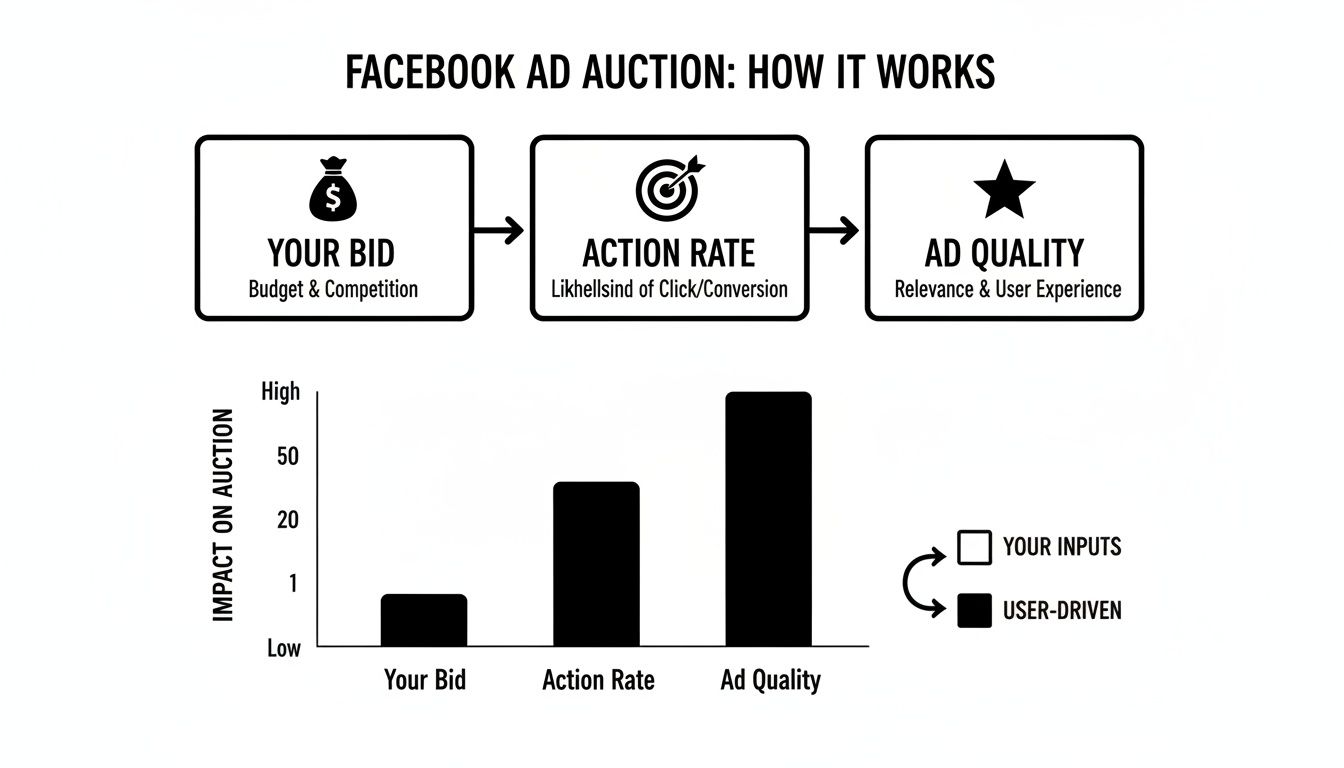
As you can see, a high-quality, relevant ad can actually beat a higher bid from a competitor. This is a game-changer because it means you don't always have to outspend everyone to win.
The Key Metrics That Dictate Your Ad Costs
To figure out if your ads are actually working, you need to speak the language of your Ads Manager dashboard. These are the main metrics you’ll be tracking, and each one tells a unique part of your performance story.
Cost Per Click (CPC): This is exactly what it sounds like—the price you pay every time someone clicks on your ad. It’s a crucial metric for measuring how much it costs to get people to your website, making it a go-to for eCommerce stores and SaaS businesses trying to fill their sales funnel.
Cost Per Mille (CPM): "Mille" is just a fancy Latin word for a thousand. So, your CPM is what it costs for your ad to be shown 1,000 times (impressions). This is your go-to metric for brand awareness campaigns, where the main goal is just getting your name in front of as many relevant eyeballs as possible.
Cost Per Acquisition (CPA): You might also see this called Cost Per Conversion. It’s the total cost to get someone to take a specific, valuable action—like making a purchase, filling out a lead form, or downloading your app. For most businesses, this is the most important number because it connects your ad spend directly to a real business result.
Your campaign objective is what determines which of these metrics you should obsess over. A traffic campaign lives and dies by its CPC, while a sales campaign is all about hitting a profitable CPA.
Understanding these benchmarks is where it gets really interesting, especially when you see how much more affordable the South African market can be. Local businesses regularly enjoy cost advantages of 50-92% compared to global averages. The average CPC in South Africa is about 55% lower than in the US, where a similar lead generation ad might cost around $1.92 per click. This translates directly into a lower cost to acquire new customers. You can learn more about these global cost comparisons and the factors that influence them.
Average Facebook Ad Costs by Campaign Objective in South Africa
A detailed look at expected costs for different advertising goals, helping businesses budget more effectively.
Your campaign objective is one of the biggest things that affects your costs. It makes sense, right? An ad designed to get a simple 'like' is going to be far cheaper than one aiming to secure a R1,000 online sale. To give you a clearer picture, here’s a breakdown of typical costs you can expect for different campaign goals when advertising here in South Africa.
| Campaign Objective | Key Metric | Average Cost Range (ZA) | Best For |
|---|---|---|---|
| Awareness & Reach | CPM (Cost Per 1,000 Impressions) | R30 – R75 | Getting your brand in front of a new, broad audience. Ideal for new businesses or product launches. |
| Traffic | CPC (Cost Per Click) | R4 – R9 | Driving visitors to your website, blog, or a specific landing page to learn more. |
| Engagement | CPE (Cost Per Engagement) | R1 – R3 | Encouraging likes, comments, and shares to build social proof and community around your brand. |
| Lead Generation | CPL (Cost Per Lead) | R75 – R250 | Collecting contact details from potential customers, perfect for SaaS and property businesses. |
| Sales (Conversions) | CPA (Cost Per Acquisition/Purchase) | R150 – R450+ | Driving direct sales on your eCommerce store. The cost can vary widely based on your product's price. |
These figures are a great starting point for your financial planning. If your campaign costs are landing within these ranges, you know you're in the right ballpark. If they're creeping up higher, it’s a clear signal that it’s time to look at other factors—like your audience targeting, ad creative, or landing page—to see where you can make improvements.
The 7 Key Factors That Drive Your Ad Costs
Ever wondered why one eCommerce brand pays R5 per click while another, seemingly similar business pays R50? It’s not random. Meta's ad auction is a dynamic marketplace, and a handful of key variables have a massive say in what you end up paying.
Getting a handle on these factors is the first step to understanding why your costs are what they are. More importantly, it shows you how to start bringing them down. It’s the difference between being a passenger along for the ride and getting into the driver's seat of your own campaigns.
1 Your Audience Targeting
Who you decide to show your ads to is probably the single biggest factor affecting your ad spend. It all boils down to simple supply and demand. If you're going after a popular, high-value audience that all your competitors want, you can bet you’re going to pay a premium for it.
- Broad Audiences: Targeting a huge group, like "women aged 25-45 in Gauteng," often means a lower cost per thousand impressions (CPM) simply because the pool of people is enormous. The catch? You might be burning cash showing your ads to people who couldn't care less.
- Niche Audiences: On the other hand, a laser-focused group like "property investors in Cape Town interested in commercial real estate" will be much more competitive and, therefore, more expensive. The upside is that every click you get is from a far more qualified and interested person.
The real skill is finding that sweet spot between broad reach and niche relevance to make your budget work smarter, not harder.
2 Your Ad Quality and Relevance
Meta has one core mission: keep users on their apps for as long as possible. An ad that people find interesting, relevant, and engaging helps them do that. An ad that looks like spam and gets ignored does the opposite.
This is why the algorithm heavily rewards ads that people actually like. It even gives you a scorecard, called "ad relevance diagnostics," which looks at:
- Quality Ranking: How your ad’s perceived quality stacks up against other ads competing for the same eyeballs.
- Engagement Rate Ranking: How likely people are to click, comment, or share your ad compared to the competition.
- Conversion Rate Ranking: How your ad's predicted conversion rate compares to others with the same goal.
Think of it like this: a low-quality ad is a red flag for Meta. The platform will essentially "tax" you for running a bad ad by making you pay more to show it. A great ad gets rewarded with lower costs and better visibility.
3 The Time of Year and Seasonality
Just like a holiday rental in December costs more than it does in May, ad costs have their own seasons. The main reason is competition. During peak shopping periods, the ad auction gets incredibly crowded, and prices shoot up for everyone.
An eCommerce brand, for example, will see its costs skyrocket during the run-up to Black Friday and the December holidays. Everyone is bidding for the same shoppers. A property business might see a spike at the start of the year when "buy a new home" becomes a popular New Year's resolution. Knowing these seasonal trends helps you budget properly and avoid any nasty surprises.
4 Your Chosen Ad Placement
Not all ad real estate is created equal. "Placement" just means where your ad shows up across Meta’s universe—the Facebook News Feed, Instagram Stories, Messenger inbox, and so on. Some of these spots are prime digital real estate and come with a premium price tag.
The Facebook and Instagram Feeds are usually the most competitive and expensive placements because that's where user attention is highest. Placements like the Audience Network (which shows ads on other websites and apps) can be a lot cheaper, but the quality of the traffic can sometimes be lower.
For most advertisers, letting Meta handle it with Advantage+ Placements is the best move. This lets the algorithm figure out the cheapest places to show your ad to get the results you want.
5 The Campaign Objective You Choose
When you set up a campaign, your chosen objective is a direct instruction to Meta about what you want to achieve. The platform then prices that action based on its value. A low-commitment action is cheap; a high-commitment one costs more.
For instance, a Reach campaign will have a very low CPM because you're literally just paying for eyeballs—nothing more. But a Sales or Leads campaign will have a much higher CPA because you're asking the algorithm to find people likely to pull out their credit card or fill in a form. That’s a much more valuable outcome.
Aligning your objective with your real business goal is crucial. This is also a huge difference when you weigh up proper paid ads vs boosted posts. To get a better sense of this, you can explore the key differences between paid ads and boosted posts in our detailed guide.
6 Your Ad Creative and Format
The ad itself—the image, the video, the words—is what actually has to stop someone from scrolling. A boring, generic ad will be completely ignored. That means low engagement, a poor quality score, and, you guessed it, higher costs.
- Video ads tend to grab attention better than static images. They can tell a story and are more dynamic, often leading to better engagement and lower costs.
- Carousel ads are fantastic for eCommerce brands, letting you show off a whole range of products in a single, interactive ad.
- UGC (User-Generated Content) feels more real and authentic than polished brand photos, which can build trust and cut through the noise.
You have to test different formats to see what your audience actually responds to. The answer is often surprising.
7 The Level of Competition
At the end of the day, your costs are a direct reflection of how many other businesses are chasing the same people you are. If you're a SaaS company targeting marketing managers, you’re in a bidding war with thousands of other software firms. That intense competition drives prices up for everyone involved.
This is where finding a unique angle or a less-crowded niche can be a real game-changer. If you can pinpoint an underserved segment of your market, you can often reach them for a fraction of what it costs to go after the main crowd.
Real-World Budgeting Scenarios
Alright, theory is great, but let's talk about what this looks like in the real world. Knowing the benchmarks is one thing; turning them into a practical budget that actually works is another.
Let's walk through a couple of common scenarios. Seeing the numbers in action will help you shift from just spending money to making smart, strategic investments in your business.
Scenario 1: The eCommerce Store
Imagine you’re running a direct-to-consumer (DTC) brand in South Africa, selling beautiful, handcrafted leather bags. Your goal is straightforward: get more sales. So, how much should you set aside to get a solid return?
Here’s a simple way to map out your budget for a sales campaign.
The Campaign Setup:
- Monthly Ad Budget: R15,000
- Average Product Price: R1,200
- Target Cost Per Acquisition (CPA): R300 (This is the maximum you're willing to pay to get one sale)
With a target CPA of R300, your R15,000 budget should aim to generate 50 sales per month (R15,000 ÷ R300 = 50). This CPA is your north star; it's the number that tells you if you're profitable or not.
Calculating Your Return on Ad Spend (ROAS):
So, what does the return look like? Let's do the maths.
- Total Sales Generated: 50 sales
- Total Revenue: 50 sales x R1,200 per sale = R60,000
- Total Ad Spend: R15,000
- ROAS Calculation: (Total Revenue ÷ Total Ad Spend) = (R60,000 ÷ R15,000) = 4x
For every R1 you put into Facebook ads, you got R4 back in sales. This is a healthy 4x ROAS, showing a profitable campaign. This kind of simple calculation helps justify your ad spend and lets you make decisions based on real data.
Scenario 2: The SaaS Company
Now, let's switch gears to a completely different business: a software-as-a-service (SaaS) company. Their goal isn't an immediate online sale; they want to generate qualified leads—demo requests—for their sales team to follow up on.
This completely changes how we measure success. Instead of ROAS, the metric that really matters here is the Cost Per Lead (CPL).
The Campaign Setup:
- Monthly Ad Budget: R20,000
- Goal: Generate demo requests from marketing managers.
- Target Cost Per Lead (CPL): R200
A target CPL of R200 means your R20,000 budget should bring in about 100 leads for the month (R20,000 ÷ R200 = 100). But the maths doesn't stop there. A lead is great, but what we really need to know is the cost to get a paying customer.
Projecting Customer Acquisition Cost (CAC):
- Leads Generated: 100
- Lead-to-Customer Conversion Rate: Let's assume your sales team is solid and converts 10% of these demo requests into paying customers.
- New Customers: 100 leads x 10% = 10 new customers
- CAC Calculation: (Total Ad Spend ÷ New Customers) = (R20,000 ÷ 10) = R2,000
Your final Customer Acquisition Cost is R2,000. If your customer's lifetime value (LTV) is, say, R10,000, then spending R2,000 to acquire them is a fantastic investment. Understanding where your audience is most active is also key; check out our guide on Meta vs Google Ads to see which platform better aligns with your goals.
For businesses focused on mobile growth, the Cost Per App Install (CPI) in South Africa reveals a huge cost advantage. For the Marketing & Advertising industry, recent data shows a median CPI of just $0.89, a fraction of the global benchmark of $10.62. That’s a massive 92% saving, making it a prime market for app acquisition campaigns. You can discover more insights about app install costs on SuperAds.ai.
Actionable Strategies to Lower Your Ad Spend
Knowing your numbers is a great start, but actively pushing them down is where you'll find your competitive edge. This all comes down to optimisation—making smart, data-backed tweaks that squeeze every last bit of value out of your budget.
You don't need a massive budget to get results; you just need to be smarter with the budget you have. Let's get into some proven, hands-on tactics you can put to work today to make your campaigns more efficient and make that ad spend go further.
Refine Your Audience Targeting
One of the fastest ways to burn through your money is showing your ads to the wrong crowd. It's really that simple: the more relevant your ad is to the person seeing it, the better it will perform and the less you’ll pay.
Start by digging into your own customer data. Who are your best customers? Use that info to build super-specific Custom Audiences and then create Lookalike Audiences from them. This essentially tells Meta, "go find me more people just like my most valuable customers."
Don't be afraid to get granular. A smaller, hyper-relevant audience that converts will always be more cost-effective than a massive, generic one that doesn't.
Remember to use exclusion lists, too. This stops you from wasting money on people who are never going to convert. For example, if you're trying to win new customers, make sure you exclude anyone who has already bought from you in the last 30 or 60 days.
A/B Test Everything Relentlessly
Never, ever assume you know what will work best. The only way to find your winning ad creative and copy is to test them against each other. A/B testing, or split testing, is your best friend when it comes to lowering costs.
Create a few different versions of your ads and test just one thing at a time. This methodical approach is key because it tells you exactly which change made the difference.
- Creative: Test a video ad against a static image. Try a carousel ad against a single product shot. You’ll often be surprised by what actually grabs people’s attention.
- Ad Copy: Experiment with different headlines. Test a short, punchy sentence against a longer, more detailed paragraph.
- Call-to-Action (CTA): Does "Shop Now" work better than "Learn More"? The only way to know for sure is to test it.
Even tiny improvements in your click-through rate (CTR) can lead to some pretty significant cost savings over the life of a campaign.
Leverage the Power of Retargeting
It's a classic marketing truth: it’s much easier to sell to someone who already knows who you are. Retargeting campaigns are built on this idea, showing specific ads to people who have already visited your website, engaged with your Facebook page, or even added an item to their cart.
This audience is already "warm," which means they are far more likely to convert. Because of this higher chance of conversion, retargeting campaigns almost always have a lower Cost Per Acquisition (CPA) than campaigns targeting a completely cold audience.
This cost advantage is especially noticeable in South Africa's advertising space. For instance, 2025 data showed the Cost Per Purchase for the Design industry in South Africa averaged just 1.57—a number that's about 97% lower than the global median. You can explore more details on these South Africa-specific cost benchmarks to get the full picture.
Beyond managing day-to-day costs, learning how to strategically scale your Facebook ads for profits is what really sets you up for long-term growth. Consistent optimisation, paired with expert insights on scaling, is what separates the good campaigns from the great ones. For businesses ready to take their results to the next level, our dedicated Facebook Ads management services can help you implement all these strategies effectively.
Your Top Facebook Ad Cost Questions, Answered
Getting into Facebook ads always brings up a ton of questions, especially around the money side of things. How much should I spend? Why are my costs so high? Let's tackle some of the most common questions I hear from clients to help you get a handle on your budget.
What’s a Good Starting Budget for Facebook Ads?
There's no single "right" answer, but a solid starting point for a small business is somewhere in the R150 to R300 per day range. This is usually enough to give Meta’s algorithm the data it needs to get out of its initial "learning phase" and start finding the right people for your ads.
The trick is to pick a number you're comfortable with and let it run for at least 7-10 days without messing with it too much. This gives the system time to stabilise and gives you a much clearer picture of what's actually working.
Why Are My Facebook Ad Costs So High?
If your ad costs are making your eyes water, it's almost always down to one of a few usual suspects. Before you panic, take a look at these common problem areas.
- Audience Problems: You might be targeting too broadly, which wastes money on irrelevant clicks. On the other hand, you could be targeting an incredibly competitive audience that every other advertiser is also trying to reach, driving up the price.
- Weak Ad Creative: Let's be honest, if your ad is boring, people will scroll right past it. Low engagement tells Meta your ad is low-quality, and they’ll charge you more to show it.
- A Rough Post-Click Experience: A user clicks your ad, but your landing page is slow, clunky, or just plain confusing. They leave immediately. This kills your conversion rate and signals to Meta that your ad isn't providing a good experience.
A good first step is to dive into your ad’s relevance scores and click-through rate. The data will usually point you straight to the source of the problem.
High ad spend is rarely just about the budget itself. It's usually a symptom of a deeper issue with your audience, your creative, or the journey you're sending people on after they click.
How Long Should I Wait Before Deciding if an Ad Is Working?
Patience is probably the hardest but most important skill in this game. You really need to let a new campaign run for at least 4-7 days before you start making big calls on its performance.
Jumping the gun and making changes after just a day or two can throw the algorithm's learning process right back to square one, leaving you with messy, unreliable data. Look for trends over a week, not knee-jerk reactions to a single day's results. And for conversion-focused campaigns, a good rule of thumb is to wait until you've hit at least 50 conversion events before making any final judgements.
Ready to turn your ad spend into a predictable revenue engine? Market With Boost builds data-driven paid media strategies that deliver measurable results. Book a discovery call today and let's uncover your brand's growth opportunities.

Written by
Head of Boost Marketing & Performance Specialist
Dylan is a digital marketer who specializes in conversion and lead generation strategies. He works closely with our clients to tailor their campaigns and evolve strategies based on data and real-time information, ensuring optimal performance and results.

Scale your performance with data-driven insights
Ready to apply these insights to your business? Hannah can walk you through how we'd approach your specific situation.
Hannah Merzbacher
Operations Manager
Continue reading
View all insights
How Much Do Facebook Ads Really Cost in South Africa?
Curious how much does fb ads cost? Get clear pricing ranges, budgeting tips, and expert insights to maximize your ROI on Facebook ads....
How to Optimize Facebook Ads: Boost ROAS in 2026
How to optimize facebook ads - Optimize Facebook ads with our 2026 playbook. Tailored for DTC, SaaS & property, boost ROAS via Pixel setup, targeting ...
Unlock Leads With Facebook Ads for Real Estate Agents
Facebook ads for real estate agents - Generate qualified leads with our playbook on Facebook ads for real estate agents in South Africa. Master target...