A Guide to Digital Marketing for Ecommerce Growth

By Chris Edington
When we talk about digital marketing for eCommerce, we're not just talking about running a few ads or posting on social media. It's the entire system you build to find new customers, convince them to buy, and keep them coming back. It’s a growth engine, meticulously designed to build a real brand and drive sales in a marketplace that gets more crowded by the day.
For any ambitious brand, especially in South Africa's booming online space, getting this right isn't optional—it's everything.
Your Blueprint for Ecommerce Marketing Success
A great product and a sharp-looking website are just the starting point. The real challenge for direct-to-consumer (DTC) founders and marketing managers is simple: how do you stand out? The answer lies in building a powerful, interconnected system that attracts, converts, and retains customers like clockwork.
Think of your marketing strategy like a high-performance engine. Your paid ads on Meta and Google are the fuel injectors, your SEO is the turbocharger providing a constant boost, and your website's user experience is the finely-tuned transmission that turns all that power into forward motion. If one part sputters, the whole machine loses momentum.
To get every part working in perfect harmony, we need a solid framework. Everything in this guide is built on four core pillars that form the foundation of a winning eCommerce strategy. This isn't abstract theory; it's an actionable roadmap.
Let's break down these pillars. Think of them as the essential components of your growth machine, each with a clear job to do.
The Four Pillars of Ecommerce Growth
| Pillar | Objective | Key Channels/Tactics |
|---|---|---|
| Strategic Channel Mastery | Find and attract your ideal customers where they spend their time online. | Meta Ads (Facebook & Instagram), Google Ads (Search & Shopping), SEO, TikTok, Pinterest, Amazon Ads |
| Full-Funnel Optimisation | Guide users seamlessly from initial awareness to making a purchase and becoming a loyal fan. | Top/Middle/Bottom of Funnel campaigns (TOF/MOF/BOF), Email & SMS Marketing, Retargeting |
| Conversion Rate Improvement | Turn more website visitors into paying customers by removing friction and building trust. | A/B Testing, Landing Page Optimisation, UX/UI improvements, Offer & Messaging tweaks |
| Data-Driven Budgeting | Measure what truly matters to allocate your budget smartly, prove ROI, and scale profitably. | Key Performance Indicators (KPIs), Attribution Modelling, Incrementality Testing |
Mastering these pillars moves your brand from just surviving to truly thriving.
The timing couldn't be better. South Africa’s online retail scene is set to explode past R130 billion in turnover by the end of 2025, grabbing nearly 10% of the country's total retail market. That’s on the back of a massive 35% jump to R96 billion in 2024, completely dwarfing the 2.5% growth seen in traditional brick-and-mortar stores. The opportunity is massive for those who get it right.
Your digital marketing efforts should function as a cohesive ecosystem. Each channel and tactic must support the others, creating a customer experience that feels seamless and intuitive, guiding them effortlessly towards a purchase.
This integrated mindset is the secret sauce. For example, understanding the role of influencer marketing in ecommerce can supercharge your efforts across social channels and build trust far more quickly than ads alone.
By focusing on these four pillars, you'll have the tools to build more than just an online store—you'll build a resilient, profitable eCommerce brand built for the long haul.
Building a Full Funnel Customer Journey
Good eCommerce marketing isn't just about shouting your message from the rooftops and hoping someone listens. It’s about being a great guide. Think of it like a helpful shop assistant leading a customer through a physical store, from the front door to the till. We often map this out as a "funnel".
Let's imagine your online store is a real-world shop on a busy high street. Some people are just strolling past, catching a glimpse of your window display. They're at the Top of the Funnel (TOF). They weren't planning on stopping, but something you've put out there has sparked their curiosity.
A few of those people decide to step inside. They start browsing the aisles, picking up products, and looking at the price tags. These shoppers have moved into the Middle of the Funnel (MOF). They're seriously thinking about making a purchase.
Finally, you have the customers at the counter, wallet in hand, ready to pay. This is the Bottom of the Funnel (BOF). Your job here is to make that final step as seamless as possible. A full-funnel strategy means you have a specific plan for each of these stages, ensuring no one gets lost along the way.
This whole process can be broken down into a simple, repeatable blueprint: you use different channels to attract people, guide them through the funnel, and then use data to make the entire system smarter.
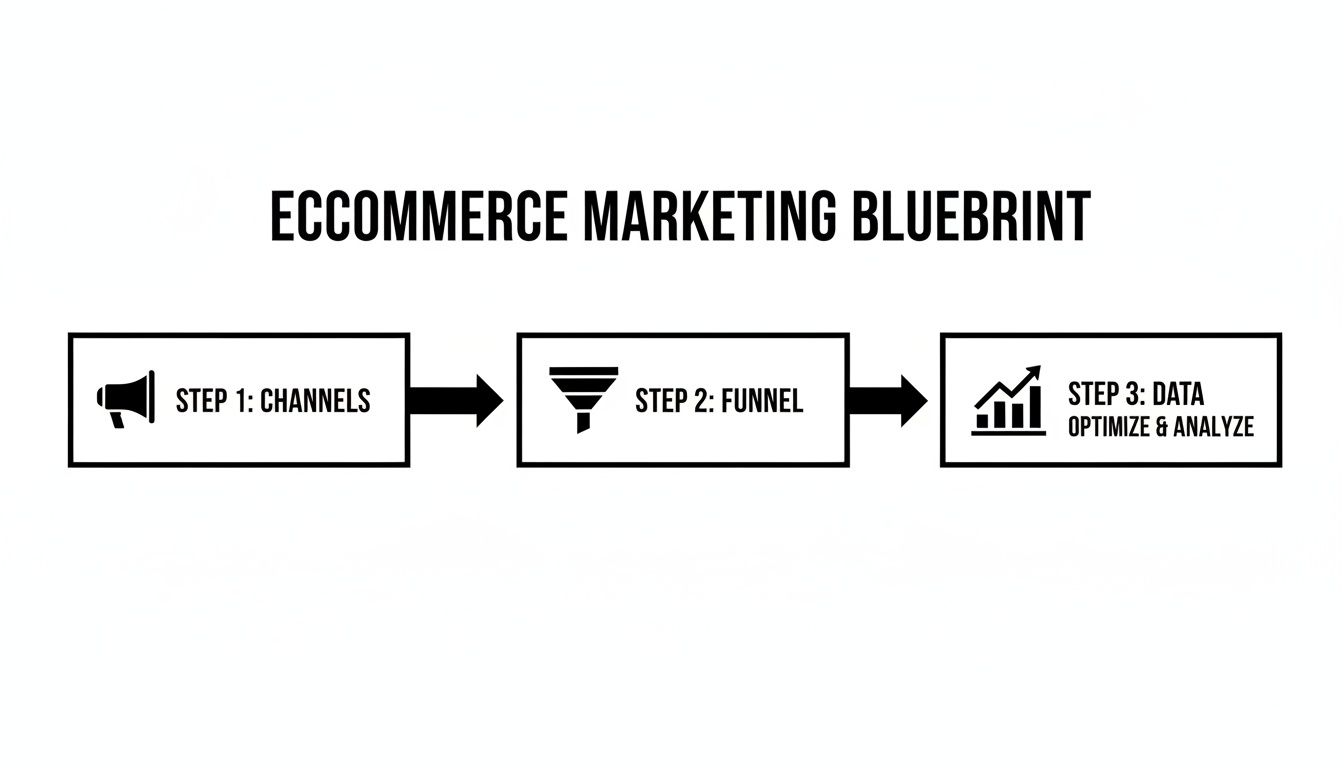
As you can see, successful marketing is a connected system. The channels feed the funnel, and the data coming out of the funnel tells you exactly how to adjust your channel strategy for better results.
Top of Funnel: Attracting the "Window Shoppers"
Right at the top, your main goal is simply getting noticed. You're trying to introduce your brand to people who look like your ideal customer but have probably never heard of you. Their mindset is all about passive discovery—they're scrolling through feeds, watching videos, and just exploring online.
This is not the time for a hard sell. Your marketing needs to be the digital equivalent of an amazing window display: it should be entertaining, educational, or inspiring.
- Key Channels: TikTok, Instagram Reels, and Pinterest are brilliant for this stage. Their algorithms are designed for discovery, pushing engaging content out to fresh audiences who are likely to be interested.
- Primary Goals: Maximise reach, impressions, and video views. It’s a numbers game—you want to get in front of as many relevant eyeballs as you can.
- KPIs to Watch: Keep an eye on Cost Per Mille (CPM), Reach, Video View Rate, and the number of brand-new visitors hitting your website.
Middle of Funnel: Nurturing the Active Browsers
Once someone has shown a flicker of interest—maybe they clicked an ad or spent some time on your site—they've stepped into the middle of the funnel. They now know they have a problem and that you might have the solution. Your task is to build trust and show them exactly why your product is their best bet.
Here, the strategy shifts from broadcasting a wide message to starting a conversation. You're no longer just shouting into a crowd; you're talking to the people who raised their hands.
The middle of the funnel is where brands are often won or lost. It's not enough to get a click; you must provide value, answer questions, and build a connection that makes the customer feel confident in their choice.
A great way to do this is with retargeting campaigns on platforms like Meta (Facebook and Instagram). You can show these engaged users customer testimonials, detailed product benefits, or user-generated content to solidify their initial interest and nudge them closer to a decision.
- Primary Goals: Drive consideration and engagement. You want to see them adding items to their cart, signing up for your newsletter, or downloading a useful guide.
- KPIs to Watch: Focus on Click-Through Rate (CTR), Landing Page Views, Add to Carts, and Cost Per Lead.
Bottom of Funnel: Closing the Sale
By the time a customer reaches the bottom of the funnel, their intent to buy is high. They’re no longer just browsing; they are actively searching for a product to buy right now. Your marketing needs to be direct, persuasive, and incredibly easy to act on. This is where you roll out your best offers and ensure the checkout process is completely frictionless.
Google Shopping Ads are an absolute powerhouse at this stage. Think about it: when someone searches for "men's leather boots size 10," they aren't just doing research. They have their credit card ready. Your ad needs to be right there at that exact moment.
- Key Channels: Google Shopping, Search Ads, and Meta Dynamic Product Ads are your go-to tools here.
- Primary Goals: Drive conversions and maximise your return. Every rand you spend should be bringing revenue back in.
- KPIs to Watch: The most important metrics are Conversion Rate, Return On Ad Spend (ROAS), Cost Per Acquisition (CPA), and Average Order Value (AOV).
Mastering the Channels Where Your Customers Spend Time
Once you’ve mapped out the customer journey, the real work begins: choosing the right tools to meet them along the way. Think of your marketing channels like a fishing tackle box. You wouldn't use a deep-sea trawler to fish a small stream, and you wouldn’t try to land a marlin with a handheld net. Each platform has its own audience, purpose, and strengths.
Great eCommerce marketing isn't about shouting from every rooftop. It's about being in the right places with the right message at the right time. For ambitious DTC brands in South Africa, this means a laser focus on the platforms that genuinely move the needle.
We’re going to dive into the big three: Meta for building community and stoking desire, Google for capturing red-hot buyer intent, and TikTok for sparking discovery with content that feels real.
Meta Ads: Fuelling Demand on Facebook and Instagram
Meta's platforms—Facebook and Instagram—are still the kings of top- and middle-funnel marketing. With billions of users, their real power comes from an incredibly sophisticated targeting engine that lets you find your perfect customer, even if they’ve never heard of you.
The entire game on Meta is about stopping the scroll. People are there to be entertained, not to shop. Your creative, whether it's an image or a video, has less than three seconds to grab their attention and pull them in.
This is why a solid creative testing strategy isn't just a nice-to-have; it's essential. Never just launch one ad and cross your fingers. You need to be constantly testing different hooks, visuals, and copy to figure out what truly clicks with your audience.
- Test your angles: Does your audience care more about a product’s benefits, its standout features, or seeing what other customers have to say?
- Test your formats: Put your slick, high-quality studio shots up against raw user-generated content (UGC). You might be surprised when a simple phone video out-pulls a polished, expensive ad because it just feels more authentic.
- Test your hooks: Play around with the first line of your copy or the first few seconds of a video. What makes people stop and pay attention?
On Meta, your creative is the single biggest variable. The algorithm is a genius at finding the right people, but it can’t make them care about your product. Your job is to feed it thumb-stopping content that makes them pause, listen, and want to know more.
By constantly testing and learning, you give the algorithm the data it needs to work its magic, leading to lower costs and much better returns down the line.
Google Ads: Capturing Intent with Search and Shopping
While Meta is fantastic for creating demand, Google is where you go to cash in on it. When someone types "buy leather hiking boots online" into the search bar, their intent couldn't be clearer. They’re at the bottom of the funnel with their wallet out, ready to buy.
For any eCommerce brand, Google Shopping campaigns are non-negotiable. These are the product listings with images and prices you see right at the top of the search results. They’re brutally effective because they give a user all the key info they need before they even click.
Performance Max is Google's newer, AI-powered campaign type that bundles Shopping, Search, YouTube, and Display ads into one. It automates your targeting and bidding to find customers across all of Google's properties, making it a powerful way to scale once you have an offer that converts. Just make sure you feed it high-quality creative assets and clear conversion goals.
Of course, paid search works best when it's supported by a strong organic presence. Check out our guide on SEO best practices for your online store (https://www.marketwithboost.com/insights/seo-best-practices-for-your-online-store-in-2022) to learn how you can capture that valuable, high-intent traffic for free.
TikTok: Igniting Discovery Through Authenticity
TikTok has completely flipped the script on top-of-funnel marketing. Its algorithm is scary good at serving up content to hyper-specific niche audiences, which is how new brands can seemingly go viral overnight and find their tribe.
The secret to winning on TikTok is to forget everything you know about traditional advertising. Polished, corporate ads almost always fall flat. Users crave content that’s authentic, raw, and entertaining—something that feels like it belongs on the platform.
Basically, you need to think less like a brand and more like a creator.
- Embrace Lo-Fi Content: Grab your phone and shoot simple, UGC-style videos. Show your product in action, tell your brand's origin story, or hop on a trending sound.
- Partner with Creators: Work with influencers who are a genuine fit for your brand. Their endorsement is powerful social proof that introduces your product to an audience that already trusts them.
- Focus on Storytelling: The best TikTok ads don't even feel like ads. They’re mini-stories, funny skits, or genuinely helpful tutorials that just happen to feature your product.
This shift to authentic, mobile-first content isn’t just for TikTok. In South Africa, mobile commerce is exploding, with 51.7% of all online purchases in 2024 made on smartphones. That number is driven by the fact that 99.3% of internet users own a smartphone, compared to just 79.1% who own a computer. To keep up, your brand has to think mobile-first.
And when it comes to nurturing those leads and keeping customers coming back, email is still a heavyweight champion. Exploring the top email marketing software for ecommerce businesses will help you find the right tools to build lasting relationships with your audience. By mastering these different channels, you create a powerful, multi-pronged approach that drives sustainable growth.
Turning Clicks into Customers with Conversion Rate Optimisation
Pouring money into ads without optimising your website is like trying to fill a bucket with holes. You can keep pouring more and more water in, but you’ll never fill it up. This is the costly reality for many eCommerce brands who get the clicks but can't turn them into paying customers.
This is where Conversion Rate Optimisation (CRO) comes in. Think of it as the plumbing for your digital marketing engine. It’s the continuous process of finding and fixing the "leaks" in your sales funnel—those spots where potential buyers drop off—to make sure more of your hard-won traffic actually makes it to the checkout.
CRO isn't a one-and-done project. It's an ongoing discipline of listening to your data, understanding how users behave, and making small, strategic improvements. These tweaks add up to serious revenue growth. A tiny increase in your conversion rate, say from 1% to 2%, literally doubles your business without spending a single extra rand on advertising.
Diagnosing and Fixing Funnel Leaks
Every eCommerce store has leaks. The real trick is knowing where to look for them and how to plug them.
To get started, we need a diagnostic tool. Think of this table as a quick-reference guide for the most common issues we see holding online stores back. Use it to pinpoint where your funnel might be losing pressure and get some ideas on how to fix it.
Common Funnel Leaks and How to Fix Them
| Funnel Stage | Common Leak (Symptom) | Potential CRO Fix |
|---|---|---|
| Top of Funnel | High bounce rates on landing/product pages. | Improve image quality, write benefit-driven copy, add customer reviews (social proof), and ensure a clear call-to-action. |
| Middle of Funnel | Low add-to-cart rates despite good traffic. | Simplify product options, offer size/fit guides, use high-quality video demonstrations, and display trust badges (e.g., "Secure Checkout"). |
| Bottom of Funnel | High cart abandonment rate. | Simplify the checkout to fewer steps, offer guest checkout, display all costs upfront (no surprise shipping fees), add trusted payment gateways. |
| Overall Experience | Low mobile conversion rates or slow page loads. | Optimise images for web, enable browser caching, and ensure the entire site is fully responsive and easy to navigate on a small screen. |
This isn't an exhaustive list, but it covers the big culprits. Fixing these leaks often involves small but surprisingly impactful changes. You don't need to rebuild your entire website to see a real difference.
Your website isn't just a digital catalogue; it's your best salesperson. Every element, from the hero banner to the checkout button, must work together to guide the user, answer their questions, and make buying an easy, confident decision.
The Power of A/B Testing
So, how do you know which changes will actually work? You don't guess—you test.
A/B testing, also known as split testing, is the core practice of CRO. It’s a simple but powerful idea: you create two versions of a page (Version A, the original, and Version B, with your proposed change) and show them to different segments of your audience to see which one performs better.
This data-driven approach takes all the guesswork out of the equation. Instead of relying on gut feelings or what you think looks best, you make decisions backed by real user behaviour.
The process is pretty straightforward:
- Form a Hypothesis: Start with an educated guess. For example, "Changing the 'Add to Cart' button colour from blue to green will increase clicks because green is more associated with 'go'."
- Run the Test: Use a testing tool to show 50% of your visitors the blue button (the control) and 50% the green button (the variant).
- Analyse the Results: After you have enough data, you can see which version led to a statistically significant increase in clicks.
- Implement the Winner: If the green button wins, you make that change permanent and move on to your next test.
Even tiny tests, like changing the text on a button from "Buy Now" to "Add to Basket," can lead to a measurable lift in sales. Over time, this iterative process of testing and improving compounds, turning your website into a highly efficient conversion machine.
For a deeper dive, check out these 10 proven eCommerce conversion rate optimisation tips that you can start applying today. By systematically plugging these leaks, you maximise the value of every single visitor who lands on your site.
Budgeting and Measuring for Sustainable Growth
Throwing money at marketing without a clear plan is a surefire way to burn through cash. Smart digital marketing for eCommerce isn't just about flashy ads; it's about making shrewd, data-backed financial decisions that actually fuel growth you can count on.
To get there, you need to speak the language of performance. This means getting comfortable with a few key numbers that show you exactly how hard your money is working. Forget vanity metrics like 'likes'—we’re zeroing in on what directly impacts your bottom line.
Think of these as the main dials on your business dashboard. Knowing how to read them, and when to turn them up or down, is what separates brands that thrive from those that just fizzle out.
Understanding Your Core Growth Metrics
Let's break down the three most important acronyms you'll ever see in eCommerce marketing. Grasping these concepts will give you the confidence to scale your campaigns without guessing.
Return on Ad Spend (ROAS): This is the clearest measure of ad profitability. For every rand you spend, how many rands in revenue do you get back? A 3x ROAS is simple: you made R3 for every R1 you spent.
Cost Per Acquisition (CPA): How much does it cost, on average, to get one new customer? If you spend R100 on ads and land two new customers, your CPA is R50. Keeping an eye on this number is absolutely vital for managing your profit margins.
Customer Lifetime Value (LTV): This is the big-picture number—the total profit you expect to make from a customer over their entire relationship with your brand. A high LTV gives you permission to spend more to acquire that customer upfront.
When you know your LTV, you can stop obsessing over the profit from the very first sale. A brand with a R1,000 LTV can confidently spend R150 to acquire a customer, even if their first purchase is only R200. This long-term view is a genuine superpower.
Allocating Your Budget Across the Funnel
A classic mistake is dumping the entire marketing budget into the bottom of the funnel, like Google Shopping ads. While those ads are great at capturing people who are ready to buy right now, they do absolutely nothing to create new demand. For long-term health, you need a balanced approach.
Think of it like an investment portfolio, where you allocate funds across every stage of the customer's journey.
Top of Funnel (60-70%): The lion's share of your budget should be here, building awareness on platforms like Meta and TikTok. This is your investment in future growth, constantly filling your pipeline with fresh potential customers.
Middle & Bottom of Funnel (30-40%): This slice is for retargeting people who've already shown interest and for snapping up high-intent searchers on Google. These campaigns usually deliver a higher immediate ROAS, but the audience is naturally smaller.
If you're looking for practical ways to make your budget work harder, you might find some useful tips in these 3 budget-savvy ways to promote your online store.
Making Sense of Marketing Attribution
So, how do you figure out which channel actually gets the credit for a sale? This is the million-rand question of marketing attribution. Someone might see your ad on TikTok, click a Facebook retargeting ad a week later, and finally buy after searching for your brand on Google. Who gets the credit?
Different models give you different answers:
Last-Touch Attribution: Gives 100% of the credit to the final click before the sale (the Google search in our example). It’s simple, but it completely ignores the channels that did the hard work of introducing the customer to your brand in the first place.
First-Touch Attribution: Gives 100% of the credit to the very first touchpoint (that TikTok ad). This model is great for highlighting which channels are your best brand-builders.
Most platforms default to a last-touch model, which is precisely why it's so important to look at your data from different angles. Once you understand how each channel contributes, you can build a robust, profitable marketing engine that drives predictable growth for your business.
Your 90-Day Digital Marketing Implementation Plan
Okay, enough with the theory. Let's talk about what actually gets results. Growth in eCommerce comes from execution, not just ideas. This 90-day plan is your roadmap for taking all the concepts we've discussed and turning them into a real, functioning marketing engine.
We'll break it down month by month, giving you a clear, manageable path from laying the groundwork to smartly scaling your campaigns. Think of it as your step-by-step guide to building a system that delivers predictable growth and takes the guesswork out of the equation.
Month 1: The Audit and Foundation
The first 30 days are all about getting your house in order. Before you pour a single rand into new ads, you need to know exactly where you stand and make sure all your technical plumbing is working perfectly. A solid foundation is what stops you from wasting money down the line.
Your main job this month is to gather data, plug any technical leaks, and get your strategy down on paper.
- Technical Audit: First things first, get your tracking sorted. Install and properly verify your Meta Pixel and Google Analytics 4 (GA4). You need to be 100% sure that every purchase and add-to-cart event is being tracked correctly. No exceptions.
- Customer Research: Dig into your existing customer data. Who are your real fans? Pinpoint your best-selling products and build a profile of your most valuable customers based on what they've actually bought.
- Creative Asset Development: Start building your creative library. You can't run ads without assets. Aim for a healthy mix: crisp product shots, aspirational lifestyle images, and some raw, authentic user-generated content (UGC) style videos.
- Funnel Strategy: Time to map it out. Sketch out your initial TOF, MOF, and BOF campaign structure. Decide which channels you'll use for each stage and what message you want to get across.
Month 2: Campaign Launch and Testing
With a solid foundation in place, month two is all about action. It’s time to get your campaigns live, start collecting real-world data, and kick off the most important part of the process: testing. The goal here isn't to hit a home run on day one. It's to learn what your audience actually responds to.
This phase is all about controlled experiments and looking for those early green shoots.
- Launch TOF Campaigns: Get your top-of-funnel campaigns running on Meta and/or TikTok. The goal is simple: build awareness and start filling up your retargeting audiences with interested people.
- Activate BOF Campaigns: Switch on your Google Shopping and Search campaigns. These are designed to catch people with high intent—those who are already searching for products just like yours.
- Start Creative Testing: This is non-negotiable. Run A/B tests on your ad creative. Pit different images against each other, try different videos, and test various headlines to see what actually gets people to stop scrolling and click.
Don't be afraid to test something that feels a bit out there. I've lost count of how many times the ad I was sure would fail ended up being the top performer. The data doesn't lie; it will always tell you what your customers truly want to see.
Month 3: Analysis and Scaling
By month three, you've got some precious data. Now, the game shifts from launching to analysing and scaling intelligently. Your job is to double down on what's working, kill what isn't, and put your budget where it will generate the biggest return.
This is where you build real profitability. In 2025, South Africa's e-commerce order volumes shot up by a massive 47%, but a staggering 44% of that growth went to the top 5% of brands. Nailing this analysis and scaling phase is what separates the winners from everyone else, a trend highlighted in recent industry analysis. You can find more of these insights into South African e-commerce trends on Bizcommunity.
- Analyse Performance Data: Dive into the numbers. Identify your winning campaigns, ad sets, and specific ads based on hard metrics like ROAS and CPA.
- Scale Winning Ads: Once you've found a winner, it's time to give it more fuel. Carefully increase the budget on your top-performing campaigns to reach more people and maximise your returns.
- Optimise Underperformers: Be ruthless. Pause the ads that are burning cash without delivering results. Reallocate that budget to your proven winners or use it to fund new creative tests.
Your Ecommerce Marketing Questions Answered
Diving into digital marketing for your eCommerce store can feel like navigating a maze. I get it. Let's clear up some of the most common questions I hear from founders and marketing managers just like you.
How Much Should I Actually Spend on Marketing?
There’s no one-size-fits-all answer here, but a good rule of thumb is to aim for 10-20% of your total revenue.
If you’re just starting out, don't throw your entire budget at the wall and hope something sticks. Instead, set aside a test budget you're prepared to lose. Seriously. Put that initial cash into one or two channels that look promising and watch them like a hawk.
Your new best friend is Return on Ad Spend (ROAS). Track it relentlessly. Once you pinpoint what's working and your campaigns are turning a profit, that's your green light. Reinvest the profits and scale up your spending based on what the data tells you, not what a blog post does.
What's the Best Marketing Channel for a Brand-New Store?
For most new DTC brands, you can't go wrong by starting with a one-two punch: Meta (Facebook & Instagram) and Google Shopping. This combination is pure gold because it covers both ends of the customer journey.
- Meta Ads: This is your demand-creation machine. It’s perfect for getting your brand in front of new eyeballs at the top of the funnel (TOF) and making people aware you even exist.
- Google Shopping: This is where you capture ready-to-buy shoppers. It’s unmatched for snagging people who are actively searching for your exact type of product at the bottom of the funnel (BOF).
Nail these two first. Their combined power gives you a rock-solid base before you even think about expanding to other platforms.
How Long Until I Start Seeing Real Results?
This really depends on the channel you’re using. If you're running paid ads on platforms like Meta or Google, you'll see traffic and clicks almost immediately—sometimes within hours of launch.
But let's be realistic. Getting to consistent profitability and truly cracking the code of what your audience wants? That takes time. You should budget for 3-6 months of solid testing and tweaking.
SEO, on the other hand, is a marathon, not a sprint. You're playing the long game here, and it'll likely take 6-12 months before you see a significant, lasting impact on your organic traffic and sales. Patience and persistence are non-negotiable.
At Market With Boost, we build data-driven growth engines that turn clicks into loyal customers. If you're ready to move beyond guesswork and scale your brand profitably, book a discovery call with us today at https://www.marketwithboost.com.

Written by
Chief Executive Officer
Chris heads the Boost Marketing team and is also CEO and CTO of Shopstar, with over ten years of digital marketing experience. Before these roles, Chris co-founded MADE Agency, a leading South African digital marketing agency, collaborating with renowned clients like BMW, Red Bull, and Pepsi. He has a deep understanding of eCommerce and a talent for identifying emerging trends.

Scale your performance with data-driven insights
Ready to apply these insights to your business? Hannah can walk you through how we'd approach your specific situation.
Hannah Merzbacher
Operations Manager
Continue reading
View all insights
Digital Marketing Agency for Ecommerce: Expert Guide 2026
Find the right digital marketing agency for ecommerce. Learn to evaluate and hire a results-focused partner that scales your DTC brand....
Hyper Personalization Marketing: A Roadmap for Growth
Implement hyper personalization marketing with our step-by-step roadmap for eCommerce, SaaS & property. Learn to unify data, segment, measure & comply...
Ecommerce Growth Agency: Your 2026 Guide to Scaling
Searching for an ecommerce growth agency? Learn what they do, how they drive revenue with CRO & paid media, and how to choose the right partner in 202...